

 |
How will the Vietnamese economy grow in 2023?
GDP in 2023 is estimated to increase by 5.05% compared to the previous year, only slightly higher than the growth rates of 2020 and 2021 in the period 2011-2023. Within the overall increase in added value of the economy, the agriculture, forestry, and fisheries sector increased by 3.83%, contributing 8.84%; the industry and construction sector increased by 3.74%, contributing 28.87%; and the services sector increased by 6.82%, contributing 62.29%.
Regarding the economic structure in 2023, the agriculture, forestry, and fisheries sector accounted for 11.96%; the industry and construction sector accounted for 37.12%; the service sector accounted for 42.54%; and product taxes less product subsidies accounted for 8.38% (The corresponding structure in 2022 was 11.96%; 38.17%; 41.32%; and 8.55%).
GDP per capita in 2023 (at current prices) is estimated at VND 101.9 million/person, equivalent to USD 4,284.5, an increase of USD 160 compared to 2022. Labor productivity of the entire economy in 2023 at current prices is estimated at VND 199.3 million/worker (equivalent to USD 8,380/worker, an increase of USD 274 compared to 2022); at constant prices, labor productivity increased by 3.65% due to improved worker skills (the percentage of trained workers with degrees and certificates in 2023 is estimated at 27%, 0.6 percentage points higher than in 2022).
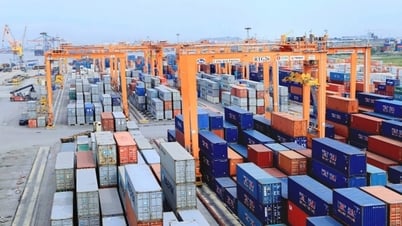
Goods exports: For the whole year of 2023, the value of goods exports is estimated at US$355.5 billion, a decrease of 4.4% compared to the previous year. Of this, the domestic economic sector accounted for US$95.55 billion, a decrease of 0.3%, representing 26.9% of total export value; the foreign-invested sector (including crude oil) accounted for US$259.95 billion, a decrease of 5.8%, representing 73.1%.
Goods imports: For the whole year of 2023, the value of goods imports is estimated at 327.5 billion USD, a decrease of 8.9% compared to the previous year, of which the domestic economic sector accounted for 117.29 billion USD, a decrease of 7.2%; and the foreign-invested sector accounted for 210.21 billion USD, a decrease of 9.8%.
For the whole year of 2023, the trade balance for goods is estimated to have a surplus of 28 billion USD (compared to a surplus of 12.1 billion USD the previous year). Of this, the domestic economic sector had a trade deficit of 21.74 billion USD; while the foreign-invested sector (including crude oil) had a trade surplus of 49.74 billion USD.
What was Vietnam's economic ranking in the world in 2023?
According to data from the General Statistics Office, the size of GDP at current prices in 2023 is estimated at 10,221.8 trillion VND, equivalent to 430 billion USD.
With this result, Vietnam's economy ranked 34th in 2023 according to the CEBR ranking.
According to forecasts, if the recovery and growth momentum continues, by 2038, with a projected GDP of US$1,559 billion, the Vietnamese economy could surpass other ASEAN economies such as Thailand (US$1,313 billion), Singapore (US$896 billion), and the Philippines (US$1,536 billion) to enter the group of the 25 largest economies in the world.
In terms of GDP (based on PPP – purchasing power parity), according to World Bank data, in 2022, Indonesia had the largest GDP (PPP) in Southeast Asia, reaching approximately US$4,036 billion, followed by Thailand at approximately US$1,482 billion, and Vietnam ranking third with a GDP (PPP) of approximately US$1,321 billion.
Following closely behind is the Philippines with a GDP (PPP) of approximately US$1.17 trillion. Malaysia ranks fifth with a GDP (PPP) of approximately US$1.134 trillion. Singapore's GDP (PPP) is approximately US$719.08 billion, ranking sixth in Southeast Asia.
Vietnam's economic targets for 2024
According to Resolution 103/2023/QH15, the main socio-economic targets for 2024 are set as follows:
- Gross Domestic Product (GDP) growth rate of 6.0 - 6.5%.
- GDP per capita is approximately US$4,700 - US$4,730.
- The proportion of the processing and manufacturing industry in GDP is approximately 24.1 - 24.2%.
- The average consumer price index (CPI) increase rate is 4.0 - 4.5%.
- The average rate of increase in social labor productivity is 4.8 - 5.3%.
- The proportion of agricultural labor in the total workforce reached 26.5%.
- The proportion of trained workers is approximately 69%, of which about 28-28.5% hold degrees or certificates.
- The unemployment rate in urban areas is below 4%.
- The poverty rate (according to the multidimensional poverty standard) decreased by over 1%.
- The number of doctors per 10,000 people is approximately 13.5.
- The number of hospital beds per 10,000 people is approximately 32.5.
- The health insurance coverage rate reached 94.1% of the population.
- The percentage of communes meeting the standards for new rural areas has reached 80%.
- The rate of collection and treatment of urban solid waste meeting standards and regulations reaches 95%.
- The percentage of operating industrial parks and export processing zones with centralized wastewater treatment systems meeting environmental standards is 92%.
Source


![[Photo] Prime Minister Pham Minh Chinh holds a phone call with the CEO of Russia's Rosatom Corporation.](/_next/image?url=https%3A%2F%2Fvphoto.vietnam.vn%2Fthumb%2F1200x675%2Fvietnam%2Fresource%2FIMAGE%2F2025%2F12%2F11%2F1765464552365_dsc-5295-jpg.webp&w=3840&q=75)

![[Photo] Closing Ceremony of the 10th Session of the 15th National Assembly](/_next/image?url=https%3A%2F%2Fvphoto.vietnam.vn%2Fthumb%2F1200x675%2Fvietnam%2Fresource%2FIMAGE%2F2025%2F12%2F11%2F1765448959967_image-1437-jpg.webp&w=3840&q=75)















































![[OFFICIAL] MISA GROUP ANNOUNCES ITS PIONEERING BRAND POSITIONING IN BUILDING AGENTIC AI FOR BUSINESSES, HOUSEHOLDS, AND THE GOVERNMENT](https://vphoto.vietnam.vn/thumb/402x226/vietnam/resource/IMAGE/2025/12/11/1765444754256_agentic-ai_postfb-scaled.png)





































Comment (0)