

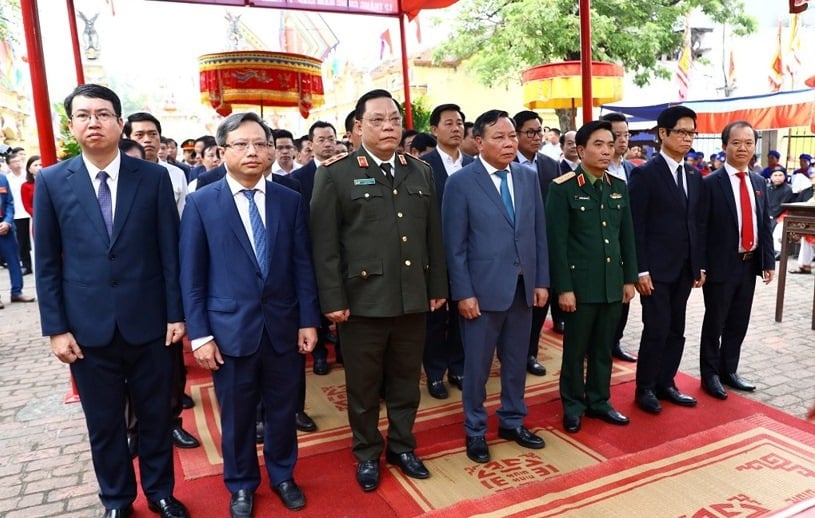
Attending the ceremony were Lieutenant General Nguyen Doan Anh - Member of the Central Committee of the Communist Party of Vietnam, Deputy Chief of the General Staff of the Vietnam People's Army; Deputy Secretary of the Hanoi City Party Committee Nguyen Van Phong; Member of the Standing Committee of the Hanoi City Party Committee, Director of the Hanoi City Police, Lieutenant General Nguyen Hai Trung; leaders of Pho Yen city (Thai Nguyen province) and Tam Nong district (Phu Tho province).
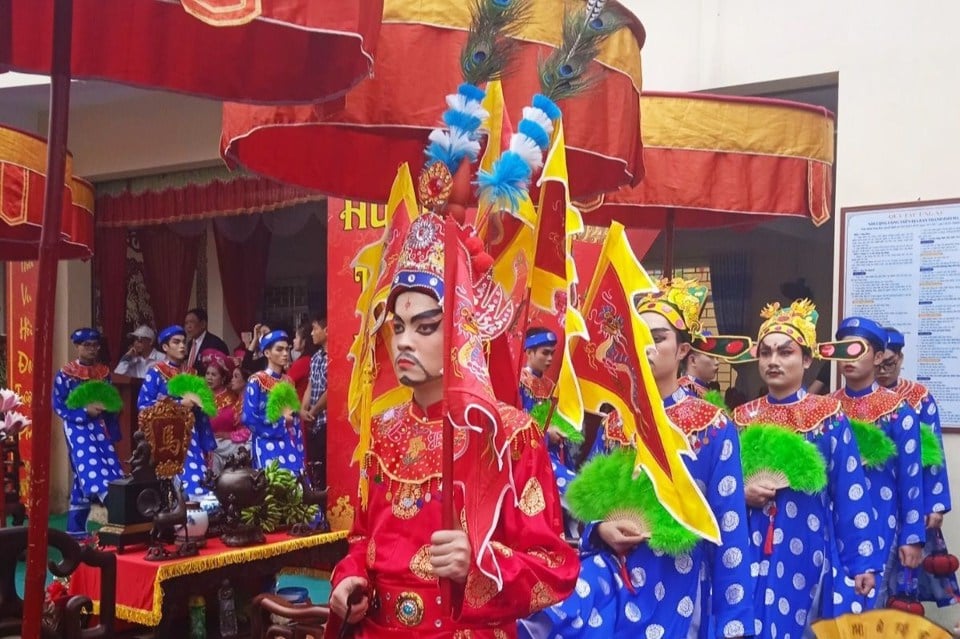
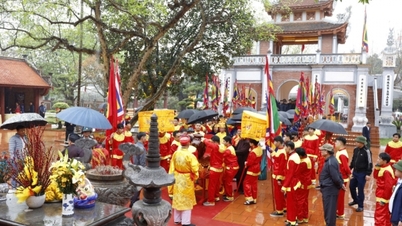
At the opening ceremony of Giang Xa communal house festival, delegates performed the ritual of offering incense, commemorating the great contributions of Emperor Ly Nam De.
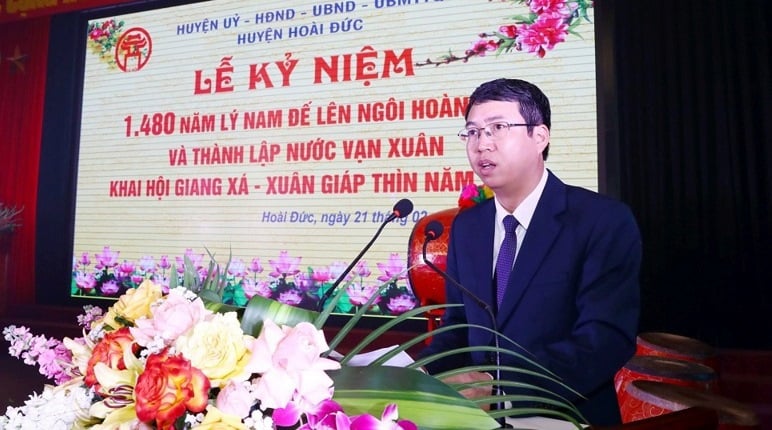
This year's Giang Xa communal temple festival is being held to commemorate the 1,480th anniversary of Ly Bi's ascension to the throne as Emperor and the establishment of the Van Xuan state.
Speaking at the commemoration ceremony, Chairman of the Hoai Duc District People's Committee Nguyen Hoang Truong said that this is an important cultural event, an opportunity to remember the great contributions of Emperor Ly Nam De, and at the same time continue to educate the present and future generations about the traditions…
According to historical records, Lý Bí was born in Cổ Pháp village – now part of Tiên Phong ward, Phổ Yên city, Thái Nguyên province. His parents died early, and he was taken in and raised by Zen Master Pháp Tổ at Linh Bảo Pagoda (also known as Giang Xá Pagoda, Hoài Đức district). Lý Bí grew up to be talented in both literature and martial arts, and possessed great ambition. He hated the Liang dynasty's rule and was dissatisfied with the greed and cruelty of Tiêu Tư, so he secretly recruited soldiers to start an uprising. After defeating the Liang and Lâm Ấp armies, in January of the year Giáp Tý (544 AD), Lý Bí ascended the throne as Emperor of Nam Việt, naming his country Vạn Xuân, adopting the reign name Thiên Đức, and building the Vạn Thọ Palace as the place of court meetings.
Lý Bí's declaration of the imperial title and the establishment of the national name demonstrated the will for independence and unwavering resilience; it clearly reflected the nation's mature consciousness.

Four years after ascending the throne (544-548), following numerous battles with his enemies, Ly Nam De retreated to Khuat Lao cave to recuperate and passed away there. The local people organized his burial, built a mausoleum and a temple in his honor. The mausoleum and temple are currently located in Van Luong commune (now Van Xuan commune, Tam Nong district, Phu Tho province).
For many years, the three localities of Tien Phong ward (Pho Yen city, Thai Nguyen province - his birthplace), Giang Xa village (Hoai Duc district, Hanoi - his second home and also where he raised the banner of rebellion), and Van Luong commune (Tam Nong district, Phu Tho province - his burial place) have always maintained close ties...
Notably, throughout the course of Ly Bi's rebellion, Hoai Duc was honored and proud to be his second home, closely associated with his name and achievements. As a tradition, the people of Giang Xa village annually organize four festivals at the temple and shrine. These include the festival on the 12th day of the first lunar month, the day Ly Bi ascended the throne as Emperor and established the Van Xuan state; the major festival (the 10th day of the third lunar month), commemorating the day he led his army into battle; the major festival on the 2nd day of the fifth lunar month, his death anniversary; and the 12th day of the ninth lunar month, commemorating his birthday…
According to the Chairman of the Hoai Duc District People's Committee, Nguyen Hoang Truong, in recent years, the Party Committee, government, and people of Hoai Duc have always upheld the tradition of patriotism, self-reliance, unity, and solidarity, striving to overcome difficulties and challenges to build a more prosperous and beautiful district. The district's economy has consistently achieved a relatively high growth rate, with structural shifts in the right direction. To date, 16 out of 19 communes have met the standards for advanced new rural areas, including 3 communes that have achieved the model new rural area standard. Hoai Duc district has also completed its dossier for advanced new rural area status and submitted it to the Hanoi People's Committee for consideration and request for official recognition.
Simultaneously, Hoai Duc district is focusing on decisively directing investment, construction, and completion of the criteria for the project to transform the district into a city district in the coming years...
Source


![[Image] Close-up of the newly discovered "sacred road" at My Son Sanctuary](/_next/image?url=https%3A%2F%2Fvphoto.vietnam.vn%2Fthumb%2F1200x675%2Fvietnam%2Fresource%2FIMAGE%2F2025%2F12%2F13%2F1765587881240_ndo_br_ms5-jpg.webp&w=3840&q=75)








































































Comment (0)