

Anxious about the weather.
In the final days of the year, in the flower-growing area along 30-4 Street (Hoa Cuong Ward, Da Nang City), the atmosphere of Tet flower production enters a crucial stage, but worries about the weather and rising input costs remain constant. According to Mr. Nguyen Quang Son (55 years old, An Khe Ward), who grows about 600 pots of chrysanthemums, the price of fertilizers and pesticides is currently about 20% higher than last year, forcing growers to carefully plan each step of the care process.
With the rain subsiding, farmers are focusing on adjusting their techniques to ensure the flowers grow uniformly, ready for the Tet market. The flowers are mainly purchased by traders and sold in the northern central provinces, with a portion also sold locally.
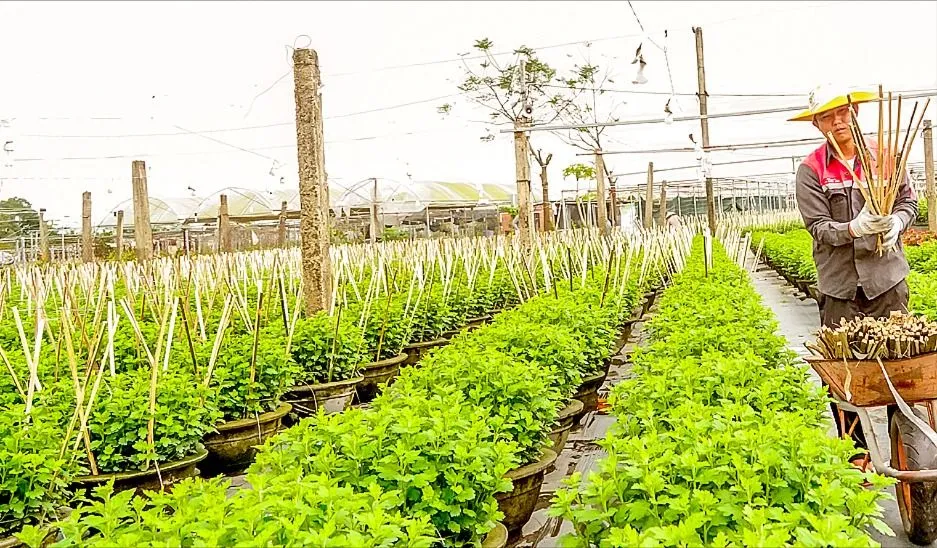
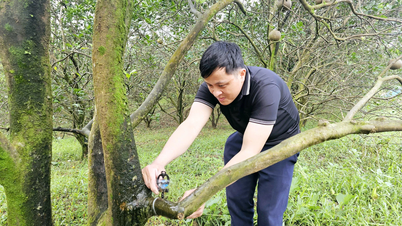
In the Duong Son flower growing area (Hoa Xuan ward, Da Nang city), thanks to its relatively high elevation, many flower fields were less affected by the heavy rains and floods at the end of October. Mr. Doan Van Trinh's family (62 years old, residing in Hoa Xuan ward) currently grows about 4,000 pots of various flowers. This year's Tet flower prices are predicted to increase slightly due to high input costs and the impact of natural disasters on many other production areas.
The entire Duong Son flower growing area covers approximately 4.5 hectares, with 21 households participating in production. The total amount of flowers and ornamental plants for this year's Tet holiday is estimated at over 80,000 pots.
According to Mr. Ly Phuoc Dang, head of the Duong Son Flower Cooperative, this year's Tet flower crop requires significant investment from farmers due to the high costs of fertilizers, pesticides, and seedlings. Although agricultural supplies show no signs of cooling down, flower growers still hope for continued favorable weather to ensure high-quality flowers, thereby recouping some of the losses after the recent natural disasters.
Meanwhile, from the beginning of December until now, flower growers downstream of the Perfume River ( Hue City) have been diligently caring for the remaining Tet flower pots in some dry areas or preparing the soil, using lime to neutralize acidity and eliminate pathogens before planting short-term flower varieties. Mr. Nguyen Son (Duong No Ward, Hue City), standing beside his lush Tet flower garden of about 500 square meters after nearly half a month of planting, said that this year is fraught with difficulties, but the people are trying their best to ensure the flowers bloom on time.
According to Mr. Nguyen Van Trai, Vice Chairman of the People's Committee of Duong No Ward, nearly 54 hectares of crops in the ward were affected, including over 3,000 potted chrysanthemums and 6.2 hectares of field flowers that suffered heavy damage. In addition to providing sufficient suitable seeds, the local government and the agricultural sector are providing technical support for care and pest control during this period of erratic weather to ensure that short-term flower crops develop and bloom in time for Tet (Lunar New Year).
Struggling to cling to the fields
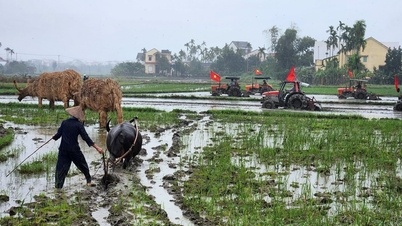
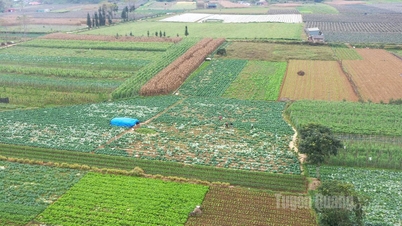
Severely impacted by the floods, farmers are rushing to restore their vegetable crops, taking advantage of every rare ray of sunshine to plant new seeds. In Thanh Trung vegetable village (Hoa Chau ward) - the largest vegetable farming area in Hue City with an area of over 100 hectares - the traces of the November floods are still visible. However, instead of leaving the land fallow, farmers are proactively collecting flooded vegetables, cleaning up their fields, and preparing the soil to replant short-term vegetable crops.
Mr. Nguyen Hoi, a farmer from Thanh Trung vegetable village, said that the current weather is quite favorable, and he hopes the Tet vegetable crop will yield high productivity to compensate for the losses caused by floods and help stabilize his livelihood.
According to Mr. Le Minh Tri, Head of the Plant Protection Department - Hue City Crop Production and Plant Protection Sub-Department, the entire city has basically restored and planted approximately 700 hectares of vegetables and crops in a timely manner, reaching nearly 100% of the area; of which more than half are produced according to safe production models, VietGAP.
In La Huong vegetable village (Cam Le ward, Da Nang city), prolonged rains in October and November caused severe damage to many vegetable crops, resulting in soggy soil and increased recovery costs. Low-lying areas were forced to plant later, while higher, drier areas already had their first crop.
According to Mr. Mai Van Phu (60 years old, residing in Cam Le ward), despite facing many risks, the people choose the option of "using short-term gains to support long-term goals." Short-term vegetables are sown first to have an early harvest, creating daily income; at the same time, they prepare to plant long-term crops such as cabbage and broccoli, expected to be harvested in time for Tet (Lunar New Year).
"Long-term crops take about two and a half months to harvest, while leafy greens can be grown quickly to generate income sooner," Mr. Phu said.
According to Mr. Tran Van Hoang, Chairman of the La Huong Safe Vegetable Cooperative, the recent floods caused preliminary damage exceeding 100 million VND. Despite the high price of seeds, farmers still have to buy them to maintain production. The cooperative will coordinate support for product distribution, helping farmers feel secure in their fields and restore production after the turbulent rainy season.
Source: https://www.sggp.org.vn/mien-trung-canh-mua-trong-nang-vu-rau-hoa-tet-post829106.html
![[Photo] Prime Minister Pham Minh Chinh receives Lao Minister of Education and Sports Thongsalith Mangnormek](/_next/image?url=https%3A%2F%2Fvphoto.vietnam.vn%2Fthumb%2F1200x675%2Fvietnam%2Fresource%2FIMAGE%2F2025%2F12%2F16%2F1765876834721_dsc-7519-jpg.webp&w=3840&q=75)
![[Photo] Prime Minister Pham Minh Chinh receives the Governor of Tochigi Province (Japan)](/_next/image?url=https%3A%2F%2Fvphoto.vietnam.vn%2Fthumb%2F1200x675%2Fvietnam%2Fresource%2FIMAGE%2F2025%2F12%2F16%2F1765892133176_dsc-8082-6425-jpg.webp&w=3840&q=75)
![[Live] 2025 Community Action Awards Gala](/_next/image?url=https%3A%2F%2Fvphoto.vietnam.vn%2Fthumb%2F1200x675%2Fvietnam%2Fresource%2FIMAGE%2F2025%2F12%2F16%2F1765899631650_ndo_tr_z7334013144784-9f9fe10a6d63584c85aff40f2957c250-jpg.webp&w=3840&q=75)

![[Image] Leaked images ahead of the 2025 Community Action Awards gala.](/_next/image?url=https%3A%2F%2Fvphoto.vietnam.vn%2Fthumb%2F1200x675%2Fvietnam%2Fresource%2FIMAGE%2F2025%2F12%2F16%2F1765882828720_ndo_br_thiet-ke-chua-co-ten-45-png.webp&w=3840&q=75)





















































































Comment (0)