

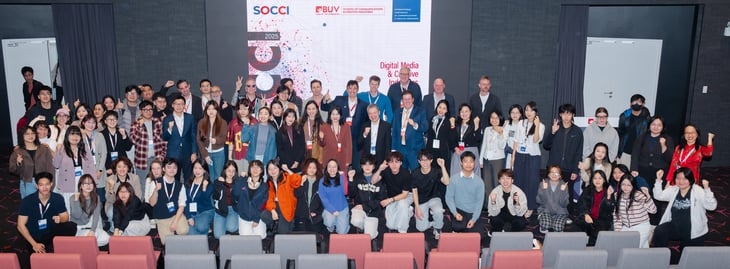
Experts, researchers and students of British University Vietnam (BUV) at the conference on December 2 - Photo: BUV
On December 2 in Hung Yen, the Faculty of Communication and Creative Industries, British University Vietnam (BUV) organized a scientific conference "Communication and Creative Industries in the Contemporary Asian Context", bringing together more than 30 scholars, practitioners and young researchers.
Here, experts shared about the role of media and creative industries in Vietnam, emerging trends under the influence of artificial intelligence, decoding the success of K-pop or the role of social networks in promoting culture.
Finding a way to tell the Vietnamese story
According to Associate Professor Dr. Nguyen Hoang Anh, the creative and cultural industries in Vietnam are still modest, contributing only 3% of GDP (compared to the global average of 5%). The creative industries are expected to contribute up to 7% of GDP by 2035, with fast-growing industries including cinema, advertising, handicrafts, software and architecture.
Sharing at the event, Mr. Le Quoc Vinh - Chairman and CEO of LeBros - said that the BlackPink concert in Vietnam is a typical example showing that the cultural and creative industry has created widespread economic value, not only bringing in ticket sales revenue, but also creating economic value for accommodation, food and shopping services for thousands of domestic and foreign audiences.
According to him, Vietnam has many beautiful stories to tell the world , such as the beauty of the Golden Bridge, the world-famous culinary scene, the young artist Xeo Chu with his NFT paintings, a safe country - where international leaders can come and enjoy the peaceful streets, the song Bac Bling "reaching the world", and nature that attracts foreign tourists.
He believes that the combination of media and creativity can create soft power for Vietnam.
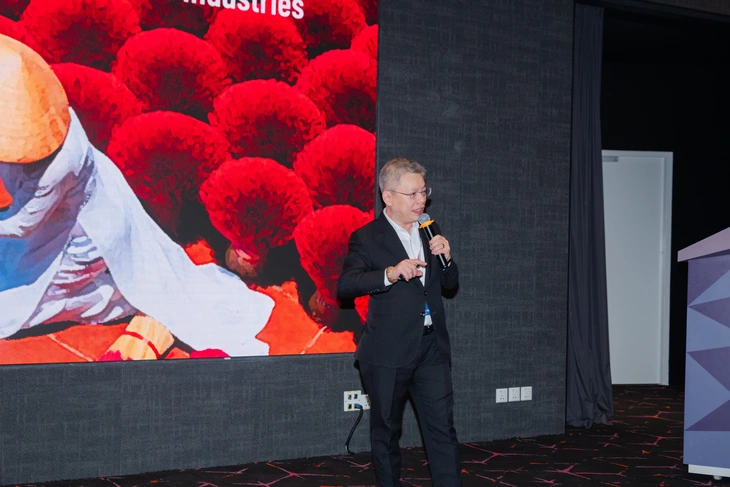
Mr. Le Quoc Vinh - Chairman and CEO of LeBros - Photo: BUV
He commented that although Vietnam has no shortage of interesting content, it lacks a coherent and cohesive way of telling it. This comes from fragmentation as each industry and each province has its own story. He said that once, while supporting communications for a province, he was told that the locality had 21 unique values to promote.
“As a communications consultant, I would typically advise clients to focus on one thing, what makes you different,” says Vinh.
Besides, according to him, Vietnam's cultural values have not been fully exploited, not converted into cultural capital, and lack specific communication strategies.
Infrastructure and institutions are needed for innovation.
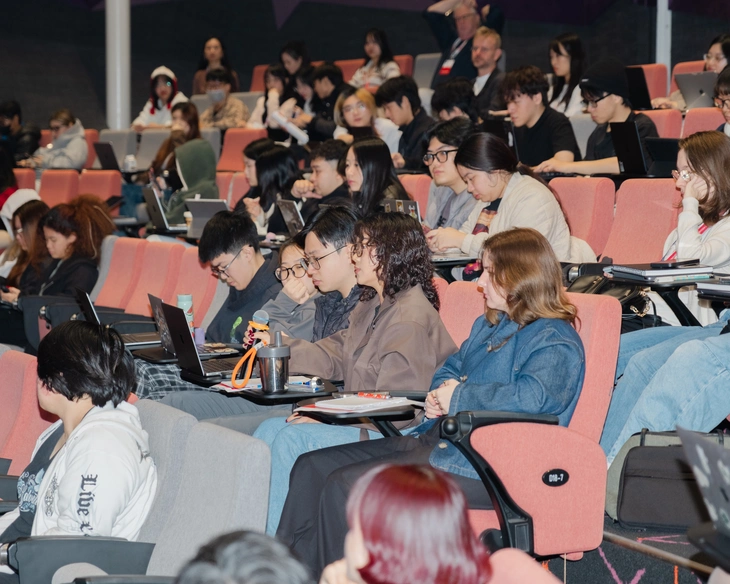
BUV students enthusiastically exchanged with speakers at the event - Photo: BUV
From here, Mr. Le Quoc Vinh proposed four strategic levers for Vietnam, including: identifying "cultural codes" - what makes Vietnam different; building creative cities and talent supply chains. For example, Hanoi is a creative city in design, Da Lat is creative in music, Hoi An is creative in crafts...
Along with that is developing cultural brands with global potential, accelerating creativity through digital platforms and artificial intelligence.
Meanwhile, Associate Professor Dr. Nguyen Hoang Anh said that Vietnam's creative economy needs policies to strengthen infrastructure, professional standards and institutional support.
Speaking at the event, Dr. Rick Bennett - Vice President of BUV - called on experts to discuss ways to raise social awareness of cultural and economic values and career opportunities in the creative industry in Vietnam.
Source: https://tuoitre.vn/nganh-cong-nghiep-van-hoa-sang-tao-con-khiem-ton-lam-sao-ke-cau-chuyen-viet-nam-hap-dan-hon-20251202172205527.htm



![[Photo] Worshiping the Tuyet Son statue - a nearly 400-year-old treasure at Keo Pagoda](/_next/image?url=https%3A%2F%2Fvphoto.vietnam.vn%2Fthumb%2F1200x675%2Fvietnam%2Fresource%2FIMAGE%2F2025%2F12%2F02%2F1764679323086_ndo_br_tempimageomw0hi-4884-jpg.webp&w=3840&q=75)
![[Photo] Parade to celebrate the 50th anniversary of Laos' National Day](/_next/image?url=https%3A%2F%2Fvphoto.vietnam.vn%2Fthumb%2F1200x675%2Fvietnam%2Fresource%2FIMAGE%2F2025%2F12%2F02%2F1764691918289_ndo_br_0-jpg.webp&w=3840&q=75)




















![[Video] Protecting World Heritage from Extreme Climate Change](https://vphoto.vietnam.vn/thumb/402x226/vietnam/resource/IMAGE/2025/12/03/1764721929017_dung00-57-35-42982still012-jpg.webp)











































Comment (0)