

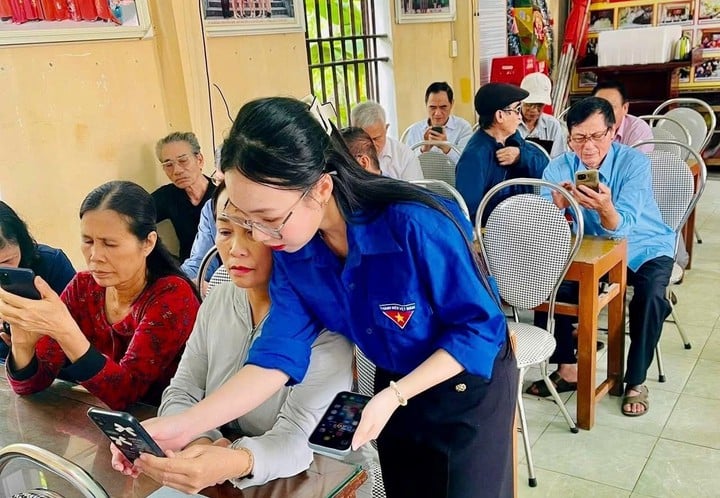
Youth union members in Tu Ky commune, Hai Phong, assist elderly people in using digital technology.
In Hai Phong, removing technological barriers for citizens, including the elderly, has been identified as a key task in implementing digital transformation from the grassroots level. According to the city's Department of Science and Technology, the biggest barrier lies not in equipment or infrastructure, but in the reluctance, lack of skills, and ingrained habits of using technology among a segment of the elderly population. Therefore, the chosen approach is a hands-on approach, starting with the most practical needs.
In mid-November 2025, in Nhi Chieu ward, over 200 trainees, many of whom were over 50 or 60 years old, participated in a digital transformation training course jointly organized by the Department of Science and Technology. The content wasn't heavily theoretical, but started with very basic operations: opening a smartphone, installing and using the "Smart Hai Phong" application, submitting applications on the National Public Service Portal, and searching for health and social security information. Trainees even got acquainted with some simple artificial intelligence (AI) applications.
Ms. Nguyen Thi Thuong, 58 years old, residing in Phu Thu 1 residential area, shared: "Previously, I was hesitant whenever I heard about administrative procedures, fearing missing documents or having to make multiple trips. Now, with step-by-step guidance, I realize that with just a few taps on my phone, I can submit applications online, which is both fast and transparent." From being unfamiliar with the process, many elderly people like Ms. Thuong have gradually formed the habit of using online public services, no longer completely dependent on their children, grandchildren, or local officials.
Meanwhile, in the mountainous communes and villages of Lao Cai, the journey of bringing technology to the elderly is also progressing steadily. The "Digital Cultural Center" model in Nghia Dung village, Lam Giang commune, is a prime example. Here, elderly residents are supported in integrating health insurance cards, using VNeID, declaring civil status, registering residence, and submitting applications for level 3-4 public services. Procedures that previously required traveling dozens of kilometers are now resolved right in the village, with the direct support of officials and young volunteers.
A common feature of these models is the active participation of "digital nuclei" in the community. In Hai Phong, community digital technology teams are deployed in villages and residential areas of 114 communes, wards, and special zones, with the core force being grassroots officials, youth union members, and members of various organizations. Each member acts as both a learner and a mentor, with particular emphasis on supporting the elderly, the group requiring the most time and patience.
The "Digital Literacy Movement" launched by the Women's Union at all levels also demonstrates the important role of middle-aged and elderly women in spreading digital skills. In the "Technology Companion" digital classes, many women learned for the first time how to install applications, search for information, and submit online applications. The "Digital Family" and "Digital Branch" models not only help the elderly become more confident with technology but also create connections between generations within the family, as children and grandchildren support and learn together.
Experience shows that when older adults have access to technology in an appropriate way, digital transformation is no longer a distant concept. On the contrary, they become cautious and responsible users of technology, knowing how to utilize digital utilities to serve their daily lives: from healthcare and access to social welfare policies to participating in providing feedback and suggestions to local authorities.
Digital transformation is only truly successful when all citizens can participate and benefit. The gradual mastery of technology by the elderly not only contributes to reducing the burden on the administrative apparatus but also affirms the spirit of lifelong learning and adaptation to the digital age. This is a crucial foundation for building a humane, inclusive, and sustainable digital society.
Source: https://mst.gov.vn/nguoi-cao-tuoi-tu-ngai-cong-nghe-tro-thanh-chu-the-cua-chuyen-doi-so-197251213141933917.htm


![[Image] Vietnam's colorful journey of innovation](/_next/image?url=https%3A%2F%2Fvphoto.vietnam.vn%2Fthumb%2F1200x675%2Fvietnam%2Fresource%2FIMAGE%2F2025%2F12%2F14%2F1765703036409_image-1.jpeg&w=3840&q=75)






















































![[Image] Vietnam's colorful journey of innovation](https://vphoto.vietnam.vn/thumb/402x226/vietnam/resource/IMAGE/2025/12/14/1765703036409_image-1.jpeg)





























Comment (0)