

The SLIM lander successfully achieved its goal of landing precisely on the Moon and sending data back to Earth, despite encountering a problem with its solar panels, which failed to generate electricity and had to temporarily cease operation a few hours after landing.
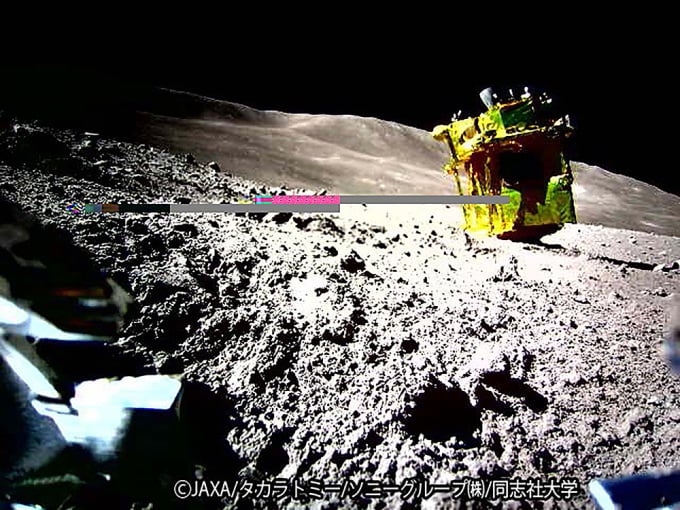
The yellow SLIM lander on the surface of the Moon. Photo: JAXA/Takara Tomy/Sony Group/Doshisha University/AFP
Japan Aerospace Exploration Agency (JAXA) announced today that the Lunar Surveying Intelligent Lander (SLIM) has landed just 55 meters from its designated location, and released the first color images from the mission.
SLIM is nicknamed the Moon Sniper due to its high accuracy. JAXA aims to land it within 100 meters of its designated location, much smaller than the usual range of several kilometers.
"SLIM successfully landed smoothly and precisely. The landing point was confirmed to be only 55 meters from the target," JAXA said. The lander experienced some engine problems during landing, which may have caused it to deviate from its course, according to Shinichiro Sakai, SLIM project manager. Prior to landing, the lander was even closer to the designated point.
SLIM successfully landed on the Moon at 10:20 PM on January 19th ( Hanoi time), making Japan the fifth country to gently land a spacecraft on Earth's natural satellite, after the United States, the Soviet Union, China, and India. However, the spacecraft encountered a problem after landing: the solar panels did not produce electricity.
JAXA decided to disconnect SLIM's solar panels just before 1:00 AM on January 20th, when they had about 12% energy remaining, to avoid hindering future restarts. According to telemetry data, SLIM's solar panels were facing west. If sunlight hits the Moon from the west in the future, JAXA believes there is a chance for the panels to generate energy and the lander to resume operation. Before remotely shutting down the lander, the mission control station received imaging and technical data from the landing and from the lunar surface.
"Based on current estimates, we are preparing for the resumption of landing ship operations around February 1st," JAXA said.
The two small robots that SLIM carried were also successfully deployed. One robot was equipped with a transmitter, and the other was designed to move around the lunar surface and send images back to Earth. This mini-rotor, named SORA-Q, is only slightly larger than a tennis ball and can change shape.
Among the newly released JAXA images, one taken by SORA-Q clearly shows the condition of SLIM. The yellow lander remains intact and rests slightly tilted on its rocky, gray surface, with the lunar slopes in the distance.
The SLIM mission targets a depression where the mantle—the deeper layers of the Moon, typically located beneath the crust—is believed to be exposed on the surface. By analyzing rocks there, JAXA hopes to shed light on the mysteries of potential water resources on the Moon. This is crucial for building bases on the celestial body.
Thu Thao (According to AFP )
Source link































































































Comment (0)