

The application of artificial intelligence (AI), the Internet of Things (IoT), and robotics is becoming a clear trend for Vietnamese businesses, helping to reduce costs, improve quality, and increase their ability to participate more deeply in global supply chains.
Optimize operations, reduce costs.
New Era Cold Storage Joint Stock Company (NECS) has just inaugurated a smart cold storage facility in Tay Ninh province. This is one of the largest fully automated cold storage facilities in Southeast Asia, with 110,000 shelving units (pallets) and a floor area of 18,000 m2.
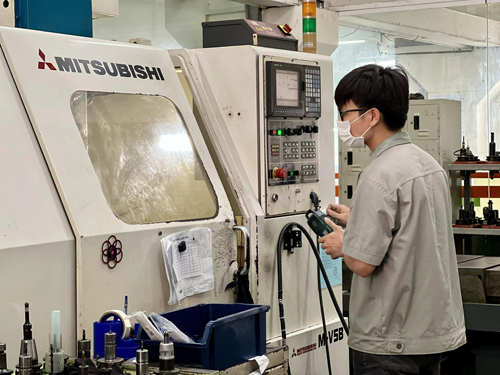
Workers operate an automated production line at Lap Phuc Co., Ltd. (Phu Thuan Ward, Ho Chi Minh City). Photo: HUYNH NHU
According to Mr. Nguyen Hoang Hai, Vice Chairman of the Board of Directors and General Director of NECS, the entire process from booking, import-export, inventory tracking, temperature management to tracing the history of each shipment is operated on a unified digital platform, integrating IoT and AI technologies. Digitalization not only optimizes operations and reduces costs by approximately 30% compared to traditional warehouses, but also ensures stable control of sub-zero temperatures, improving preservation quality and increasing the trust of international customers. On this platform, customers can track shipments in real time and control the entire logistics journey, from cold storage, bonded warehouses, distribution warehouses to international seaports. This synchronized approach contributes to increased transparency, seamless connection of all stages in the supply chain, and gradually elevates Vietnam's logistics capabilities. "By digitizing processes, the digital management system also creates a difference in the market compared to other warehouses by collaborating with banks to implement a financial support model for businesses (managing pledged goods), allowing businesses to use the goods in the warehouse as collateral. The system helps to ensure data transparency, connect directly with banks, and reduce risks, thereby accelerating disbursement and maintaining production," shared a representative from NECS. The smart cold storage model has attracted many foreign partners from China, India, Japan, the US, etc., choosing Vietnam as a transit point for storage and organizing seasonal production before export.
Digitalization and automation are not only taking place in the logistics sector, but also in many other manufacturing industries. At Mebipha Production - Trading Co., Ltd., the digitalization of the entire production chain, from animal feed to eggs, has helped the company increase productivity by 30%, reduce management costs by 20%, and almost eliminate inventory errors. Data transparency also helps this company meet international standards and expand its ability to participate in modern supply chains.
In the textile and garment industry, the smart factory of Viet Thang Jean Co., Ltd. (Ho Chi Minh City) is built on a digital supply chain platform, connecting data from raw materials, design, production to distribution. By applying 3D design, automated cutting, smart warehousing, and a modern sewing system, the company can flexibly fulfill large and small orders, meeting the stringent emission standards of the European market.
Change the mindset of management.
Currently, many domestic manufacturing enterprises still rely on manual labor, with only over 20% implementing partial automation and a very low adoption rate of smart technologies. This situation shows that despite the rapid growth of the processing and manufacturing sector and its continued role as a "locomotive" attracting FDI, the transition to smart manufacturing is still slow.
According to a technology expert, the main reasons are the high initial investment costs, which are beyond the reach of small businesses; a shortage of personnel to operate new technologies; and the lack of a comprehensive transformation roadmap. Digital transformation and automation are not just technological challenges; more importantly, they require a change in management mindset, restructuring of processes, and enhancement of human capabilities, especially among middle management, so that technology can truly be effective in production and business.
A leader of a manufacturing company in Ho Chi Minh City stated that building a smart factory is not simply about installing automated production lines, but must begin with lean manufacturing processes. If the process is not optimized before applying technology, the waste will only increase. According to this leader, AI or IoT will only be effective when the operating platform is lean, data is transparent, and processes are standardized. At the same time, businesses also need specific incentive policies, especially regarding taxes, to encourage the transition to green and smart manufacturing.
Sharing international experience, Gordon Wan, Chief Technology Officer of MiTAC Group, said that a factory in Taiwan (China) reduced electricity consumption by 22%, CO2 emissions by 18%, and shortened ESG reporting time by up to 80% after implementing a smart system. Mr. Wan recommended that Vietnamese businesses should start by testing on one production line, building a data platform, and investing in human resources, because AI will not create value without data and a knowledgeable internal workforce.
From an implementation perspective, Mr. Tran Minh Long of Vietnam Technology and Communications Joint Stock Company believes that businesses need to standardize and optimize processes before automation, while clearly defining objectives and carefully evaluating the effectiveness of the investment. Automation should only focus on repetitive, error-prone, time-consuming processes or those requiring integration with multiple systems. During implementation, businesses must select appropriate technology, design flexible processes, conduct thorough testing, and proactively train personnel. After commissioning, the system needs continuous monitoring and optimization, with a focus on security, regular maintenance, and contingency plans to reduce risks and avoid complete dependence on machinery.
The core is human resources.
According to market research firm IMARC, given the growing demand for smart manufacturing, Vietnam needs to focus on developing high-quality human resources to support the transformation process. Educational institutions and businesses need to strengthen cooperation in training advanced manufacturing skills such as robotics, AI, and data analytics. Focusing on enhancing human capabilities is seen as the foundation for a workforce capable of managing and operating smart systems, thereby enabling Vietnam to effectively leverage new technological trends.
Source: https://nld.com.vn/tu-dong-hoa-chia-khoa-tang-toc-san-xuat-196251213215429197.htm


















































































Comment (0)