

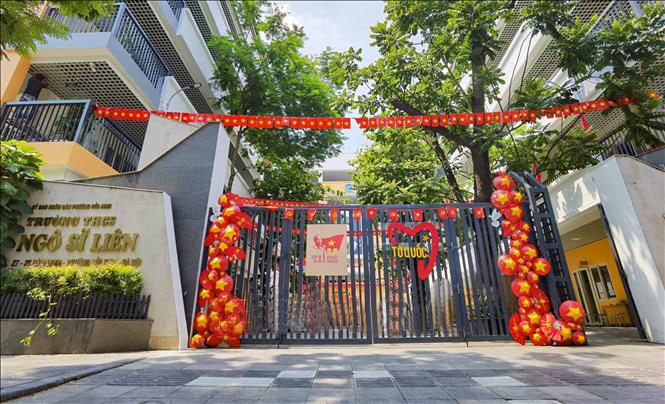
From the "eradicate illiteracy" movement to three educational reforms.
Immediately after the success of the August Revolution and the establishment of the Democratic Republic of Vietnam, the country faced countless difficulties: internal and external enemies, a devastated economy , and over 90% of the population illiterate. Therefore, the top priority task set by the Government was to "eradicate illiteracy," vigorously implemented through the Popular Education Movement, making learning the national language a compulsory and free obligation for all citizens.
Simultaneously, a completely new education system was formed, based on three core principles: nationalization (using Vietnamese as the main language), scientification (combating dogmatic learning), and popularization (serving the broad masses of the people).
The period from 1945 to 1954 was a particularly challenging time in the nation's history. As the resistance war spread, education underwent a dramatic transformation, becoming a true front with the motto "Learn to fight the resistance." The culmination of this shift was the comprehensive education reform of 1950, aimed at establishing a new, unified, and interconnected education system that directly served the war effort and future nation-building. The reform replaced the 12-year general education system with a more streamlined 9-year system, while simultaneously rebuilding the entire curriculum and textbooks in a practical, scientific, and deeply nationalistic direction.
During the period from 1954 to 1975, the Party and State considered education a crucial front closely linked to the revolutionary cause. A prominent policy was demonstrated through the 1956 Education Reform, establishing a 10-year general education system with a comprehensive curriculum, linking theory with practice, and building a complete national education system from preschool to university, expanding the network to even the most remote communes. Teachers received more thorough training. Textbooks were newly compiled. Universities developed rapidly, from 5 (1959-1960) to 17 (1964-1965), and many cadres were trained in the Soviet Union and other socialist countries, preparing human resources for the post-war reconstruction of the country.
The most outstanding achievement of education during this period was the basic eradication of illiteracy in the North. By 1958, 93.4% of the population aged 12-50 in the plains and midlands were literate. This laid the foundation for raising the intellectual level and developing the country's culture and economy. Tens of thousands of cadres, intellectuals, engineers, doctors, and teachers were trained, becoming the key force in building the North and supporting the South. In the South, in the liberated areas, revolutionary education demonstrated flexibility and resilience, building a network of democratic schools, training cadres to serve the resistance, and printing and distributing millions of textbooks.
Following the reunification of the country, the period from 1975 to 1986 was a particularly significant historical phase, marking the extraordinary efforts of Vietnam's education sector. Resolution 14-NQ/TW (January 1979) on educational reform is considered the most important legal document, officially launching the third educational reform.
This resolution serves as a "long-term educational reform program," outlining core goals and solutions: Establishing a 12-year national general education system, eliminating the distinction between the 10-year system in the North and the 12-year system in the South; Compiling a unified national curriculum and textbooks in a modern, practical spirit, closely integrating Natural Sciences and Social Sciences; Emphasizing the principle of "learning goes hand in hand with practice, education combined with productive labor," strengthening comprehensive technical education and vocational guidance for students; The goal of education is to build a new socialist person with full intellectual, moral, physical, and aesthetic qualities.
During this period, the sector successfully fulfilled its historical mission of unifying the national education system, contributing to strengthening national unity. However, difficulties in quality and resources necessitate a more comprehensive reform, not only in education but also in socio-economic aspects, paving the way for the next stage of national development.
During the period 1986-2000, alongside the country's reform process, the education sector strived to overcome the crisis, recover, and develop, achieving significant accomplishments. Despite remaining limitations and difficulties, the achievements in expanding scale, perfecting institutions, promoting socialization, diversifying types of education, and integrating internationally have created a solid foundation for the Vietnamese education sector to continue implementing more comprehensive reforms.
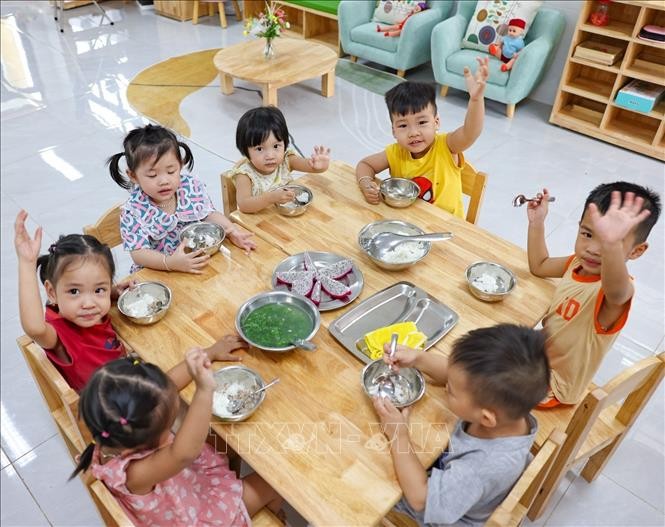
Creating a comprehensive, innovative, and adaptable education system.
Entering the 21st century, Vietnamese education has continuously innovated, proactively and flexibly implementing many breakthroughs, creating a comprehensive education system ready to adapt to the development of the times.
Resolution 29-NQ/TW on fundamental and comprehensive reform of education and training has identified a shift in mindset from equipping students with knowledge to developing their competencies, focusing on training future generations to make Vietnam a strong nation in English and information technology, opening a new path and a long-term development direction for the country.
The guiding documents of the Party and State during this period formed a consistent ideological system, characterized by continuity and continuous development. This system was shaped by profound philosophical changes: from a centralized management mechanism and primary resource allocation from the state budget to a socialized education system; a shift from knowledge-based education to the comprehensive development of learners' abilities and qualities; and a move from the mere application of information technology to comprehensive digital transformation… These policies not only affirmed the view that “Education is a top national priority” but also aimed at building a humane, modern education system that ensures fairness and proactive international integration.
According to the Ministry of Education and Training, over the past 25 years, Vietnamese education has expanded rapidly at all levels, forming a synchronized network from preschool to postgraduate, with diverse types of education, approaching regional and international standards.
Early childhood education achieved universal access for 5-year-olds in 2017, with nearly 99% of children attending. At the general education level, universal primary education was firmly maintained, lower secondary education was completed nationwide, and many localities achieved universal upper secondary education; the percentage of students attending school at the appropriate age increased, and the dropout rate decreased significantly. The implementation of the 2018 General Education Program has completed its first cycle.
Vocational education has developed strongly; by 2020, approximately 70% of the workforce had received vocational training and been certified. In higher education, the number of students per 10,000 people increased from 117 (2000) to over 200 (2010) and is expected to continue increasing in the 2020-2025 period. Many universities have implemented autonomy, linked with the labor market, carried out quality accreditation, and have many programs that meet regional and international standards.
Educational equity has improved thanks to policies supporting poor students, disadvantaged areas, and ethnic minorities, helping to increase enrollment rates for vulnerable groups. The digital transformation process after the COVID-19 pandemic has promoted the development of digital learning resources, online teaching, and modern governance, laying the foundation for Vietnam's digital education ecosystem.
Currently, in the context of profound and comprehensive global changes, particularly with digital technology and artificial intelligence reshaping education worldwide, each country must define a new vision and strategy for its education system in the future.
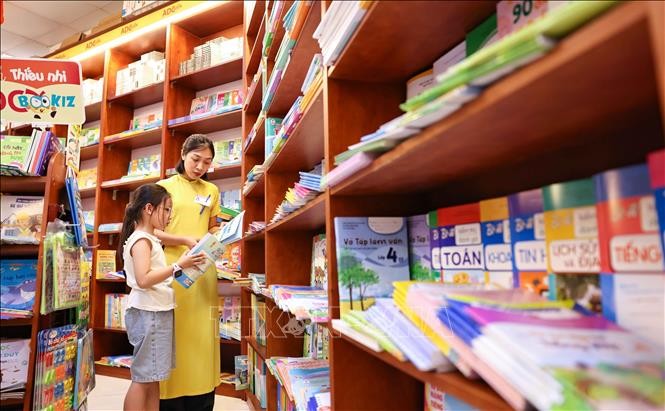
Our country is facing a historical opportunity for breakthrough development, and the need to build human resources is extremely important and urgent. Therefore, on August 22, 2025, General Secretary To Lam signed and promulgated Resolution No. 71-NQ/TW of the Politburo on breakthrough development in education and training.
The resolution sets targets for 2030 to build a basic school network that meets the learning needs of students from all backgrounds and regions; with at least 80% of general education schools meeting national standards. It aims to achieve universal preschool education for children aged 3 to 5 and compulsory education up to lower secondary school; at least 85% of people of school age will complete upper secondary education or equivalent, with no province or city falling below 60%. The education index's contribution to the Human Development Index (HDI) will be above 0.8, with the education inequality index reduced to below 10%.
Furthermore, the goal is for 100% of higher education institutions and at least 80% of vocational education institutions to meet national standards, with 20% of institutions receiving modern investment comparable to developed countries in Asia. The percentage of the workforce with college or university degrees or higher should reach 24%. The percentage of students studying basic sciences, engineering, and technology should reach at least 35%.
Elevating higher education institutions to truly become national and regional centers for research, innovation, and entrepreneurship. Striving for at least 8 higher education institutions to be among the top 200 universities in Asia, and at least 1 higher education institution to be among the top 100 universities in the world in certain fields.
By 2035, Vietnam aims to achieve universal secondary education and equivalent levels; the education index's contribution to the Human Development Index (HDI) should be above 0.85; and at least two higher education institutions should be among the top 100 universities in the world in certain fields.
By 2045, Vietnam aims to have a modern, equitable, and high-quality national education system, ranking among the top 20 countries in the world; and strives to have at least 5 higher education institutions among the top 100 universities in the world in certain fields according to reputable international rankings.
In his Letter to Students on the first day of school in the Democratic Republic of Vietnam (September 15, 1945), President Ho Chi Minh wrote: "Whether the Vietnamese nation will become beautiful and prosperous, and whether the Vietnamese people will reach the pinnacle of glory to stand shoulder to shoulder with the great powers of the five continents, depends largely on the learning efforts of you children."
After 80 years, the new Resolution on breakthroughs in education and training development is expected to become a major milestone in the journey of building the future, transforming high-quality human resources and scientific and technological talents into a core driving force and competitive advantage, leading the country steadily into a new era.
Source: https://baolaocai.vn/nhung-cuoc-cai-cach-lon-kien-tao-nen-giao-duc-phat-trien-toan-dien-post880691.html





























![[Video] The craft of making Dong Ho folk paintings has been inscribed by UNESCO on the List of Crafts in Need of Urgent Safeguarding.](https://vphoto.vietnam.vn/thumb/402x226/vietnam/resource/IMAGE/2025/12/10/1765350246533_tranh-dong-ho-734-jpg.webp)
















































Comment (0)