

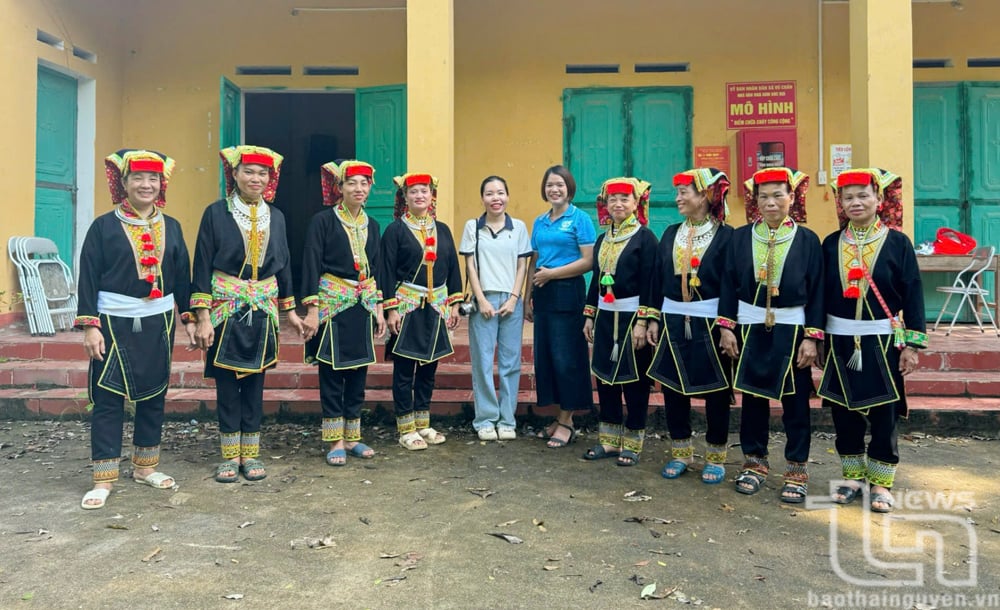
 |
| The author took the photo with members of the Women's Club for Preserving the Traditional Dao Ethnic Costume in Khe Ria hamlet, Vu Chan commune (Vo Nhai district). |
Go, listen, and understand.
When I first started my career, I was firmly convinced that "journalism only requires intelligence and speed. You have to deliver news as quickly as possible. The faster, more accurate, and more up to standard, the better."
But then, the more I wrote, the more people I met in different situations in society, the more I listened to their stories, and the more I used my own emotions to gently touch their lives, the more I realized that, in addition to the above factors, journalism also requires a heart. It's a heart that knows how to listen, how to be moved, and how to retain a part of that emotion for itself after each article. Such thoughts often come unexpectedly, I don't know when they started, but they always make me ponder every time I talk to a subject.
It might have started on a scorching June day, when I stood in the blazing sun on the construction site, watching a worker hastily wipe away the sweat from his tanned face to look his best for an interview. It was when I noticed the worker's eyes light up as he spoke about how his entire team had braved the sun and rain to complete the project ahead of schedule.
Or perhaps it started when the veteran who experienced the fiery summer at Quang Tri Citadel in 1972 teared up while speaking about his fallen comrades.
I still vividly remember his choked-up words at the time: "We promised each other that when we were discharged from the army, we would go to Nam Dinh, Thai Binh, then circle through Hai Phong, and then up to Thai Nguyen to visit each of our homes. But when the war ended, only I remained to keep that promise."
It was also when I myself shed tears while listening to the story of Ms. Trinh Thi Le, from Thinh Dan ward ( Thai Nguyen City). Despite suffering from nearly a dozen serious illnesses, she remains strong, living, working, and raising her two young children.
Undeterred by life's storms, Ms. Le herself radiates positive energy to those around her, helping them deeply appreciate the values of life and cherish the present moment; teaching them about the resilience of human beings even in the depths of physical and mental suffering.
Sometimes I often sit and reminisce about the days I worked during the historic flood in Thai Nguyen in early September 2024. It's the image of Mr. Nguyen Van Tu (from Chua Hang ward, Thai Nguyen city) sitting on the roof of his small house, his face pale and his eyes filled with worry as he gazed out at the raging floodwaters. And then the old man's eyes lit up when he saw the rescue boats of the soldiers.
When I met Ms. Le Thi Kieu (Linh Son commune, Thai Nguyen city) after the flood, I didn't know what to say. I just sat quietly beside her, listening to her recount in a low voice how her belongings, crops, and livestock were all swept away by the floodwaters. As she told her story, I silently recorded every word, not just with pen, but with my heart.
Journalism allows me and many other reporters to travel and listen to many stories with diverse nuances. We then realize that we are not just news reporters; we are witnesses, and sometimes even sharers. We then bring that information to our readers, so that these very real stories can touch the deepest emotions in everyone's heart.
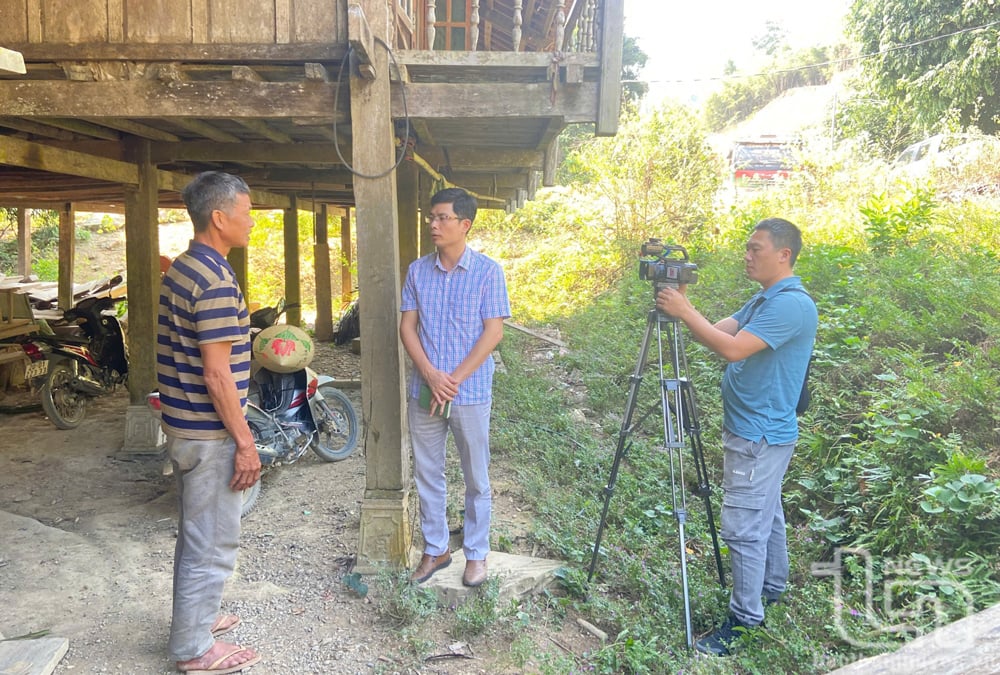 |
| Reporters from Thai Nguyen Newspaper are covering the issue of illegal logging in the mountainous district of Vo Nhai. |
Use the pen to touch the heart.
A renowned associate professor once lectured us journalism students, saying: "Journalism values objective information. Before every event, a journalist must consider the professional perspective. However, this profession doesn't choose the insensitive. It demands a heart strong enough to empathize, and a clear mind to recount the truth honestly, kindly, and humanely."
It's safe to say that my time in the profession has changed my perspective on my work. As a journalist, I don't just write to provide information; I write to "touch." To touch the joys, sorrows, anxieties, and hopes of people. And when I shared this thought with my colleagues, we came to the conclusion that journalists also need to learn to feel, to learn to leave a part of themselves in each story. Because if we don't feel, how can we help readers understand?
And stemming from the very emotions I felt in response to each word, glance, and fate I encountered, I also learned to use language as a means of human connection, not to judge or compare, but to understand.
Despite having experienced countless major and minor events and written hundreds of articles, for me, what remains after each piece of writing is not just information, data, and arguments, but also hearts that resonate with every beat of emotion. It's the heart of the journalist, of the subject, and of the reader.
And when heart touches heart, that is the strongest proof that: In a society sometimes numb by the overwhelming amount of information, there are still writers who know how to listen and empathize. We use our pens to keep those emotions together, quietly but profoundly.
Source: https://baothainguyen.vn/xa-hoi/202506/nhung-trai-tim-o-lai-f863962/

![[Photo] Golden season of organic farming under the canopy of the vast Mang Den forest.](/_next/image?url=https%3A%2F%2Fvphoto.vietnam.vn%2Fthumb%2F1200x675%2Fvietnam%2Fresource%2FIMAGE%2F2026%2F01%2F24%2F1769247398190_ndo_br_cam-15-jpg.webp&w=3840&q=75)




Comment (0)