

Following the storm, healthcare facilities are working urgently and diligently to treat patients affected by the flooding.
According to information from Viet Duc Friendship Hospital, the facility received 100 emergency cases, 50% of which were severe, mostly involving head injuries, along with injuries to the cervical spine, chest, abdomen, and limbs following the storm.
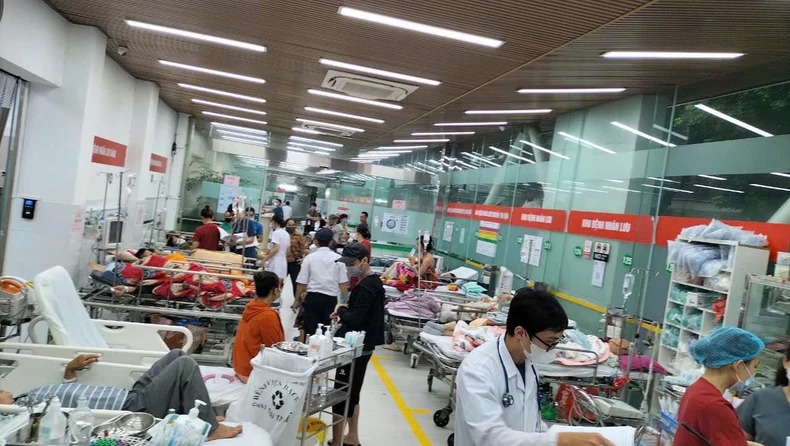 |
| The patient is currently receiving treatment at Viet Duc Friendship Hospital. |
According to information from Viet Duc Friendship Hospital, on September 6th and 7th, the hospital's on-call team received and treated 14 emergency cases admitted due to the impact of the super typhoon. Specifically, these included one case of a head injury caused by a falling tree; two cases of limb injuries and head injuries due to broken walls and glass falling on people; and nearly 10 cases of car and motorbike accidents while traveling home during the storm.
According to Dr. Quach Van Kien, Deputy Head of the Department of Gastrointestinal Surgery at Viet Duc Friendship Hospital, on Saturday (September 7th), most of the emergency cases were from the Hanoi area. By Sunday (September 8th), the number of emergency cases had increased fivefold, with most being transferred from provincial hospitals.
The medical team worked tirelessly to provide emergency care to patients during the storm, protecting their lives and health in this critical situation. Timely emergency care helps patients avoid further injury, maintain continuous treatment, and minimize the risk of death or severe long-term consequences caused by the natural disaster. This is also a crucial medical responsibility of the hospital, ensuring that no one is left behind during dangerous times.
"The most serious case currently hospitalized at our hospital is a head injury requiring mechanical ventilation due to slipping on a corrugated iron roof. Another case involves a person cutting trees after the storm, whose saw blade struck their leg...", Dr. Kien said.
Recently, the hospital has arranged 24/7 on-call shifts including doctors, nurses, technicians, and medical staff with specific task assignments to receive and treat victims of rain and storms, ensuring uninterrupted emergency treatment for patients and readiness to handle any emergency situation.
The hospital has established a telemedicine network comprising 8 hospitals: Son La, Quang Ninh, Lao Cai, Lai Chau, Hai Phong ... to support lower-level hospitals, such as providing remote consultations and assisting patients after the Phong Chau bridge collapse at Tam Nong Hospital.
Viet Duc Friendship Hospital has established a Steering Committee and mobile medical teams to respond to storms, headed by Dr. Duong Duc Hung, Director of the Hospital. Eight mobile medical teams, comprising doctors, nurses, and drivers from the hospital, are ready to support neighboring medical facilities and lower-level hospitals in emergency care and patient transport to respond promptly to storms and heavy rain.
At E Hospital, Dr. Nguyen Minh Tuan, Deputy Head of the Department of Nephrology, Urology and Dialysis, said that on the day Typhoon No. 3 hit Hanoi, E Hospital received a total of 36 emergency cases.
Among them were 16 surgical emergencies: 10 emergency cases due to patients being injured in accidents related to Typhoon No. 3; and 20 medical emergencies.
In order to proactively respond to Typhoon No. 3 and prevent flooding at the hospital due to post-typhoon rain, the Board of Directors of E Hospital instructed all departments and wards throughout the hospital to ensure readiness of personnel, supplies, medicines, and chemicals for flood and storm prevention and search and rescue; and to ensure 24/7 on-call and emergency services.
Dr. Nguyen Cong Huu, Director of E Hospital, affirmed that the advantage of E Hospital is that it is a complete general hospital with many leading specialties such as cardiology, musculoskeletal, orthopedics, gastroenterology, hepatobiliary, intensive care, etc., meeting the emergency and treatment needs of the people.
In addition, the pre-hospital emergency medical system of Hospital E will coordinate with the 115 Emergency Center to be ready to receive emergency patients transferred from other locations.
The pre-hospital emergency medical team is always on standby, ready to provide assistance to localities when needed. If people experience any medical emergency requiring emergency care, please call 115 or the E Hospital pre-hospital emergency medical system hotline at 0243.7480648 (24/7) for assistance and to transport the injured person to the nearest medical facility, ensuring their safety.
Immediately after the storm, the hospital's leadership held an emergency meeting, assigning tasks to key leaders and on-call teams, and actively clearing fallen trees and cleaning up the hospital grounds and wards to prepare for the smooth operation of medical examinations and treatments the following day.
At Bach Mai Hospital, from the evening of September 7 to the morning of September 8, the A9 Emergency Center received 10 patients injured by collapsed houses, collapsed roofs, and fallen trees on the street due to the impact of storm No. 3. These patients were all promptly treated after being transferred.
Among the five patients admitted to the hospital in the early morning of September 8, two were seriously injured in the head and neck due to a metal roof falling on them and falling from a height.
Associate Professor Dr. Dao Xuan Co, Director of Bach Mai Hospital, said that the hospital has organized personnel and staff on duty to monitor and control the situation, ready to handle incidents such as fallen trees, flooding, and roof damage caused by storms.
The hospital also arranged additional mobile emergency teams with full medicine and equipment, ready to support lower levels when requested. The professional council consisting of leading experts in many fields is also ready to consult remotely, supporting colleagues in provinces affected by storms to provide the most effective emergency care for patients.
The A9 Emergency Center - Bach Mai Hospital ensures 24/7 emergency care for patients during Typhoon No. 3. Simultaneously, it focuses on treating the injured; urgently addressing the consequences at medical facilities, ensuring uninterrupted emergency care and treatment for the public, and guaranteeing that no one is left without medical examination, treatment, or care. It also organizes environmental sanitation, disease prevention, and ensures access to clean water and safe food.
Regarding medical examination and treatment nationwide, on the afternoon of September 8th, the Ministry of Health issued an urgent dispatch to the Departments of Health in provinces and cities in the Northern and North Central regions; and units under and directly affiliated with the Ministry of Health in the Northern and Central regions, regarding proactive measures to overcome the consequences of the recent floods.
The official dispatch signed by Deputy Minister of Health Do Xuan Tuyen clearly states that, in accordance with the Prime Minister's directives at the meeting on the morning of September 8, 2024, regarding the assessment of response efforts, damage assessment, and implementation of urgent measures to mitigate the consequences of Typhoon No. 3.
To proactively respond to and mitigate the consequences of Typhoon No. 3 in 2024 and minimize damage from potential heavy rains, landslides, flash floods, and mudslides, the Ministry of Health requests the Departments of Health in provinces and cities in the Northern and North Central regions, and units under and directly affiliated with the Ministry of Health, to strictly implement the directives of the Prime Minister; the National Steering Committee for Civil Defense; the National Steering Committee for Disaster Prevention and Control; the National Committee for Incident Response, Disaster Relief and Search and Rescue; and the Ministry of Health regarding the prevention, control, and mitigation of consequences caused by Typhoon No. 3.
The Ministry of Health requests that relevant units closely monitor the developments of natural disasters, rain, and floods in their areas, especially the risk of localized flooding, landslides, flash floods, and mudslides in mountainous areas due to heavy rains after the storm, in order to proactively assess the situation and implement timely and effective response measures according to the "four on-the-spot" principle.
Report the extent of damage, needs, local capacity to provide assistance, and propose support when the local capacity is exceeded to the Ministry of Health (via the Planning and Finance Department) for compilation and reporting to the competent authority for consideration and decision.
The Ministry of Health requests that the heads of agencies and units under and directly affiliated with the Ministry of Health, the Directors of the Departments of Health in provinces and cities in the Northern and North Central regions, and relevant units urgently organize and coordinate the implementation of the task.
Source: https://baodautu.vn/no-luc-cuu-chua-nguoi-benh-trong-mua-lu-d224517.html

























![[Video] The craft of making Dong Ho folk paintings has been inscribed by UNESCO on the List of Crafts in Need of Urgent Safeguarding.](https://vphoto.vietnam.vn/thumb/402x226/vietnam/resource/IMAGE/2025/12/10/1765350246533_tranh-dong-ho-734-jpg.webp)
























































Comment (0)