

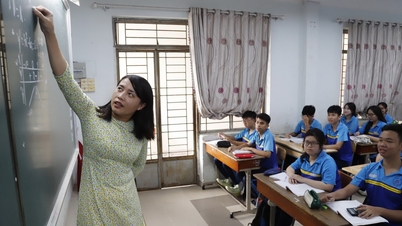
The National Assembly passed 3 laws and 2 resolutions on education.
On December 10th, the National Assembly passed three new laws in the field of education and training, including: the Law amending and supplementing a number of articles of the Law on Education; the Law on Vocational Education (amended); and the Law on Higher Education (amended).
In addition, the National Assembly also passed a resolution on a number of special and outstanding mechanisms and policies to achieve breakthroughs in education and training development; and a resolution on the investment policy for the National Target Program on modernization and improvement of the quality of education and training for the period 2026-2035. These laws and resolutions will take effect from January 1, 2026.
One of the notable new points of the Law amending and supplementing a number of articles of the Law on Education is that from 2026 onwards, junior high school diplomas will no longer be issued, and there will be a unified set of textbooks nationwide; the Government will regulate the provision of free textbooks for students.
The law also stipulates the National Scholarship Fund – a completely new mechanism aimed at expanding learning opportunities for students and promoting talent development; adds a series of new mechanisms for scientific, technological, and innovative activities; recognizes digital diplomas and certificates; defines "educational support personnel" in the national education system; amends regulations on training in specialized fields of arts, physical education, and sports; and reduces administrative procedures.
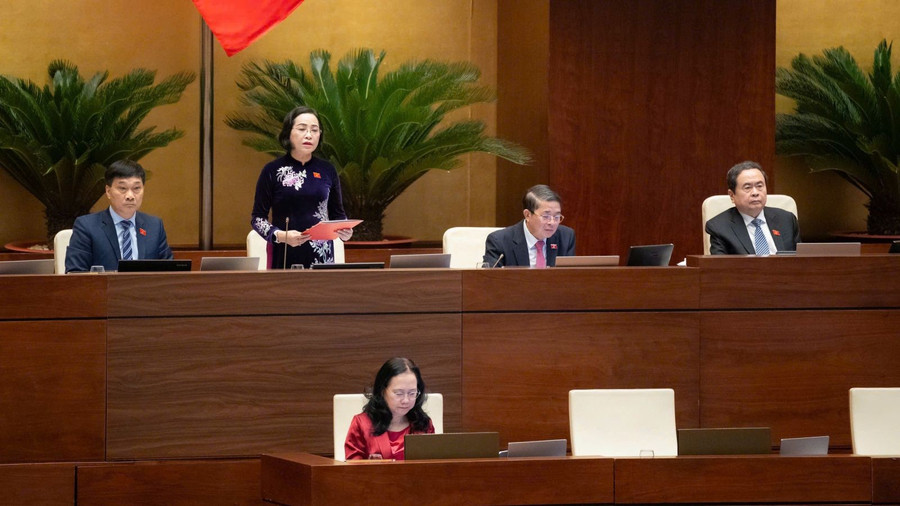
The amended Higher Education Law establishes a unified higher education system with advanced governance, increasing endogenous strength; it terminates the operation of the University Council in public higher education institutions and strengthens the leadership role of the Party organization in higher education institutions. The law guarantees the comprehensive autonomy of universities in academic space, staff, scientific research, innovation, finance, and international cooperation.
The law creates a breakthrough in grassroots governance, synchronizing training levels and increasing the decision-making power of higher education institutions. The state manages the system according to standards, applies information technology, and seamlessly combines post-audit and pre-audit to ensure quality.
The law aims to reform higher education by promoting lifelong learning, modernizing curricula, learning materials, and technology, narrowing the gap with the labor market, and strictly controlling the fields of teaching, health, and law.
The investment policy aims to improve the standards of higher education institutions; to establish excellent universities to lead the system; to mobilize all resources and create a level playing field for competition between public and private institutions. The law opens a corridor to attract talented lecturers, support students from undergraduate to postgraduate levels; and promote training linked to scientific research and new technologies.
Regarding the amended Law on Vocational Education, one of the most notable points is the addition of the vocational high school model and the expansion of the target group participating in vocational education activities, aiming to perfect the national education system in an open, flexible, and interconnected direction, creating lifelong learning opportunities for all citizens.
Another important aspect is the innovation of curricula, training organization, and quality assurance in vocational education through the establishment of program standards and training institution standards; managing registration activities on a digital data platform; and recognizing accumulated knowledge and skills to enable learners to participate in other programs.
The law supplements preferential policies on taxes, land, and policies for enterprise personnel participating in vocational education in the roles of visiting lecturers, co-workers, or full-time teachers. In addition, the law also promotes decentralization and delegation of power to improve the effectiveness of state management of vocational education, ensuring the serious and coordinated implementation of the Party and State's policies.
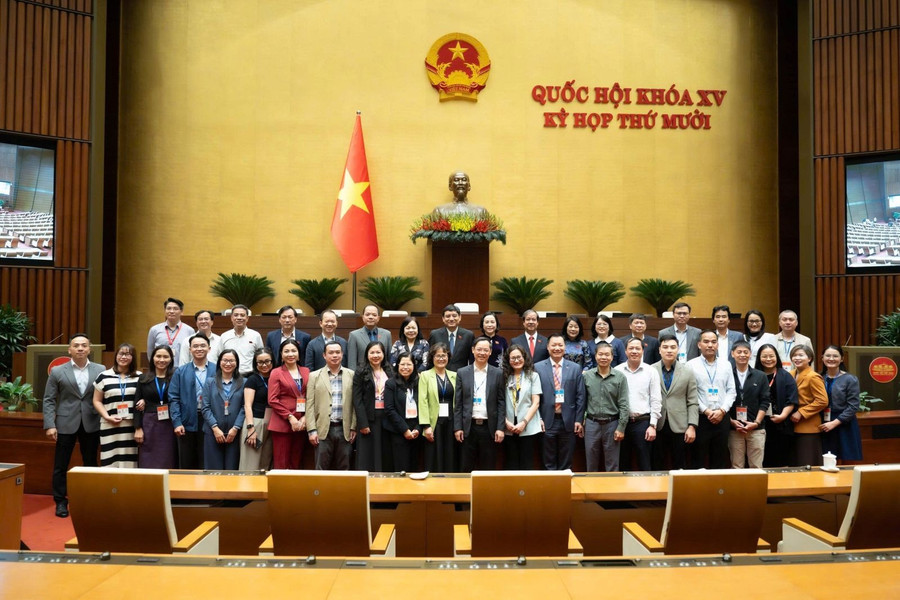
The National Assembly's resolution on some special and outstanding mechanisms and policies to achieve breakthroughs in education and training development consists of 9 articles, focusing on stipulating 5 groups of outstanding policies.
Specifically, regarding the recruitment, employment, and management mechanisms for human resources in the education sector, the Resolution stipulates that the Director of the Department of Education and Training has the authority to recruit and appoint teachers, educational administrators, and staff in public preschools, primary and secondary schools, continuing education institutions, special schools, and vocational high schools (public educational institutions) within the province; and to exercise the authority to transfer, reassign, second, appoint, and change job positions for teachers, educational administrators, and staff in public educational institutions under their management and for public educational institutions involving two or more commune-level administrative units within the province.
The Chairman of the People's Committee at the commune level has the authority to transfer, reassign, second, appoint, dismiss, and change job positions for teachers, educational administrators, and staff in public educational institutions under their management.
Vocational and higher education institutions have the autonomy to determine job positions, recruit, and sign labor contracts with foreign experts and scientists with doctoral degrees, as well as Vietnamese citizens residing abroad, according to their internal regulations; they also decide and take responsibility for the recruitment and confirmation of eligibility for work permit exemptions for foreign experts and scientists for a period not exceeding 3 years to carry out teaching and scientific research.
Regarding remuneration for personnel in the education sector, the Resolution stipulates: Professional incentive allowances shall be implemented according to a roadmap prescribed by the Government for public preschool and general education institutions, with a minimum rate of 70% for teachers, a minimum rate of 30% for staff, and 100% for teachers working in areas with particularly difficult socio-economic conditions, ethnic minority areas, border areas, and islands.
Vocational and higher education institutions have the autonomy to determine the additional income for teachers, staff, and employees from legitimate sources of revenue outside the state budget that are retained according to the law, in accordance with internal spending regulations and the unit's performance.
The Resolution on the investment policy for the National Target Program on modernization and improvement of the quality of education and training for the period 2026-2035 stipulates the objectives, scope and time of implementation of the Program, beneficiaries, implementation costs, urgent issues that need to be focused on, principles of allocation of central budget funds, specific mechanisms and policies in the implementation of the Program, and solutions and mechanisms for managing and operating the Program.
The resolution also stipulates the responsibilities of the Government and the Prime Minister; the responsibilities of the Ministry of Education and Training (the lead agency for the Program) and the responsibilities of the People's Councils and People's Committees at the provincial level; and the responsibilities for monitoring the implementation of the Program.
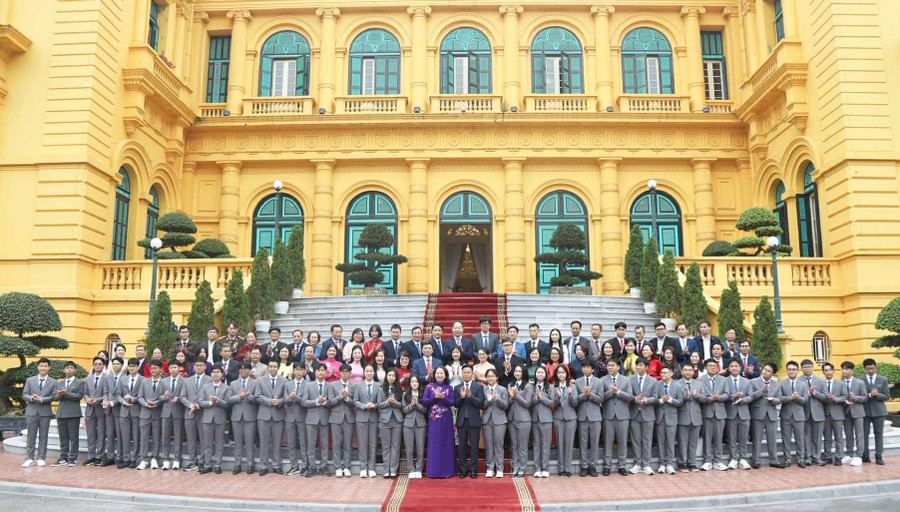
Honoring students who win prizes at the 2025 International Olympiads and Science & Technology competitions.
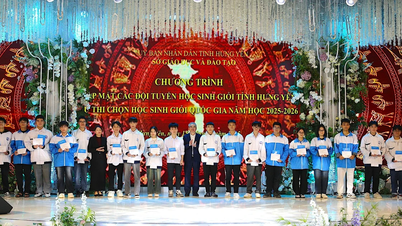
On the morning of December 12th, at the Presidential Palace, Vice President Vo Thi Anh Xuan met with and commended the delegation of students who won awards at the 2025 International Olympiads in Science and Technology.
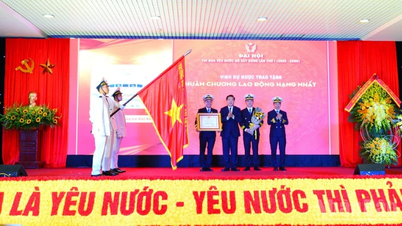
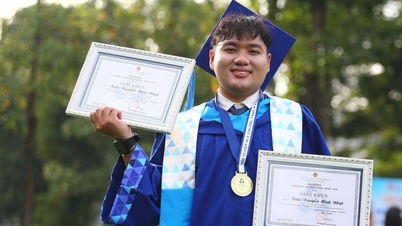
On this occasion, 19 students were honored with the Labor Medal and 5 students received Certificates of Merit from the Prime Minister.
Reporting at the meeting, Director of the Quality Management Department (Ministry of Education and Training) Huynh Van Chuong stated that 2025 will continue to witness significant achievements in Vietnamese education. Under the leadership of the Party, the attention of the Government, and the direct guidance of the Ministry of Education and Training, advanced education has made strong progress, clearly demonstrated by the results at regional and international Olympic competitions and the Science and Technology Competition in 2025. This outstanding achievement further affirms Vietnam's position in the region and the world, while also reflecting the remarkable development of general education.
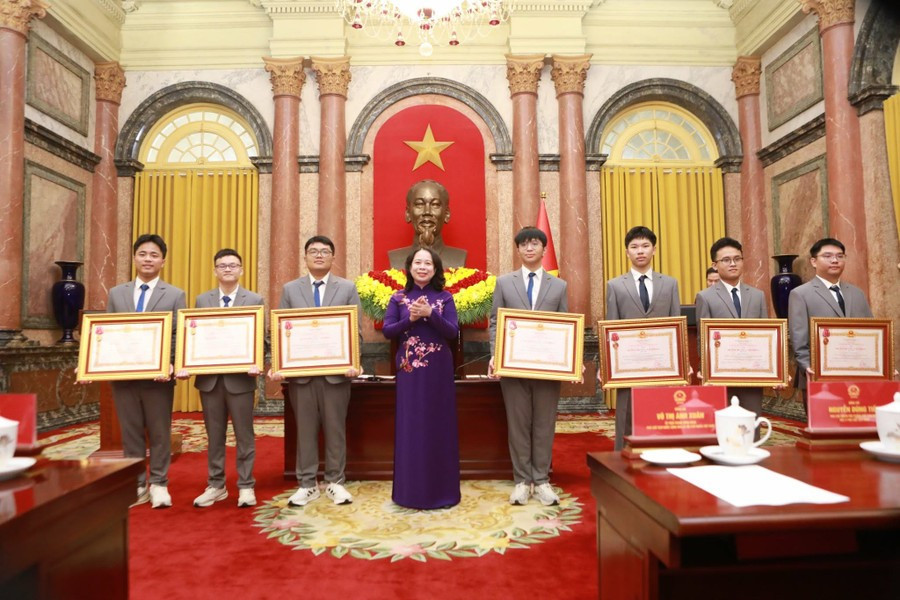
In 2025, Vietnam had 7 delegations with 37 students participating in international and regional Olympiad competitions. The results were impressive, with all contestants winning awards, including 13 Gold Medals, 16 Silver Medals, and 8 Bronze Medals - an increase of 1 Gold Medal and 1 Silver Medal compared to 2024.
The Ministry of Education and Training, in coordination with relevant units, selected and formed the national team to participate in the International Artificial Intelligence Olympiad. As a result, all 8 participating students won awards, including 3 Gold Medals, 1 Silver Medal, 3 Bronze Medals, and 1 Certificate of Merit, placing Vietnam 4th out of 60 participating countries.
In addition, Vietnamese students have achieved outstanding results in many other competitions such as: the 2nd International Mathematical Olympiad in Turkmenistan; the 9th European Physics Olympiad in Bulgaria; the Mendeleev International Chemistry Olympiad; the Abu Rayhan-Beruni International Chemistry Olympiad; and the Artificial Intelligence Olympiad in China.
Notably, 2025 marks the first time the Vietnamese delegation has achieved the highest results at the International Science and Engineering Fair (ISEF) in the United States, with 2 second prizes, 1 third prize, 3 fourth prizes, and 4 special awards from sponsors. This is the highest achievement since Vietnam began participating in ISEF in 2013.
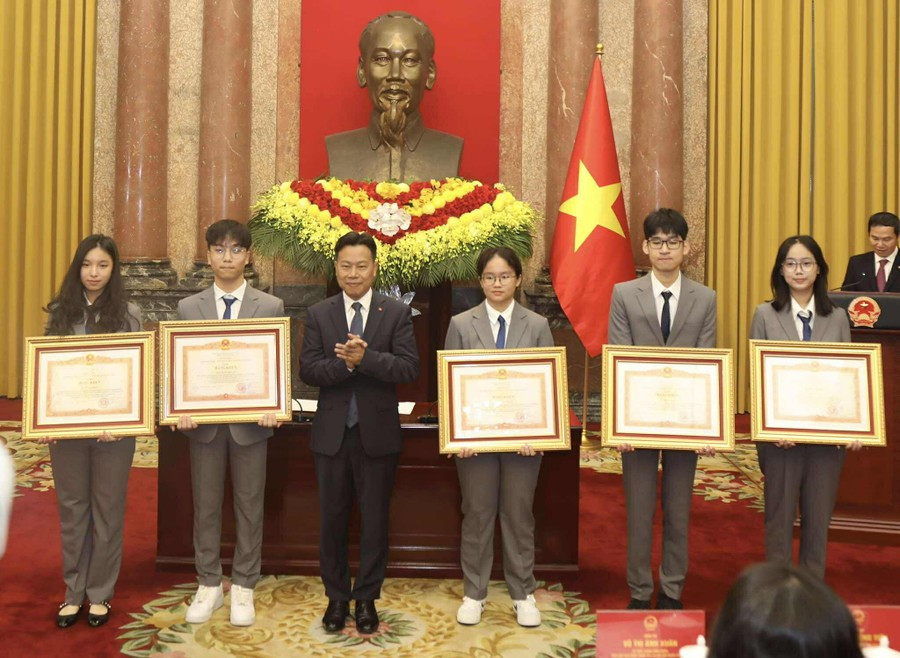
Vice President Vo Thi Anh Xuan acknowledged and commended the outstanding efforts and achievements of the education sector, teachers, and students in recent years. She affirmed that, along with the overall achievements of the country, Vietnamese education is making strong progress, gradually approaching advanced global standards; the achievements at international Olympiads and science and technology competitions in recent years demonstrate Vietnam's increasingly strong position.
In the context of a rapidly changing world driven by the Fourth Industrial Revolution, artificial intelligence, the digital economy, and climate change, the Vice President urged the younger generation of Vietnam, including the outstanding students who were honored, to continue nurturing a spirit of learning, creativity, daring to think, daring to act, and daring to take responsibility.
The education sector needs to continue developing and implementing practical plans and solutions with clear roadmaps to identify, nurture, and develop talent in line with the country's development needs and the trends of the times.
Regarding the teaching staff, the Vice President expressed his hope that teachers would continue to "keep the flame alive," inspire students to learn and research; and innovate teaching methods to train citizens with the qualities and abilities to meet new requirements.
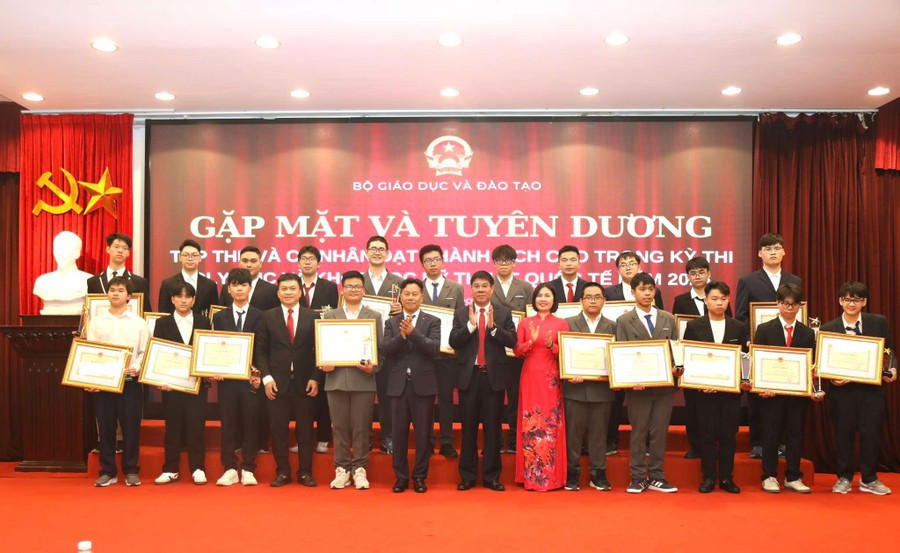
Continuing the program of honoring achievements, on the afternoon of December 12th, the Ministry of Education and Training organized a meeting to commend students who won prizes in the 2025 International Olympiads and Science and Technology competitions, chaired by the Deputy Minister of Education and Training.
Here, outstanding collectives and individuals were awarded commemorative medals and certificates of merit from the Minister of Education and Training.
Source: https://giaoducthoidai.vn/nong-trong-tuan-quoc-hoi-thong-qua-3-luat-2-nghi-quyet-ve-giao-duc-post760524.html



![[Photo] Two flights successfully landed and took off at Long Thanh Airport.](/_next/image?url=https%3A%2F%2Fvphoto.vietnam.vn%2Fthumb%2F1200x675%2Fvietnam%2Fresource%2FIMAGE%2F2025%2F12%2F15%2F1765808718882_ndo_br_img-8897-resize-5807-jpg.webp&w=3840&q=75)







































































Comment (0)