

This regulation marks a major turning point in education policy, overcoming the limitations of the one-curriculum-multiple-textbook model.
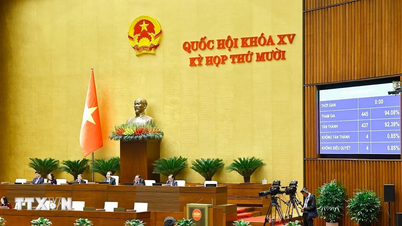
On the same day, the National Assembly also passed a Resolution "On some specific and outstanding mechanisms and policies to achieve breakthroughs in education and training development." According to this Resolution, the Minister of Education and Training will decide on a set of general education textbooks to be used uniformly nationwide, starting from the 2026-2027 school year.
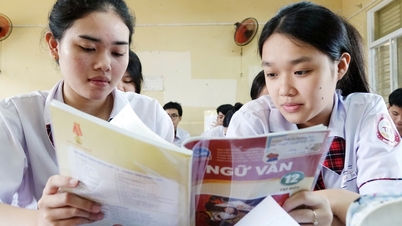
In fact, the model of a unified national set of textbooks is not only technical but also reflects the urgent demands of practice. The implementation of the 2018 General Education Program has revealed disparities in quality between different sets of textbooks; teachers' confusion in choosing; a lack of uniformity in testing and evaluation; pressure to purchase new materials; and the emergence of textbook "commercialization," causing public concern. Therefore, the policy of unifying textbooks is expected to create stability, reduce variability, and avoid waste.
It should also be emphasized that the model of multiple textbooks is not fundamentally flawed, as it encourages creativity, diversity of pedagogical viewpoints, and fosters competition to improve quality. The shortcomings of the past are not entirely due to this model itself, but may be related to its implementation. Therefore, unifying a single set of textbooks nationwide is expected to thoroughly address the existing problems in practice.
At the 10th session of the 15th National Assembly , National Assembly deputies analyzed that unifying a single set of textbooks has many advantages, such as: creating a common standard in content, helping to make testing and evaluation more consistent, especially in national examinations. In addition, this regulation helps teachers reduce the pressure of researching and comparing many different sets of textbooks; and helps schools and parents save costs.
According to the Law amending and supplementing a number of articles of the Law on Education, "the curriculum remains the legal framework." The law stipulates that textbooks implement the general education curriculum, specifying the requirements of the general education curriculum regarding educational goals and content, requirements for students' qualities and competencies; and providing guidance on teaching methods and ways to test and evaluate the quality of education.
Textbooks are mandatory reference materials, but teachers have the right to adjust their methods and flexibly use other learning materials to suit their students. This means that unifying a set of textbooks does not equate to "uniformizing" teaching and learning methods. Pedagogical innovation remains important, and the role of the teacher remains central.
The biggest challenge today lies in implementation. A set of textbooks is only truly effective when it is developed on a scientific basis, involves a team of reputable experts, undergoes extensive peer review, is rigorously tested through experimentation, and, most importantly, has a mechanism for regular updates.
Unifying textbooks is a major change, but it's not a magic wand that will solve all the challenges facing general education. More important is how it's implemented, monitored, and adjusted. If done well, this policy can create a stable foundation, helping the education system operate more efficiently. Conversely, if management thinking doesn't change, and transparency and accountability aren't prioritized, it could lead to unforeseen consequences.
In the context of education facing the need for radical reform, every policy decision must be viewed with discernment. A unified set of textbooks is only the starting point; the quality of education depends on many different factors. Therefore, this change should be seen as an opportunity for the system to review its bottlenecks, moving towards a more transparent, equitable, and high-quality educational environment.
Source: https://giaoducthoidai.vn/su-dung-thong-nhat-mot-bo-sgk-co-hoi-chuan-hoa-post760204.html
















![[Photo] Prime Minister Pham Minh Chinh holds a phone call with the CEO of Russia's Rosatom Corporation.](/_next/image?url=https%3A%2F%2Fvphoto.vietnam.vn%2Fthumb%2F1200x675%2Fvietnam%2Fresource%2FIMAGE%2F2025%2F12%2F11%2F1765464552365_dsc-5295-jpg.webp&w=3840&q=75)


















































Comment (0)