

This major change has generated high expectations from teachers and administrators; along with a desire to implement synchronized teacher training and provide clear professional guidance for effective teaching using a unified set of textbooks.
Expectations when unifying a set of books
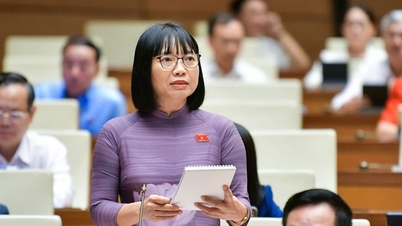
Based on her experience teaching with various textbooks, Ms. Pham Nguyen Trang Ngan, a teacher at A Luoi High School ( Hue City), hopes that the new textbooks will closely adhere to the spirit of the 2018 General Education Program, but without "rigidly" limiting the content, allowing teachers flexibility in implementation. The books should reduce academic content, increase practicality, and utilize more situations related to real life and regional contexts, especially for ethnic minority students.
The textbook structure should be open-ended, with numerous suggested activities, projects, differentiated questions, and competency-building tasks, rather than simply listing knowledge. In addition, the new textbook needs to be accompanied by a synchronized digital learning ecosystem, such as videos , simulations, question banks, and worksheets, to support teachers in effective implementation.
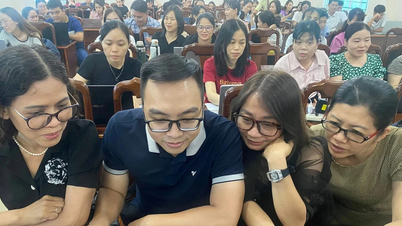
To help teachers quickly adapt to the new textbooks, Ms. Trang Ngan suggested that training programs should focus on the core aspects: designing a series of teaching activities to develop competencies, teaching sample lessons using the new methods, and providing specific guidance on competency-based assessment.
In addition, teachers need a shared system of learning materials, inter-school professional development activities, a team of teachers to provide direct support, as well as guaranteed equipment and internet access for schools in disadvantaged areas. During the initial phase of implementing the new textbooks, teachers also need to have their paperwork burden reduced so they have time to invest in innovation.
As the head of the educational institution, Ms. Tran Thi Bich Hanh - Principal of Ha Hoa Town Primary School (Ha Hoa, Phu Tho) - hopes that the new textbooks will retain the pedagogical principles, logical structure, and practical relevance of the current textbooks. At the same time, the textbooks must surpass the current ones in terms of scientific rigor and quality; they should serve as guiding learning materials, not rigid templates, allowing teachers to foster creativity.
According to Ms. Hanh, textbooks should be designed in an open and flexible way so that teachers can creatively apply them, relate them to real-world situations, and utilize other materials to meet the competency-based development goals of the 2018 General Education Program.
The textbooks should also facilitate teachers in developing lesson plans, organizing thematic teaching, and designing competency-based assessments. Consistency in knowledge, terminology, and scientific perspectives across the textbooks (if integrated) will help teachers and learners avoid confusion when transitioning between them.
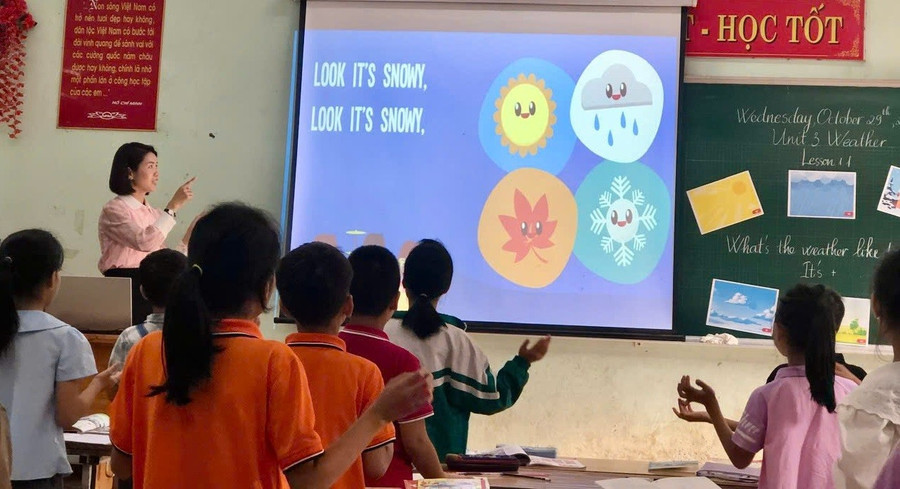
Not dependent on textbooks
Using only one set of textbooks while still ensuring competency-based teaching is entirely possible through a change in mindset and approach to the materials. The core issue lies in treating textbooks as resources, not as mandates.
To achieve this, Ms. Tran Thi Bich Hanh believes that teachers need to carefully study the general curriculum framework. All activities and content included in the lesson must aim to help students achieve the competencies and qualities stipulated in the curriculum.
Evaluating lessons and learning outcomes should be based on whether students meet the required learning objectives, not solely on whether the teacher taught the lesson "correctly" according to the textbook. Textbooks are the basic materials for organizing formal classroom activities; however, teachers need to select the most appropriate materials, examples, and images.
Teachers should proactively seek out materials, examples, and real-life situations from open educational resources, other reference books (if available), or from real-life experiences to enrich their lectures. They should avoid using pre-written questions from textbooks, especially test questions, verbatim. Instead, teachers should design open-ended questions, real-life scenarios, or high-level application activities to stimulate critical thinking.
Ms. Tran Thi Bich Hanh also emphasized the need to enhance active learning activities, placing students at the center. Teachers should consider themselves co-designers of lesson plans with the textbook authors. If any part of the textbook is too heavy or abstract, teachers should proactively supplement it with more engaging activities, practical examples, or reduce the amount of theoretical content.
Teaching activities must be flexible: Emphasize group work, small projects, and hands-on experiences to allow students to acquire knowledge independently. Simultaneously, testing and evaluation should focus on assessing competence (application, problem-solving), rather than simply memorizing textbook content. Teachers should utilize standardized question banks (if available) or create their own tests closely aligned with the curriculum to ensure objectivity and avoid being limited by the specific content of a single textbook.
Regarding this issue, Ms. Pham Nguyen Trang Ngan believes that the core issue lies in recognizing that textbooks are only one of many learning materials, while the real "regulation" is the curriculum. When preparing lessons, teachers should start from the learning objectives and competencies to be developed, and only then use textbooks as a reference source to select or adjust content. In addition to textbooks, teachers can combine digital learning materials, local resources, community projects, experiments, or small-scale student research.
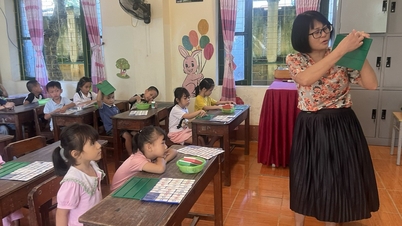
Sharing the same view, Mr. Nguyen Phuong Bac, a teacher at Lam Thao Primary and Secondary School (Luong Tai, Bac Ninh), believes that, first and foremost, textbooks should be recognized as merely a source of "material," not the entire lesson. Teachers must base their lesson planning and teaching on the learning objectives of the 2018 General Education Program, rather than blindly adhering to every page of the textbook.
In organizing teaching and learning, teachers proactively design open and diverse activities. Even with a standardized textbook, teachers can still develop group activities, small projects, learning games, real-life scenarios; connect with the local area, take students on field trips, create videos, conduct interviews, etc.
Regarding assessment, teachers need to be given greater autonomy. They should be flexible in designing tests to suit each class, not strictly adhering to the textbook format; at the same time, they should strengthen regular assessment methods such as observation, worksheets, and learning journals… to comprehensively reflect the students' learning process.
"To successfully implement the new textbook series, my greatest expectation is that teacher training and professional development will be organized in a coordinated and unified manner; helping teachers quickly familiarize themselves with the new content and methods, thereby proactively developing appropriate teaching plans."
"Hopefully, the Ministry/Department of Education and Training will issue specific guiding documents to serve as a basis for adjusting teaching methods; reducing unnecessary administrative work and reporting so that teachers can focus on their expertise, self-study, and research educational materials; thereby improving their teaching capacity," Principal Tran Thi Bich Hanh expressed.
Source: https://giaoducthoidai.vn/su-dung-thong-nhat-mot-bo-sgk-giao-vien-linh-hoat-hoc-sinh-chu-dong-post760203.html



























































Comment (0)