

Taking steps towards school
Ia Mơ is a border commune in Gia Lai province, comprising 6 villages with 746 households and over 3,200 inhabitants. 84% of the population here are ethnic minorities. Ia Mơ commune lacks a boarding school, making teaching and learning challenging. Having worked for 16 years at Nguyen Van Troi Primary and Secondary School (Klah village, Ia Mơ commune), Ms. Nguyen Thi Anh Nguyet understands the difficulties and hardships faced by the children of Ia Mơ on their journey to acquire knowledge. The majority of students at the school are Jrai ethnic minorities living in remote villages, making access to school very difficult.
"Parents have to drive their children many kilometers to get to school. On sunny days, the dirt roads are rough and dusty. In the rainy season, the roads are muddy and slippery. In addition, many families are in difficult circumstances, so from a young age, the children have to follow their parents to work in the fields, which affects their studies," Ms. Nguyet shared.
Every year, after the start of the new school year or after the Lunar New Year holiday, teachers have to go to people's homes to persuade them to let their children attend school. To get the "yes" of parents, besides verbal persuasion, teachers often have to help children with household chores. In Ia Mơ, many people cannot read or write Vietnamese, so teachers are responsible for completing all the necessary paperwork for their children to attend school. Despite this arduous effort, due to the remote location and lack of boarding facilities, many students still drop out. Therefore, having a boarding school would solve many problems and allow students to focus on their studies.
Mr. Nguyen Tuan Anh, Vice Chairman of the People's Committee of Ia Mo commune, said that many poor households in the commune still face difficulties in their lives, leading to a situation where children do not attend school regularly. Besides economic issues, distance is one of the factors causing children to drop out of school. "For example, in Ring village, due to the long distance, for many years, primary and secondary school students have had to go to Dak Lak province to study. At meetings with voters, the people have expressed their desire for the State to provide support in building boarding schools so that the children can study better. At the same time, it would also ease the burden of transporting children to and from school for parents," Mr. Tuan Anh shared.

The construction of integrated boarding schools will help maintain stable student numbers at schools in border areas - Illustration photo.
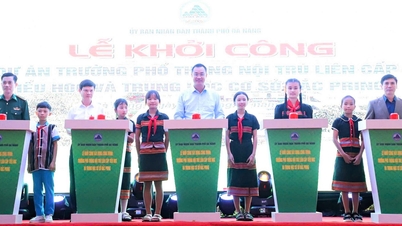
The aspirations of the people of Ia Mơ are about to become a reality as the locality has been allocated budget for the construction of a multi-level boarding school. The local government has also proposed reclaiming a 6-hectare plot of land to promptly implement the project. Having a new, spacious school will fulfill the people's hopes. "The commune government has also considered solutions to maximize the effectiveness of the boarding school after its completion. These include focusing on training and developing management staff, improving the quality of the teaching staff, promoting digital transformation, and investing in modern equipment. The commune will continue to coordinate and mobilize social resources, maintaining models to support poor students and create the best possible learning conditions for them," Mr. Tuan Anh said.
At a school with nearly 500 students studying at one main campus and three satellite locations, Mr. Ngo Van Vinh, Deputy Principal of Nguyen Van Troi Primary and Secondary School, could not hide his joy at the prospect of a spacious, multi-level boarding school being built in this remote border region, supporting the development of future generations of children. The dispersed teaching across four locations makes management and the organization of group experiential activities difficult. In particular, Computer Science classes are held outside of regular school hours, requiring students to travel to the main campus. The construction of a boarding school would facilitate the school's organization of practical experiential activities, contributing to the holistic development of students' knowledge, skills, and character.
Furthermore, Mr. Vung believes that boarding schools will help students overcome geographical distances and difficult, dangerous journeys, especially during the rainy season, to get to school, thereby maintaining class attendance and diligence. Stable accommodation and learning conditions at the school will also reduce the rate of students dropping out. At the new school, in addition to studying, students will also be provided with complete and hygienic meals, contributing to improving their physical condition and overcoming the widespread malnutrition in the highlands.
Opening the door to the future
In the sun-drenched and windy border region of Quang Ngai province, teachers and residents of Duc Nong commune are eagerly awaiting the completion of their boarding school. This project is not only a solution to the dilapidated infrastructure problem but also opens a new door for the future of students in this border area. Dak Duc Primary and Secondary School (Duc Nong commune) was formed by merging three schools with 1,136 students, nearly 90% of whom are ethnic minorities. Mr. Tran Duc Thu, the school's principal, said that for many years, teachers and students have been accustomed to cramped classrooms with faded roofs and peeling floor tiles. Many students from remote villages have to wade through streams and navigate dirt roads to get to class. Therefore, upon hearing the news that the commune would receive investment for the construction of a boarding school, the teachers and students were very happy. "This project truly opens up new hope for the students here," Mr. Thu shared.

Teachers at a primary school in Thai Nguyen carry stream water back home for daily use.
In the border commune of Yen Khuong (Thanh Hoa province), the main school will be located in Bon village with an area of 1.7 hectares, along with a 0.3-hectare branch school in Xang Hang village. Both will receive comprehensive infrastructure investment to support learning and boarding for students and teachers. Mr. Nguyen Van Hoan, Deputy Principal of Yen Khuong Secondary School, said that the school has 19 staff and teachers and 313 students, of whom 70 are currently living in rented accommodation. Most staff and teachers work far from home, and the roads are treacherous, so they live at the school in inadequate conditions. In addition, the current teaching and learning equipment cannot adequately meet the requirements of the new curriculum.
Mr. Hoan anticipates that around 500 students will register to stay at the boarding school once it is inaugurated. The school will provide students with more spacious and safer accommodation, especially those from remote villages. Previously, during the rainy season, many students had to miss school due to landslides. Furthermore, Mr. Hoan believes that improved facilities will help teachers feel more secure in staying at the school, innovating teaching methods, and improving the quality of education.
The ongoing implementation of multi-level boarding school projects across border regions demonstrates the special attention the Party and State pay to the education of ethnic minorities and disadvantaged areas. These new schools will serve as a foundation of knowledge, making a significant contribution to improving educational quality, maintaining stable student numbers, and creating generations of young people with knowledge and skills, forming a solid basis for development and security in border areas.
Source: https://phunuvietnam.vn/chien-dich-dac-biet-vi-hoc-tro-vung-bien-238251212203351628.htm








































































Comment (0)