


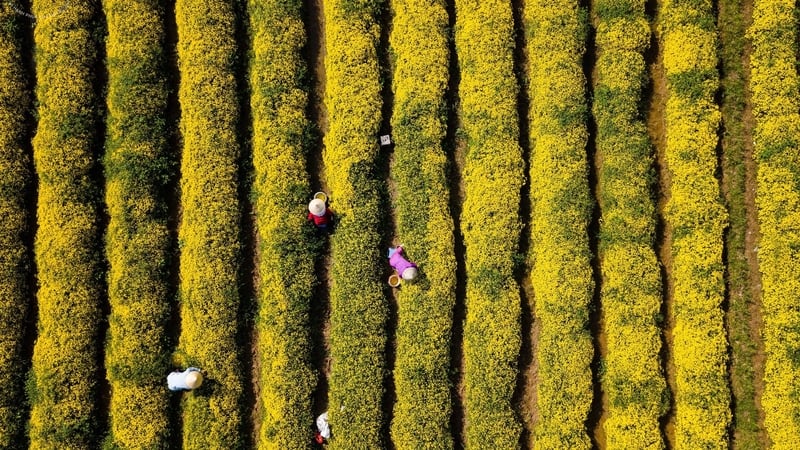
A large-scale farming model applying high technology to produce high-quality, low-emission rice is being implemented in Thanh An commune, Can Tho city.
Sustainable agricultural development
According to the Ministry of Agriculture and Environment (MARD), the One Million Hectare Project is strategically significant in enhancing the value and competitiveness of Vietnamese rice, while significantly reducing greenhouse gas emissions and promoting sustainable agriculture. The specific goals of the project are to increase farmers' income, reduce production costs, improve the environment, adapt to climate change, and contribute to Vietnam's commitment to reducing carbon emissions, aiming for a Net Zero target by 2050. The first phase of the project (2024-2025) will consolidate the existing 180,000 hectares from the Sustainable Agricultural Transformation Project in Vietnam (VnSAT), focusing on training, planning, establishing MRV systems, carbon sequestration, and piloting carbon credit issuance. Phase 2 (2026-2030) will expand by an additional 820,000 hectares, complete infrastructure development, reorganize production, build value chains, and finalize the MRV system.
The Mekong Delta is a key rice-producing region, but it is also a major emitter of greenhouse gases, accounting for 75% of CH₄ emissions from agriculture, equivalent to 88.6 million tons of CO₂e annually. The transition to low-emission rice farming is urgent and has initially yielded positive results. In Can Tho City, the "Green Vietnamese Rice" brand, low-emission, has been introduced, with the first shipment of 500 tons exported to Japan. The rice-shrimp farming model helps reduce chemical fertilizers by 30% and pesticides by 75%, increasing profits for farmers; the role of AI and satellite data in determining land boundaries, soil quality, monitoring AWD (alternating wetting and drying) methods, optimizing fertilizer and water for production; AWD techniques, straw reuse, organic farming, water-saving rice varieties, IPM, and ecological technologies are all noteworthy. Applications of UAVs (unmanned aerial vehicles) in crop monitoring, weed identification, plant density, pest and disease warning, and improved management efficiency; proposals for processing by-products such as rice husks, bran, and broken rice into high-value products (rice bran oil, rice protein, fermented products), reducing pollution and increasing value; proposals to improve "healthy soil" by adjusting pH, adding beneficial microorganisms and organic fertilizers, and reducing chemicals, with the ST25 rice-shrimp model helping to reduce chemical fertilizers by 30%, pesticides by 75%, and doubling profits; introduction of accurate greenhouse gas measurement technologies such as the Eddy Covariance method, sealed chambers and smart water level sensors, MRV systems, etc.
Mr. Le Thanh Tung, Vice President of the Vietnam Rice Industry Association, stated: “The MRV system is a core tool for verifying emission reductions, with relevant principles that are comprehensive, consistent, accurate, transparent, and prudent. Reducing emissions in rice production in the Mekong Delta not only helps protect the climate and environment, but also enhances economic efficiency, competitiveness, and sustainable livelihoods for farmers, contributing to building a green, low-emission, and climate-resilient agriculture…”
Focus on implementing the MRV process.
From 2023 to the present, the Institute of Agricultural Environment has collaborated with domestic and international experts to implement demonstration models and practice MRV measures such as mid-season water drainage, nitrogen fertilizer reduction, and early-season water regulation. From these, an effective MRV process has been developed, helping to quantify the reduction in greenhouse gas emissions for each farming method. The Institute of Agricultural Environment, together with experts from the World Bank and many international organizations, has developed and finalized the "MRV Process for High-Quality, Low-Emission Rice Cultivation in the Mekong Delta".
The MRV process was developed to establish a mechanism for measuring, reporting, and verifying greenhouse gas emission reductions in rice cultivation, creating a foundation for certification and validation of carbon credits in agriculture. The MRV process consists of six steps: MRV preparation, registration, establishing a baseline for the registered area, monitoring, reporting, and verification.
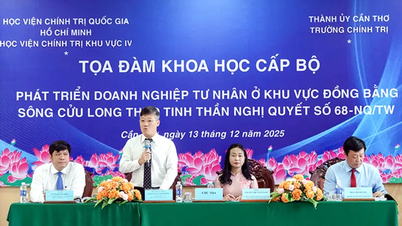
Recently, at the conference "Implementing the MRV Process and the High-Quality, Low-Emission Rice Production Process in the Mekong Delta," Deputy Minister of Agriculture and Environment Tran Thanh Nam directed the Department of Crop Production and Plant Protection to guide, train, and support localities in applying the MRV process from the 2025-2026 winter-spring crop (approximately 300,000 hectares). The Departments of Agriculture and Environment in the Mekong Delta region are to review and select suitable raw material areas, linking the application of the process with other projects, establishing planting area codes, ensuring traceability, and achieving sustainability certification. The Department of Science, Technology and Environment, in coordination with the Institute of Agricultural Environment and international organizations, will finalize the emission reduction verification framework, synchronizing it with the national MRV system.
Deputy Minister Tran Thanh Nam emphasized: “Applying this process is not only a technical requirement, but also the first step in transforming Vietnam's rice production methods from traditional to green, smart, circular, and low-emission production. The Ministry of Agriculture and Environment hopes that localities, businesses, cooperatives, and farmers will cooperate synchronously to turn this process into a new standard in rice production in the Mekong Delta region.”
Text and photos: HA VAN
Source: https://baocantho.com.vn/nang-cao-hieu-qua-canh-tac-lua-bang-quy-trinh-mrv-a195375.html






































































Comment (0)