

At its 10th session, the 15th National Assembly officially passed the amended Law on Vocational Education . This law allows higher education institutions to implement vocational education training programs. Specifically, it permits higher education institutions that have been upgraded from colleges, and higher education institutions that merged with colleges before the effective date of this Law, to continue enrolling students at the college level (with the training for this group expected to end in 5 years).
Furthermore, to institutionalize Resolution No. 57 and incorporate the opinions of some National Assembly deputies, the Government reviewed and supplemented regulations allowing higher education institutions currently training in fields listed in the Strategic Technology List according to the Prime Minister's Decision to implement associate degree programs in the same fields.
Avoid distorting vocational education.
Dr. Hoang Ngoc Vinh, former Director of the Department of Professional Education ( Ministry of Education and Training ), believes that allowing universities that meet the requirements to offer college-level training stems from practical needs.
"The market is currently lacking highly skilled technicians who can 'get the job done immediately,' while the vocational education network in many places is fragmented, overlapping in fields, and in some areas lacking the capacity to train in new fields. Furthermore, some localities have already merged colleges into universities, so 'banning' colleges within universities would be both shocking and wasteful of facilities, disrupting the supply of technical personnel. Moreover, the current model of separation is sometimes too restrictive, lacking flexible pathways for accumulation and transfer according to the needs of students and businesses. However, opening up must also be done cautiously, wary of the motive of 'opening to attract enrollment,' turning colleges into tools to boost enrollment targets," analyzed Dr. Hoang Ngoc Vinh.
From a network planning perspective, Dr. Hoang Ngoc Vinh believes that the new regulations will redistribute student enrollment. The "university" brand is generally more attractive than the "college" brand, so without a regulating mechanism, students will flock to "colleges within universities," making it difficult for many independent colleges to recruit, shrinking the vocational education system, and potentially impacting private vocational schools that have invested heavily in vocational training. This could skew the goal of balancing the supply and demand of technical personnel: instead of increasing the number of people entering the workforce, it would increase the number of people "holding a place to go to university."
Conversely, if the college enrollment targets are closely linked to local/enterprise needs within industry clusters, clearly defining the fields to be opened and mandating the public disclosure of employment data, then colleges within universities can fill the skills gap in areas where vocational education and training has not yet been strengthened after restructuring.
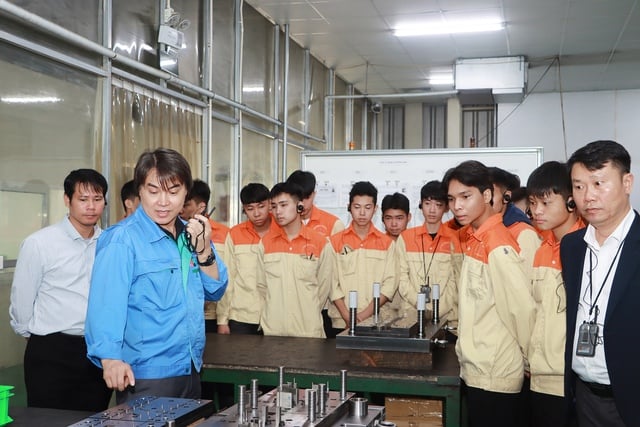
Allowing qualified higher education institutions to offer associate degree programs stems from practical needs. (Illustrative image)
In addition, Dr. Hoang Ngoc Vinh expressed concern about the planning of the vocational education and training network and the distortion of the mission of vocational education institutions when universities participate in college-level training. "The biggest challenge is the mismatch between output standards and training philosophy. A true college-level education should emphasize practical training, learning to do, while some university lecturers have a habit of teaching at the university level without a strong connection to practice, easily turning colleges into a shortened version of universities. This is the biggest challenge, easily resulting in a 'half-teacher, half-worker' environment."
Furthermore, while management and accreditation mechanisms are crucial, if vocational output standards and the ratio of practical training/internship in businesses are not strictly enforced and measured by actual work performance, then any management system will easily allow for circumvention of regulatory bodies to obtain training. This is not to mention the differences between the accreditation of higher education institutions based on various standards, missions, objectives, and organizational structures," Dr. Hoang Ngoc Vinh expressed.
Training that is transparent and aligned with societal needs.
In response to these concerns, Dr. Hoang Ngoc Vinh affirmed that there must be mandatory criteria, and no flexibility or adjustment, for granting licenses to universities to offer college-level training.
Firstly , this occurs when the local vocational college cannot meet the demand for manpower in a particular field, both in terms of quantity and quality, or when a vocational college merges with a university and is upgraded to a university, but still has a group of lecturers who are only capable of training at the vocational college or high school level and need to be fully utilized.
Secondly , it is necessary to have adequate facilities and cooperate with businesses to provide practical training in order to ensure the quality of college-level training as prescribed.
Thirdly , the curriculum is designed to align with the National Qualifications Framework at the college level.
Fourthly , the teaching staff must meet competency standards, especially in practical professional skills.
Finally , it is necessary to separate the accreditation standards for associate degree programs from those offered within universities.
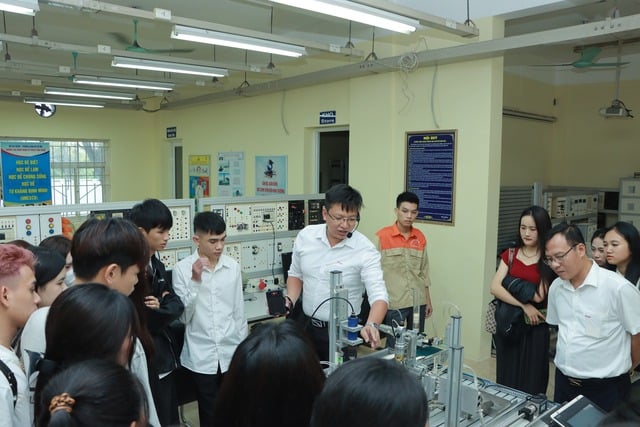
The targets for vocational training programs need to be closely linked to local/enterprise needs within industry clusters. (Illustrative image)
In addition, Dr. Hoang Ngoc Vinh emphasized five immediate actions needed to avoid a "free-for-all" approach and to build a transparent, interconnected vocational education and university ecosystem that serves businesses.
Firstly , any program offered as a college within a university must be based on the workforce needs of the region/locality and real practical skills, not just chasing after "trendy" fields.
Secondly , how can we ensure that colleges truly function as colleges, and not as "university students within a university"?
Thirdly , businesses should be involved from program design and internship organization to competency assessment, considering this as a condition for licensing, rather than just signing cooperation agreements to enhance their application profiles.
Fourth , all information regarding student recruitment, training, and employment should be made public on digital platforms for public oversight.
The post-training review process must be particularly rigorous. What can be opened can also be closed, so that the colleges can train highly skilled technicians, rather than creating a roundabout pathway directly to university. "Universities shouldn't exploit college enrollment to increase revenue while neglecting their primary mission of providing university education and diverting resources to training and research within the university," Dr. Hoang Ngoc Vinh recommended.
Source: https://phunuvietnam.vn/nhung-tieu-chi-bat-buoc-bao-dam-chat-luong-khi-dai-hoc-dao-tao-cao-dang-238251213140741912.htm


![[Photo] Prime Minister Pham Minh Chinh attends the Conference summarizing and implementing tasks of the judicial sector.](/_next/image?url=https%3A%2F%2Fvphoto.vietnam.vn%2Fthumb%2F1200x675%2Fvietnam%2Fresource%2FIMAGE%2F2025%2F12%2F13%2F1765616082148_dsc-5565-jpg.webp&w=3840&q=75)
















































































Comment (0)