

The challenge of clean water in saline intrusion areas.
The State has enacted numerous policies on water resources, environmental protection, and rural clean water supply, including the Water Resources Law (amended in 2023), the Environmental Protection Law of 2020, and the National Strategy for Rural Clean Water Supply and Sanitation to 2030, with a vision to 2045. As a result, the percentage of urban population with access to clean water has reached approximately 98.5%; in rural areas, about 92% of people use hygienic water, although the percentage of water meeting national standards still varies between regions.
In the Mekong Delta – the country's "rice bowl" – the percentage of rural residents using clean water that meets standards is approximately 57%. The region has nearly 4,000 centralized water supply systems, but only about 62% operate sustainably. During the dry season, many stations have to shut down or reduce their capacity due to surface water contamination with salinity and acidity, while groundwater levels are declining.
The 2019-2020 drought and saltwater intrusion, with its deep penetration, left tens of thousands of households without access to clean water, including those using centralized water supply systems. This reality demonstrates that ensuring clean, safe, and affordable water for people in the Mekong Delta is a long-term challenge, requiring both large-scale infrastructure investment and the development of flexible models tailored to each community.
In many coastal areas, students and residents still have to collect rainwater, use untreated well water that doesn't meet standards, or buy bottled water at considerable cost. Some schools have installed reverse osmosis (RO) filtration systems, but if iron, manganese, and organic compounds in the incoming water source are not properly treated, the filter membranes can easily become clogged, reducing efficiency and increasing operating costs.
Technological solutions for rural clean water
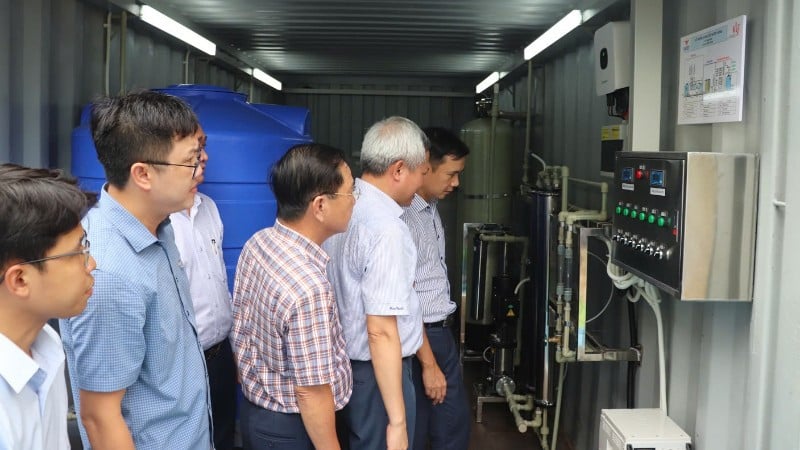
Based on that experience, scientists from KIST and VKIST have developed a small-scale, flexible system for treating saline water. The first system was deployed at Thanh Hai Primary School in Vinh Long province, with a capacity of approximately 2 m³/day, using solar energy; all equipment is housed in containers, making it convenient to move and install in areas lacking fresh water.
A key feature of the system is the addition of coagulation-sedimentation and pre-filtration steps before the water enters the RO membrane. After pumping, the saline water is fed into a coagulation-sedimentation tank to remove most of the sediment and organic compounds bound to iron and manganese, then successively passes through a manganese sand filter, activated carbon, and microfiltration column. Thanks to this effective "pre-RO" treatment, the membrane is less prone to clogging, operates more stably, extends equipment lifespan, and reduces replacement costs.
Water, after passing through the RO membrane, has most of its salts, dissolved ions, and microorganisms removed. It is then further sterilized with UV lamps before being transferred to a storage tank, providing direct supply to teachers and students for daily use and school meals. Combining solar power with grid electricity allows the system to operate flexibly, suitable for the abundant solar radiation conditions of Vinh Long and many other localities in the Mekong Delta.
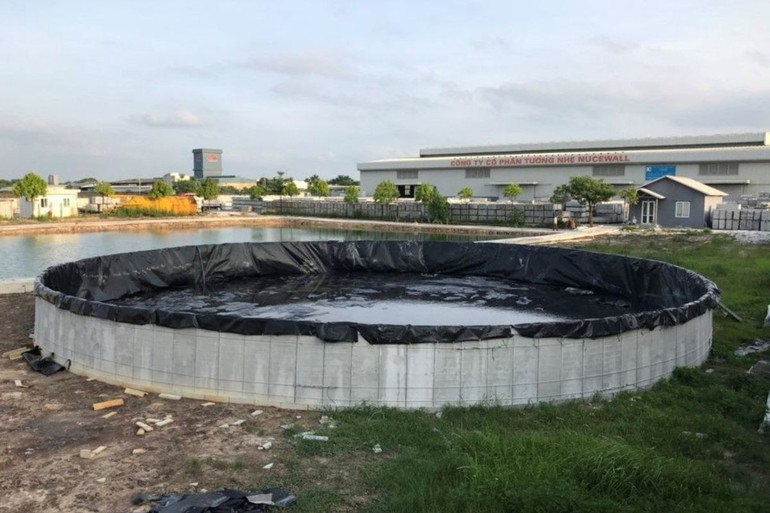
Building on the initial results in Vinh Long, VKIST continued to optimize and localize equipment, deploying a water treatment system for saline and acidic water at Tran De Ethnic Boarding Secondary School in Can Tho City. This system provides drinking water that meets standards for hundreds of teachers and boarding students. The model helps reduce the cost of purchasing bottled water while raising awareness of water conservation and safety within the school.
These small-scale desalination systems are well-suited to the dispersed nature of rural populations in the Mekong Delta, where many schools and communities are far from centralized water supply networks or frequently affected by drought and saltwater intrusion. Their advantages include flexible design to suit local conditions, utilization of existing infrastructure, and easy scalability with additional funding.
Alongside investment in centralized water supply systems, developing and replicating models for treating saline water that are suitable for local conditions, using renewable energy and environmentally friendly technologies, will contribute to the implementation of the National Strategy for Clean Water Supply and Rural Sanitation. Clean water is the foundation for safe rural areas; each system reaching a school or a cluster of coastal communities in the Mekong Delta. It's another step forward on that journey.
Source: https://nhandan.vn/nuoc-sach-vi-mot-nong-thon-xanh-ben-vung-tai-dong-bang-song-cuu-long-post930180.html















































































Comment (0)