

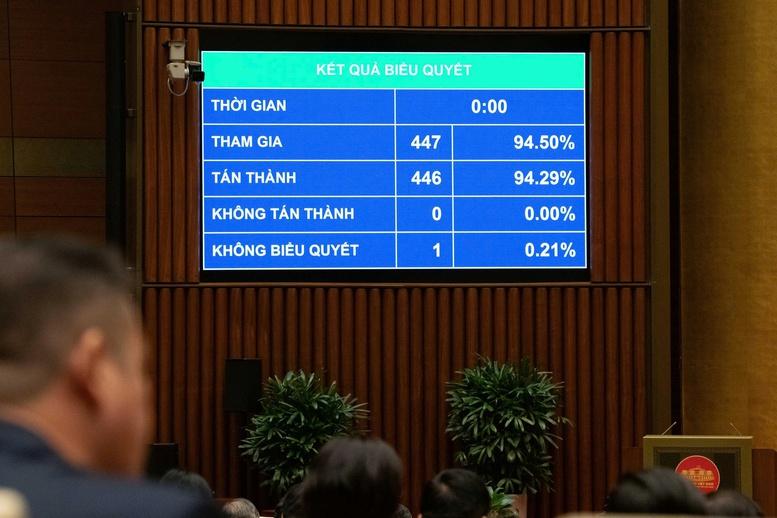
On the morning of December 10th, continuing the program of the 10th Session, under the chairmanship of Deputy Speaker of the National Assembly Tran Quang Phuong, the National Assembly voted to pass the Law on Supervisory Activities of the National Assembly and People's Councils (amended).
With 446 out of 447 delegates present voting in favor, representing 94.29% of the total National Assembly delegates, this important bill was officially passed.
We have incorporated many suggestions to improve the draft.
Before the vote, the National Assembly heard the Chairman of the National Assembly's Committee on Citizen Petitions and Supervision, Duong Thanh Binh, present the Report on the acceptance, explanation, and revision of the draft Law.
Regarding the authority and supervisory activities of the National Assembly and the Standing Committee of the National Assembly, some opinions suggest that instead of stipulating the organization of supervisory delegations for specific topics, this task should be assigned to the National Council and the Committees of the National Assembly.
However, the practical implementation of the current Law shows that the establishment of supervisory delegations organized by the National Assembly and the Standing Committee of the National Assembly has yielded many positive results, especially with major topics, broad scope, and related to many fields.
Therefore, the draft Law continues to inherit the current regulations, while adding a mechanism for flexibly assigning tasks to the Standing Committee of the National Assembly, the National Council, and the Committees of the National Assembly to organize supervision of certain thematic areas.
Clarifying the supervisory authority of the National Assembly Delegation
Some opinions suggested clarifying the term "other local agencies" to ensure consistency in implementation. According to the explanatory report, this concept is defined generally to be comprehensive and consistent with the Law on Organization of Local Government.
These agencies may include: specialized agencies under the People's Committee, public service units directly under the People's Committee, or central agencies organized vertically at the local level such as the police, tax authorities, etc.
To ensure feasibility in application, the draft Law adds a provision assigning the Standing Committee of the National Assembly to provide detailed guidance on "other local agencies" in the relevant articles.
Furthermore, to avoid overlapping in monitoring the resolution of voter petitions, the draft Law has been revised to stipulate that the National Assembly delegation only participates in monitoring, as assigned by the National Assembly Standing Committee, for petitions falling under the jurisdiction of central agencies.
Regarding the supervisory authority of the People's Council delegation, the draft Law incorporates the opinions of the majority of delegates and stipulates that: The People's Council delegation shall conduct supervision when assigned by the People's Council or the Standing Committee of the People's Council, and then report the results for consideration and decision. This is not an independent supervisory authority, thus ensuring consistency with the Law on Organization of Local Government.
Current practice shows that the scale of provincial and commune-level jurisdictions has expanded, requiring more flexibility in on-site supervision. Therefore, granting this authority to the People's Council Delegation is necessary, appropriate to reality, and does not require amendments to the Law on Organization of Local Government.
Many opinions suggested reconsidering the effective date of the Law to ensure compliance with the Law on the Promulgation of Legal Normative Documents. Taking these opinions into account, the draft Law was revised, and it was unanimously agreed to choose March 1, 2026, ensuring: compliance with current legal regulations; timely application at the beginning of the 16th National Assembly term; and ease of practical implementation.
Updated on December 10, 2025
Source: https://laichau.gov.vn/tin-tuc-su-kien/chuyen-de/tin-trong-nuoc/quoc-hoi-thong-qua-luat-hoat-dong-giam-sat-cua-quoc-hoi-va-hdnd-sua-doi-.html



















![[Video] The craft of making Dong Ho folk paintings has been inscribed by UNESCO on the List of Crafts in Need of Urgent Safeguarding.](https://vphoto.vietnam.vn/thumb/402x226/vietnam/resource/IMAGE/2025/12/10/1765350246533_tranh-dong-ho-734-jpg.webp)



















































Comment (0)