

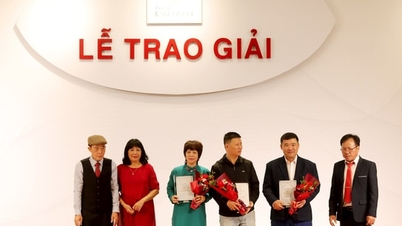
To commemorate the 70th anniversary of the Liberation of Hanoi (October 10, 1954 - October 10, 2024), Tre Publishing House is releasing the short story and diary "Luy Hoa" by writer Nguyen Huy Tuong.

"Flower Ramparts" is a film series recreating the 60 days and nights (from December 19, 1946 to February 17, 1947) during which our army and people bravely fought to defend the capital, marking the beginning of the nationwide resistance against the French. Sixty days and nights of fighting to the death for the Fatherland: 60 days and nights we see "Flowers on the Ramparts".
The story of the flower-covered rampart takes readers back to those unforgettable days, witnessing the evacuation of civilians and those who took up arms to hold their ground against the enemy. Through the transitions in scenes captured by the pen of writer Nguyen Huy Tuong, we see the streets of Hanoi again, with Hang Gai, Hang Dao, Dong Xuan Market, and encounter the people of Hanoi from all walks of life and professions. They fought, they worked, they fell in love.
In *The Flower Fortress*, there is an interplay between the fierce intensity of battle and the unique elegance of Hanoi. Amidst the gunfire and grenade explosions, as holes in the walls connect the will of the capital, there are still kisses, sticky rice cakes and peach blossoms, music and singing, and lovers. All of this is expressed through a refined yet playful, simple yet masterful writing style.
The film adaptation of "The Flower-Strewn Fortress" will help readers recall the glorious past of the country, understand and love Hanoi even more, through the eyes of someone who poured all his energy and heart into writing about the capital. Like the novel "Living Forever with the Capital," published posthumously, "The Flower-Strewn Fortress" is the result of a whole process in which Nguyen Huy Tuong devoted his efforts to the subject of Hanoi, from the beginning of 1957 until the final days of his life, the summer of 1960.
Sharing the same theme of the struggle to defend the capital and the same inspiration about the land and people of Hanoi, the two works complement and support each other to become an organically connected whole.
In particular, the film script for "The Flower Fortress" is not only considered a viable framework for the unfinished novel, but also possesses sufficient literary qualities to exist as a literary work with its own unique style. Nguyen Huy Tuong's diary meticulously records the writing process of these two works.

Notably, the book also includes photographs of manuscript pages of *Luy Hoa*, a first edition cover illustration by Van Cao, and the diary of writer Nguyen Huy Tuong recording the creative process of *Luy Hoa* and *Song Mai Voi Thu Do*.
In the book's preface, Professor Phong Le argues that in the final stages of his life, Nguyen Huy Tuong almost entirely devoted his energy and heart to the theme of the resistance of the people and soldiers of the capital, to a Hanoi that was always firmly rooted in his mind throughout his artistic journey, from historical stories and plays written before 1945, such as Vu Nhu To, Long Tri Night Festival... to the play "Those Who Remain," which depicts the people of Hanoi who lived at the beginning of the resistance against the French...
And only now can he look back at Hanoi in a way that is both clear thanks to a passage of time, and yet tinged with the mist of nostalgia and history.
“If 'Living Forever with the Capital' pauses at the first three days and nights of the war, then 'The Flower Fortress' allows us to witness the war unfolding over 60 days and nights, until the Capital Regiment withdrew from Hanoi to join the entire nation in the protracted resistance war, as called for by President Ho Chi Minh; along with a poignant, romantic finale seven years later when the victorious army returned to the old streets...”
"This means that Luy Hoa was tasked with completing the rest of 'Living Forever with the Capital'—a novel that, if Nguyen Huy Tuong had completed it entirely, would have been the largest-scale work of modern Vietnamese prose up to the day the writer passed away," Professor Phong Le wrote.
Source


![[Image] Vietnam's colorful journey of innovation](/_next/image?url=https%3A%2F%2Fvphoto.vietnam.vn%2Fthumb%2F1200x675%2Fvietnam%2Fresource%2FIMAGE%2F2025%2F12%2F14%2F1765703036409_image-1.jpeg&w=3840&q=75)














































![[Image] Vietnam's colorful journey of innovation](https://vphoto.vietnam.vn/thumb/402x226/vietnam/resource/IMAGE/2025/12/14/1765703036409_image-1.jpeg)




















Comment (0)