

Avoid awkward situations
Tran Y Dieu, a student at Hanoi Medical University, shared that compared to students in other majors, studying medicine is much harder. In the first two years, students are immersed in studying theory with a huge amount of knowledge, taking one exam each month. From the third year, students have to study theory at school and practice at medical facilities, so they do not have time to care about part-time jobs or other things. Practicing at the hospital, students must ensure working hours and on-duty hours like a real doctor.
Having won a national prize in Biology, Diu said that he had no difficulty learning the theory thanks to his basic knowledge from high school and being used to the high intensity of studying when he was in the national competition team. However, there were also difficult subjects that Diu could not keep up with. “The entrance requirements for the medical field are the highest at universities that train health professionals, but there are still some students who do not meet the requirements of the program and are forced to leave the game,” Diu said.
According to statistics from the Ministry of Health , with the current scale of training of doctors, nurses, and pharmacists at higher education institutions, the target for 2025 of 15 doctors per 10,000 people, 3.4 pharmacists per 10,000 people, and 25 nurses per 10,000 people has been basically achieved. The number of medical staff per 10,000 people in Vietnam is ranked among the countries with high rates, increasing from 29.2 in 2001 to 35.1 in 2010 and 49.5 in 2020. Over 98% of villages have active medical staff; nearly 88% of communes have doctors. Statistics also show that in the health sector, there are over 400 professors, associate professors, 1,977 medical doctors, and 273 pharmaceutical doctors. In addition, there are a significant number of specialist doctors, specialist doctors, and resident doctors. To date, there are 29 higher education institutions participating in training at the specialist level (level I, level II, and resident doctors) with 128 training majors. The number of postgraduate graduates reported by the Ministry of Health in 2023 is a total of 10,135 people, of which about 50% are level I specialists. Thus, the medical human resources have basically met the quantity requirements.
Dr. Le Dong Phuong, former Director of the Center for Higher Education Research, Vietnam Institute of Educational Sciences ( Ministry of Education and Training ), expressed concern that recently a number of universities, especially private ones, have massively opened more health science majors, mainly training general practitioners. He said that the National Assembly's discussion of the issue of "only medical schools are allowed to train doctors" is reasonable in the practical context. Many medical training institutions do not have practice hospitals, the conditions are not sufficient, and there is a lack of facilities and teaching staff. Many people's concerns about the quality of training human resources in the health sector are well-founded.
According to Dr. Le Dong Phuong, the nature of the industry requires training institutions to ensure the highest quality of training, just lowering the standards will have unpredictable consequences. However, he believes that it is necessary to clearly define the concept of "what is a medical school". Medical training currently exists in two types of schools: independent medical schools like the traditional model have a great advantage in expertise when focusing on training in health sciences; multidisciplinary universities, mainly private schools. In the current context, digital technology, 4.0 technology, artificial intelligence, medical training in multidisciplinary schools will have more benefits to absorb scientific and technical advances. It is necessary to consider and calculate these conditions.
Dr. Le Dong Phuong proposed that there should be clear and detailed training program standards for health sciences, most importantly, it is mandatory to have a practice hospital. If there is not one, there must be an exclusive cooperation contract with a qualified medical examination and treatment facility according to Government regulations, to avoid the current situation of 1 hospital being signed by 6-7 training units. “Not only the medical sector, but also the pharmaceutical sector, before granting a training license, needs to be carefully and thoroughly inspected and assessed, to avoid the situation of a fait accompli, where the lack of first makes up for later, which is currently happening. The Ministry of Health and the Ministry of Justice must work with the Ministry of Education and Training to examine and allow training in these two fields, as well as the subsequent accreditation process. “Avoid situations where chemical experts are accredited in the law sector, and math experts are accredited in the medical sector, as is happening now,” said Dr. Le Dong Phuong.
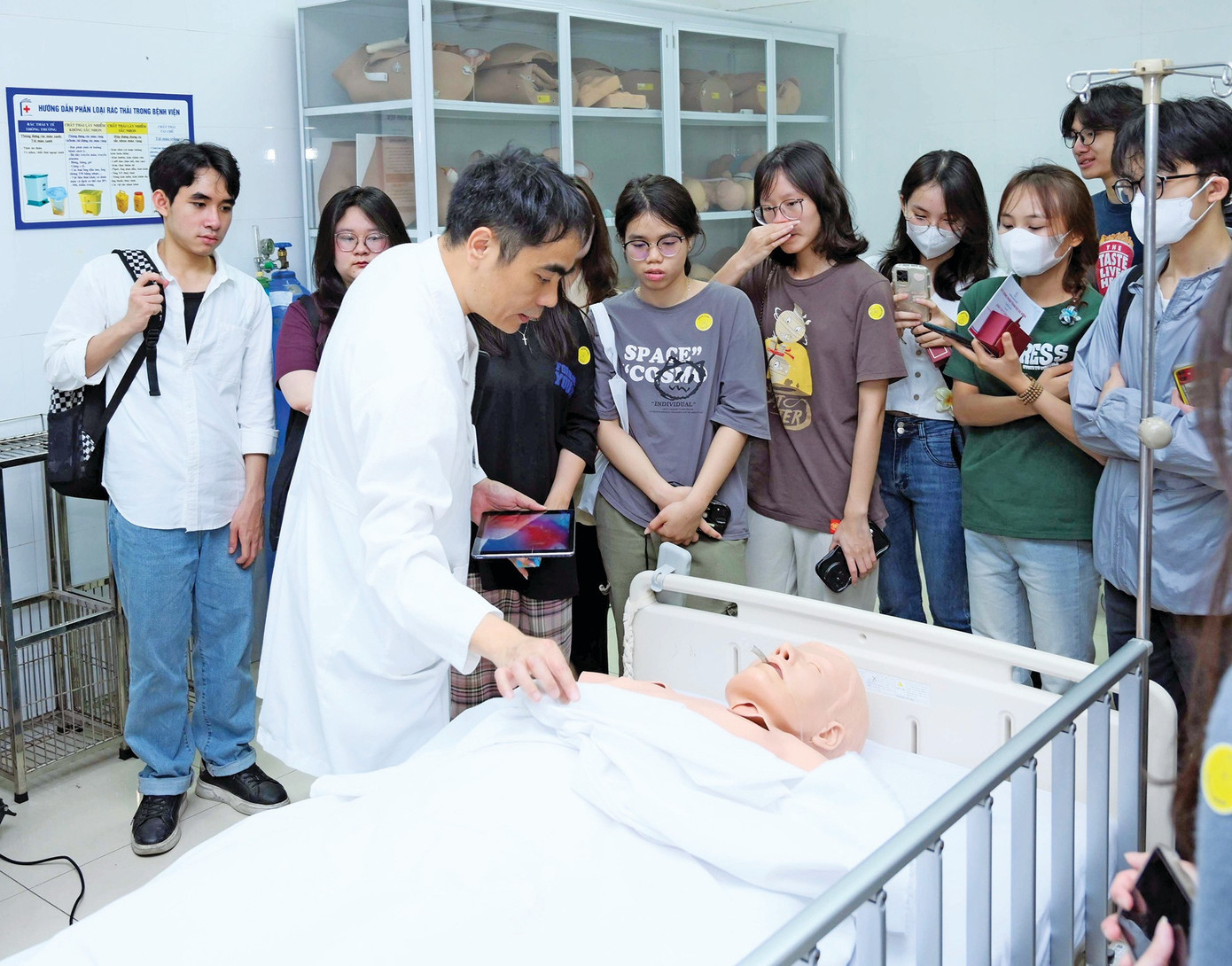
The abnormality of the "fever" of opening new industries
Prof. Dr. Nguyen Dinh Duc, University of Technology (Hanoi National University) shared that strictness and rigor in training in medicine and law are extremely necessary. These are two very specific fields, requiring staff not only to have qualifications, but also experience and practice certificates. Countries around the world also have very high and strict requirements for these two fields.
Professor Dinh Duc informed that in 2012, when he was Head of the Training Department of Hanoi National University, there were 3 places in the country that trained law: the Faculty of Law (Hanoi National University), Hanoi Law University and Ho Chi Minh City Law University. In 2017, in a conference on law in the context of the 4.0 industrial revolution, he was startled to see that 34 schools had trained law, and now this number is 90. The picture is quite similar to the medical industry while the number of hospitals that ensure practice conditions has not increased significantly. In fact, some schools train medicine but the staff and facilities are too thin, leading to the training quality of these fields not being as expected. Therefore, tightening management, even merging, dissolving, and re-planning medical and law training facilities to improve quality is necessary and very correct.

Regarding time, the doctor is the first position to apply competency assessment test from January 1, 2027. The positions of physician, nurse, midwife will be tested and assessed from January 1, 2028. The positions of medical technician, clinical nutritionist, emergency room attendant and clinical psychologist will be tested from January 1, 2029. With the new regulations of the Law on Medical Examination and Treatment, a university degree is only a necessary condition, not a sufficient condition. Tightening the output with the national exam will be a safe barrier to protect people's health, regardless of the difference in the entrance scores of medical schools. The Ministry of Health has announced the list of 37 members of the National Medical Council, including one chairman, three vice chairmen and 33 members.
From January 1, 2027, according to the Law on Medical Examination and Treatment, graduating doctors must pass the National Medical Council exam to be licensed to practice. Those taking the medical examination and treatment competency assessment must meet the following conditions: Have a diploma appropriate to each professional title and have completed medical examination and treatment practice according to the provisions of this law.
However, the fact that only medical schools can train doctors and only law schools can train law needs to be understood thoroughly and comprehensively, the guiding principle and prerequisite is quality. “It is not easy for us to have a university right away. The roadmap usually starts from the faculty, building and developing step by step to become a university. This process can take up to 15 years or several decades. For example, the University of Medicine and Pharmacy (Hanoi National University) started from the Faculty of Medicine and Pharmacy, after 10 years of persistent development it became a university. Moreover, Hanoi National University has an a+b model, medical and pharmaceutical students in the first years will study math, chemistry, biology at the University of Natural Sciences, with leading professors and modern equipment in these fields, during that process practice in hospitals, and the last 2 years of specialization will train in medicine at the faculty. Such a model promotes the strengths of the team and facilities, equipment, and modern laboratories of the schools in Hanoi National University. “Medical and legal training needs to be tight and strict, but it is also necessary to understand and pay attention to such factors and practices,” Professor Nguyen Dinh Duc stated his opinion. He affirmed It is necessary to closely and regularly monitor and inspect quality assurance factors, especially staff, facilities, practice rooms, clinical laboratories and internship facilities (for the medical industry) and be transparent so that learners, society and management agencies can monitor and also put pressure on training facilities in these industries to continuously improve and enhance quality.
Source: https://tienphong.vn/siet-chat-luong-dao-tao-nganh-y-dung-tha-ga-ra-duoi-post1800783.tpo

![[Photo] Cat Ba - Green island paradise](/_next/image?url=https%3A%2F%2Fvphoto.vietnam.vn%2Fthumb%2F1200x675%2Fvietnam%2Fresource%2FIMAGE%2F2025%2F12%2F04%2F1764821844074_ndo_br_1-dcbthienduongxanh638-jpg.webp&w=3840&q=75)











































![[VIMC 40 days of lightning speed] Da Nang Port: Unity - Lightning speed - Breakthrough to the finish line](https://vphoto.vietnam.vn/thumb/402x226/vietnam/resource/IMAGE/2025/12/04/1764833540882_cdn_4-12-25.jpeg)














































Comment (0)