

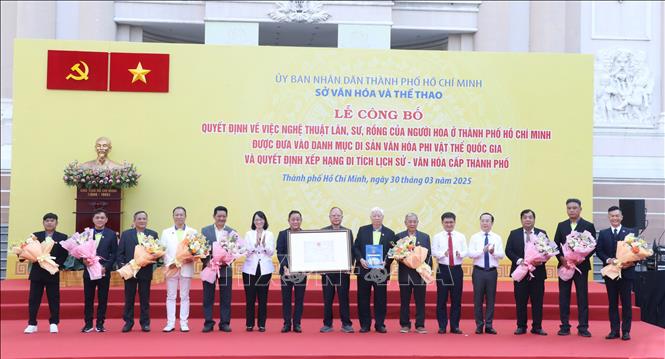
The leaders of Ho Chi Minh City presented a certificate recognizing the Lion and Dragon Dance art form in the city as a National Intangible Cultural Heritage to a representative of the Lion and Dragon Dance Federation.
Long associated with the Chinese community in Ho Chi Minh City, the Lion and Dragon Dance art not only holds cultural value but also embodies the spirit of unity and community cohesion. Recognizing it as a heritage contributes to the preservation and promotion of this beautiful tradition within the city's diverse cultural life.
According to information from the Ho Chi Minh City Department of Culture and Sports , there are 63 lion dance troupes operating in the city, ranging in size from small to large. Although the art of lion dance has a history of hundreds of years of formation and development on a large scale, it was only in recent years that an official organization representing this art form was established. In 2021, the Ho Chi Minh City Lion Dance Federation was founded.
Mr. Lu Chan Loi, Chairman of the Ho Chi Minh City Lion and Dragon Dance Federation, said that since its establishment, the Federation has been a gathering place for lion dance troupes in the Chinese community. To introduce and preserve this art form, the Federation conducts research and documentation on the history, origins, performance skills, costumes, props, and cultural elements related to Lion and Dragon Dance, while also recording, photographing, and archiving relevant materials.
Mr. Lu Chan Loi expressed his hope that in the future, the Federation will continue to receive the support and cooperation from Ho Chi Minh City to effectively promote the Lion and Dragon Dance art form, so that it can develop into an indispensable spiritual activity for the public.
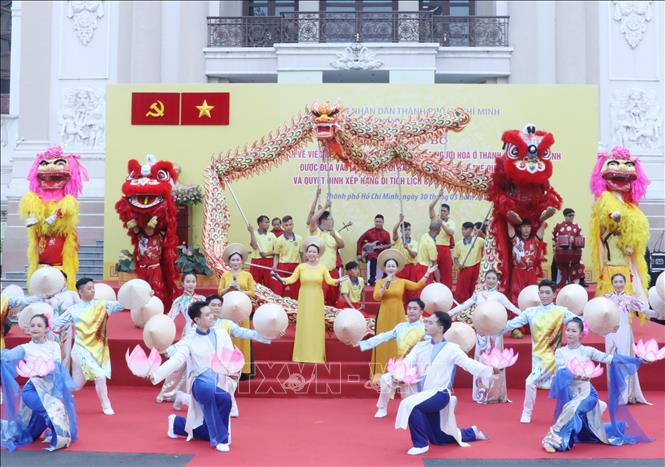
The ceremony opened with a cultural performance combining singing and dancing, including lion and dragon dances.
Speaking at the ceremony, Mr. Luong Tan Hang, Head of the Hang Anh Duong Lion Dance Troupe, said that this is a source of pride not only for those involved in Lion Dance but also for the entire community. This recognition helps the younger generation to be aware of preserving and promoting this art form; and at the same time affirms the value of those who have been involved with Lion Dance from the past to the present.
Hang Anh Duong is a lion dance troupe that has performed and competed in countries such as Japan, China, Malaysia, and the Philippines. Notably, since 2015, the troupe has expanded strongly nationwide, contributing to bringing Vietnamese lion dance art to the same level as international counterparts.
To date, Ho Chi Minh City has four national intangible cultural heritage sites: the Nghinh Ong Festival in Can Gio, the Lantern Festival of the Chinese community in District 5, the Khai Ha Festival - Prayer for Peace at the Mausoleum of General Le Van Duyet, and the Lion and Dragon Dance art of the Chinese community in Ho Chi Minh City.
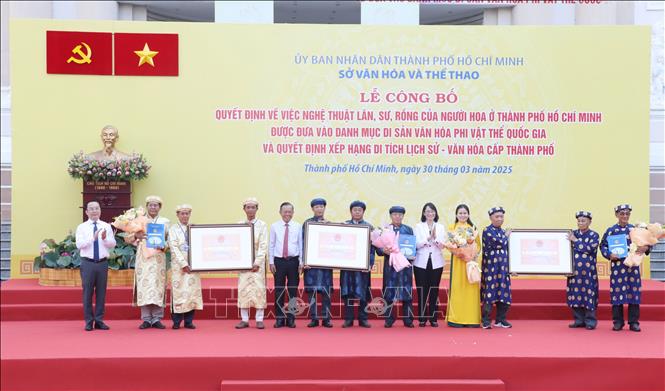
Ho Chi Minh City leaders presented certificates recognizing historical and cultural relics as city-level ranked sites to various units.
At the ceremony, Ho Chi Minh City announced the addition of 7 more historical and cultural relics to the city-level ranking. Among them, 3 historical relics are village communal houses in Thu Duc City, namely: An Khanh Communal House, Long Binh Communal House, and Long Hoa Communal House. These relics not only showcase the distinctive architectural style of Southern Vietnamese village communal houses but are also sites associated with the national liberation struggle and reunification of the country.
Four architectural and artistic landmarks showcase the cultural exchange between Vietnam and India, and between Eastern and Western architecture. The historical and cultural values in these structures reflect the level of development in the past, and remain valuable to this day: Tan Dinh Market, Mariamman Temple, Trung Vuong High School (District 1); and Saigon University (District 5).
According to Mr. Nguyen Minh Nhut, Deputy Director of the Ho Chi Minh City Department of Culture and Sports, the newly recognized historical and cultural sites have increased the number of sites to 200. These sites are of significant importance in preserving historical and traditional values, helping younger generations better understand the struggles, construction, and development of Ho Chi Minh City; contributing to fostering national pride, patriotism, and a sense of responsibility among citizens in building and developing a more prosperous and civilized city.
According to VNA
Source: https://bvhttdl.gov.vn/tp-ho-chi-minh-gop-phan-dua-nghe-thuat-lan-su-rong-viet-nam-sanh-vai-voi-ban-be-quoc-te-20250331101435147.htm

![[Photo] Closing Ceremony of the 10th Session of the 15th National Assembly](/_next/image?url=https%3A%2F%2Fvphoto.vietnam.vn%2Fthumb%2F1200x675%2Fvietnam%2Fresource%2FIMAGE%2F2025%2F12%2F11%2F1765448959967_image-1437-jpg.webp&w=3840&q=75)
![[Photo] Prime Minister Pham Minh Chinh holds a phone call with the CEO of Russia's Rosatom Corporation.](/_next/image?url=https%3A%2F%2Fvphoto.vietnam.vn%2Fthumb%2F1200x675%2Fvietnam%2Fresource%2FIMAGE%2F2025%2F12%2F11%2F1765464552365_dsc-5295-jpg.webp&w=3840&q=75)



































![[OFFICIAL] MISA GROUP ANNOUNCES ITS PIONEERING BRAND POSITIONING IN BUILDING AGENTIC AI FOR BUSINESSES, HOUSEHOLDS, AND THE GOVERNMENT](https://vphoto.vietnam.vn/thumb/402x226/vietnam/resource/IMAGE/2025/12/11/1765444754256_agentic-ai_postfb-scaled.png)






































Comment (0)