

Ho Chi Minh City - Colorful and diverse Tet feasts, meticulously prepared, are recreated at the Vietnamese Tet Festival in Le Van Tam Park.


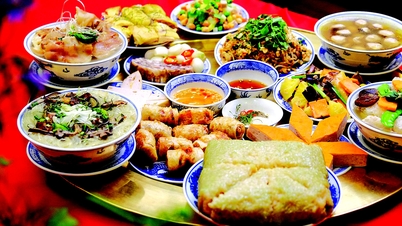
The Tet feast trays are constantly changing throughout the festival. This is a picture of a traditional Central Vietnamese Tet feast tray consisting of 21 dishes, prepared by culinary artist Nguyen Ho Thi Anh, with artisan Ho Dac Thieu Anh as advisor. Ms. Thieu Anh shared that the artisans from Hue want to bring traditional flavors to the festival so that visitors, especially the younger generation, can imagine how sophisticated and elaborate the traditional Central Vietnamese Tet feast trays were in the past.
"The Year of the Dragon feast is highlighted by dishes shaped like the four mythical creatures: Dragon,麒麟 (Kirin), Turtle, and Phoenix, symbolizing peace and prosperity. These four dishes are golden turtle rice shaped like a turtle, unicorn salad fit for a king, five-colored phoenix patties, and fig and dragon fruit salad," said Ms. Thieu Anh.
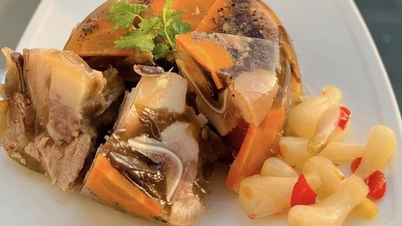
In addition, the feast also includes elaborately prepared dishes characteristic of Central Vietnam such as shrimp spring rolls, beef with pickled onions, pork head cheese with plum blossoms, or sticky rice with braised pork.

The Central Vietnamese culinary space is also attractive because of the display of Buddha's hand fruit jam and flower-colored jam. The Buddha's hand fruit jam is special because it is made by simmering the whole fruit, a process that takes half a month to complete. Artisan Thieu Anh said that to make whole Buddha's hand fruit jam, the fruit must be soaked in salt water for at least a week to remove the bitterness from the peel. Then, it is peeled, boiled, soaked in sugar, sun-dried during the day and dew-dried at night, and simmered whole until the Buddha's hand fruit becomes translucent to meet the standard.

The Tet cuisine of Central Vietnam also attracts visitors to linger and experience it thanks to the fragrant aroma of banh thuan (a type of traditional Vietnamese cake). Artisans make these cakes at the festival and serve them to visitors free of charge.
Ms. Nhi Nguyen, from Binh Dinh, shared that upon arriving at the festival, she immediately went to the area recreating Tet celebrations of the past. The traditional rice cakes at the festival reminded her of the days leading up to Tet when she returned home to help her mother make and sell cakes at the market.
"Every year my family makes banh thuan (a type of Vietnamese rice cake), its aroma is so familiar to me. It's a specialty of Binh Dinh and many other central provinces. This cake has simple ingredients like tapioca flour and chicken eggs, but the important thing is to control the heat so that both sides of the cake puff up evenly without burning," said Ms. Ly.

The Southern Vietnamese Tet feast, named "Saigon Connects," consists of 16 signature dishes from the ethnic groups living in the South, such as the Chinese "lucky cake," the Cham people's specialty beef sausage, and Vietnamese dishes. Chef Doan Thi Huong Giang, culinary advisor for the Southern Vietnamese Tet feast, said that the feast will change according to the theme during the four days of the festival. The first day is the "Connecting Meal," the second day is the "Pioneering" feast, returning to the early days of Saigon, with mainly boiled dishes. The third day is the "Modern Saigon" feast with dishes combining the cultures of many countries, and the last day is a vegetarian feast.

The Western Vietnam food stall also features a traditional cake counter. Visitors can sample various specialty cakes from the Mekong Delta. A colorful and attractively arranged platter of cakes includes steamed rice cakes, palm sugar steamed rice cakes, pork skin cakes, and banana cakes.

Food stalls also dominated the festival. Unlike some recent festivals, the Vietnamese Tet Festival focused on interaction with visitors. Chef Le Minh Canh's clay pot noodle-making stall offered visitors a space to experience making noodles by hand.

Another area for experiencing Tet culture is the banh chung (traditional Vietnamese rice cake) making booth. After being wrapped, the cakes are boiled in a large pot over a nearby wood-fired stove. This is the traditional banh chung of Phu Tho province, traditionally said to have been offered to King Hung in the past. The glutinous rice selected for making the cakes must be either "nếp cái hoa vàng" or "nếp nhung," creating a distinctive aroma. The banh chung contains no additives or preservatives.


The stall serving Southern Vietnamese cuisine stands out thanks to its Western-style vermicelli with fermented fish sauce. Even from 15-20 meters away, you can clearly smell the distinctive aroma of the fish sauce. The soul of this dish is the fermented fish sauce made from snakehead fish or catfish, garnished with yellow Sesbania grandiflora flowers – a common ingredient in hot pot and broth dishes in the Western region. Toppings include seafood and meat. Some people enjoy the fragrant aroma of the fish sauce, while others find the smell unpleasant.

Diners can enjoy Northern Vietnamese flavors at the festival with bun cha nem cua be (vermicelli with grilled pork and crab spring rolls). The crab spring rolls are made with crab caught from the waters of Hai Phong. Unlike regular spring rolls which are typically cylindrical and elongated, crab spring rolls are wrapped in a square shape. Portions at the festival are packaged for takeout, with each portion costing between 40,000 and 50,000 VND.































































Comment (0)