

The HERA drone, developed by a team of Vietnamese engineers, is seeking to export to one of the world's most demanding markets: the United States.
The headquarters of Real-Time Robotics Vietnam (RtR), a company designing and manufacturing unmanned aerial vehicles (UAVs), is a single-story house with a floor lower than the street level, tucked away in a cul-de-sac in Thu Duc City (Ho Chi Minh City). Inside, engineers are busy checking two HERA drones before packaging them for export to a customer in the power sector in the United States.
Every square meter in this rented house, costing 30 million VND per month, is utilized to the maximum, providing enough workspace for the design, mechanical, electronics, and artificial intelligence departments. They don't have private rooms; instead, they share a common space, separated by PVC plastic curtains, similar to those found in manufacturing workshops, for convenience when moving aircraft in and out of the research and development areas.
“The HERA patent is registered under a Vietnamese name. Inventing and mastering core technologies is the only way for Vietnam to transition from a developing to a developed country,” Luong Viet Quoc, 58, founder and CEO of RtR, told Forbes Vietnam about his hope of putting Vietnam “on the world map for drone manufacturing.”
HERA is currently the result of many versions developed over more than a year by RtR and launched in late 2022. Weighing only 9kg, HERA can lift a payload of 15kg, has a 360-degree field of view per payload, a flight time of 56 minutes, and a maximum radius of 15km. HERA is proving to be a good fit for potential customers.
In an email exchange with Forbes Vietnam , JT VonLunen, president of RMUS, a company specializing in providing drone services to government agencies, corporations, and universities in North America, commented: “RtR has developed a truly unique drone. It has incredible lift, long flight times, and is very compact. It’s very difficult to design a drone with all these features.”
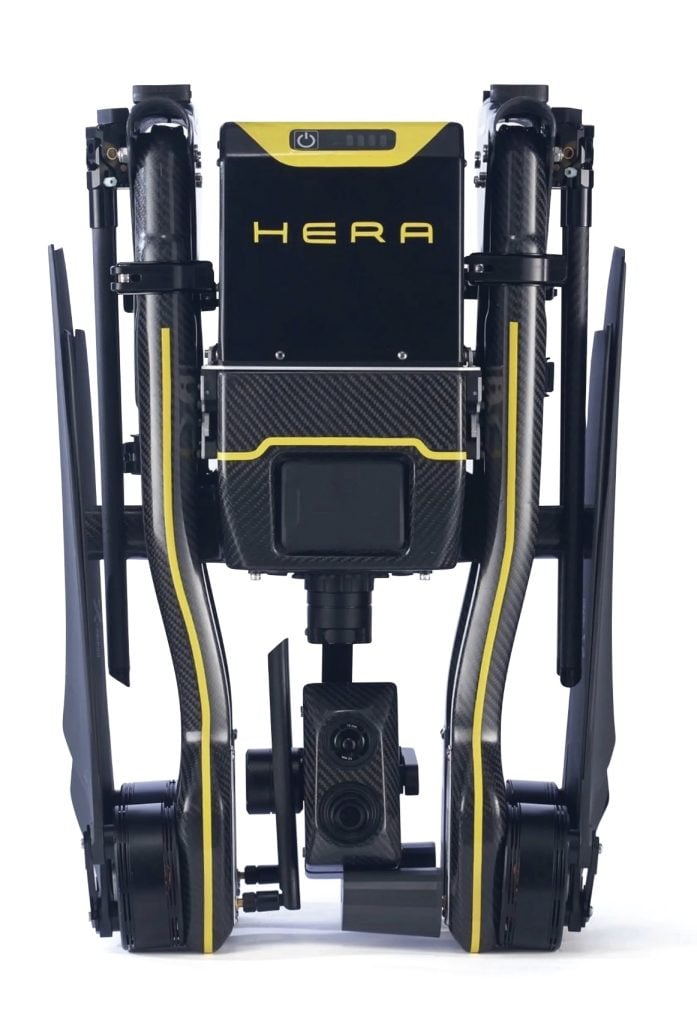
After nearly nine years in the UAV field, RtR has just exported its first HERA drones to the United States. The entire research, development, design, and manufacturing process takes place in Vietnam. HERA differs from similar products in five key ways: compact size that fits in a backpack; a lifting capacity of up to 15kg; ample space and the ability to attach four different payloads; and an intelligent "brain" with artificial intelligence algorithms that allows for versatile operation and customization for various fields.
Going back 10 years, while still in the United States, recognizing the potential of UAVs, Mr. Luong Viet Quoc began venturing into this field by becoming a UAV service provider, similar to what large companies like Flyability, Aerodyne, Drone Base, etc., had done. He opened a company in the United States and imported drones to Vietnam, providing services such as pest and disease inspection in fields, and infrastructure monitoring at solar power and high-voltage power line projects.
But the results didn't meet expectations because "the advertised product was a 10, but its features were only a 2-3." He and his team in Vietnam disassembled the device, modifying everything from the camera to the battery to increase the range, duration, and image clarity of the drone.
In 2017, Mr. Quoc came up with the idea of designing and manufacturing it after accumulating some knowledge and experience during his three years of apprenticeship.
RtR was founded and began shifting to UAV production, a business segment dominated by large companies like DJI, Parrot, and Autel Robotics. The RtR team started researching, conducting trial production, and then taking prototypes to trade fairs in various countries.
Their initial success came with the VIAN prototype, released in 2018, which could "diagnose the health" of plants and serve the rescue and relief efforts in Vietnam. However, this prototype has only attracted media attention and has not yet been commercially exploited. The first version only had a single camera and was not significantly different from other products on the market.
"I didn't feel the company's vision in their previous product designs," said Phi Duy Quang, a mechatronics engineer at Saigon Technology University, referring to the VIAN model and his decision to leave the company at that time.
In 2017, RtR faced a difficult period as key personnel left, some shareholders withdrew their capital, and the product wasn't outstanding. At the age of 52, Mr. Quoc was faced with the decision of whether to give up or continue his entrepreneurial journey. He chose to continue and met with Phi Duy Quang, currently the chief mechanical engineer at RtR, to find solutions for a new product that required better load capacity, a more compact design, and greater versatility. Together, they brainstormed the initial design concept for HERA.
Quang recalled, “On the way home from a cafe in District 9 to District 8, I came up with an idea. I stopped at a cafe to think it over, then went home, sketched out a draft, and sent it to Quoc. He replied with just one word: ‘Excellent.’” In early 2021, Quang officially returned to work at RtR.
To date, RtR has exported 15 HERA units (four to the EU and 11 to the US). Having started working with Mr. Quoc in early 2022, RMUS ordered several units for testing by customers in the US electrical sector and expects, “one day, HERA will account for nearly half of our sales.”
The starting price for each HERA unit is approximately US$40,000 (over 900 million VND), and RMUS sells them starting at US$58,000 (approximately 1.3 billion VND). To be used in US projects, HERA meets the standards of the National Defense Authorization Act (NDAA), particularly regarding the use of chips, microchips, and data security.
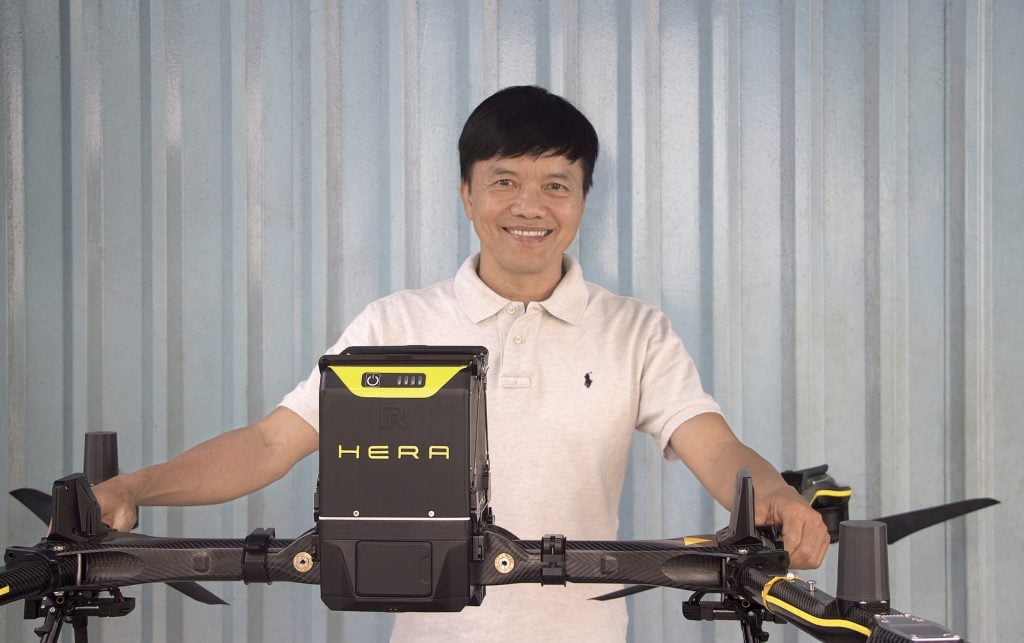
Mr. Luong Viet Quoc, founder and CEO of RtR, the company that invented the HERA drone (Photo: Ta Hong Phuc).
Besides RMUS, Mr. Quoc is also working with Idan Tessler, a former military pilot who runs Prof-Worx, a drone service provider in the Netherlands. After watching a promotional video, Idan came to Vietnam in February 2023 to learn more. Following the trip, Idan assisted RtR in testing HERA in the Netherlands. He assessed HERA as having reasonable production costs and superior engineering and design compared to its competitors in almost every aspect.
Born in Ho Chi Minh City, Quoc's family circumstances forced him to earn a living by collecting scrap metal along the Nhieu Loc canal from the age of 10. Following his grandmother's advice, he didn't drop out of school, dreaming of finding a job just to avoid hunger. Although he passed the university entrance exam, his family's financial situation only allowed him to attend a vocational program in finance at the University of Finance and Accounting (now merged with the University of Economics Ho Chi Minh City).
Mr. Quoc then tried to continue his education at the undergraduate level, improving his English and earning a Fulbright scholarship for a master's degree at Cornell University in 2002. After graduating with an excellent thesis, he chose to pursue a Ph.D. in economics at UC Berkeley. For over 10 years in the United States, he worked as an economist at consulting firms before starting his own business in the drone industry.
Having received his master's scholarship at the age of 37, Mr. Quoc believes that learning knows no age or geographical limits. His doctoral program instilled in him the habit of "deep thinking, always asking: Is what I've heard really true and logical?" He admits that he always views problems from a user's perspective, not a technical one; meaning he identifies user needs and considers which technologies can solve them.
In drone design, the challenge is balancing lift and size. RtR found a solution to this problem after nearly 10 years of struggle. The HERA frame is made of high-strength carbon fiber, and the landing gear automatically folds away during takeoff, not obstructing the camera's view.
HERA has enough space for four cameras with different features, and the entire electronic circuit board system inside the aircraft, as well as the control software, were built by the RtR engineering team. The team created algorithms that help HERA identify objects to be photographed and automatically capture images.
“The challenge lies not only in exploring and learning more, but also in not letting existing knowledge hinder us from finding new directions,” Mr. Quoc said, proudly speaking of the team of 50 young engineers, mostly under 30, from universities such as the Ho Chi Minh City University of Technology and the Ho Chi Minh City University of Education, who are passionate about conquering new fields, possess the knowledge, and believe in the vision of exporting drones from Vietnam.
According to Drone Industry Insights (DRONEII), the global drone market is projected to grow from US$30.6 billion in 2022 to nearly US$56 billion by 2030. DJI (China) is currently the world's largest drone manufacturer, holding over 70% of the civilian drone market.
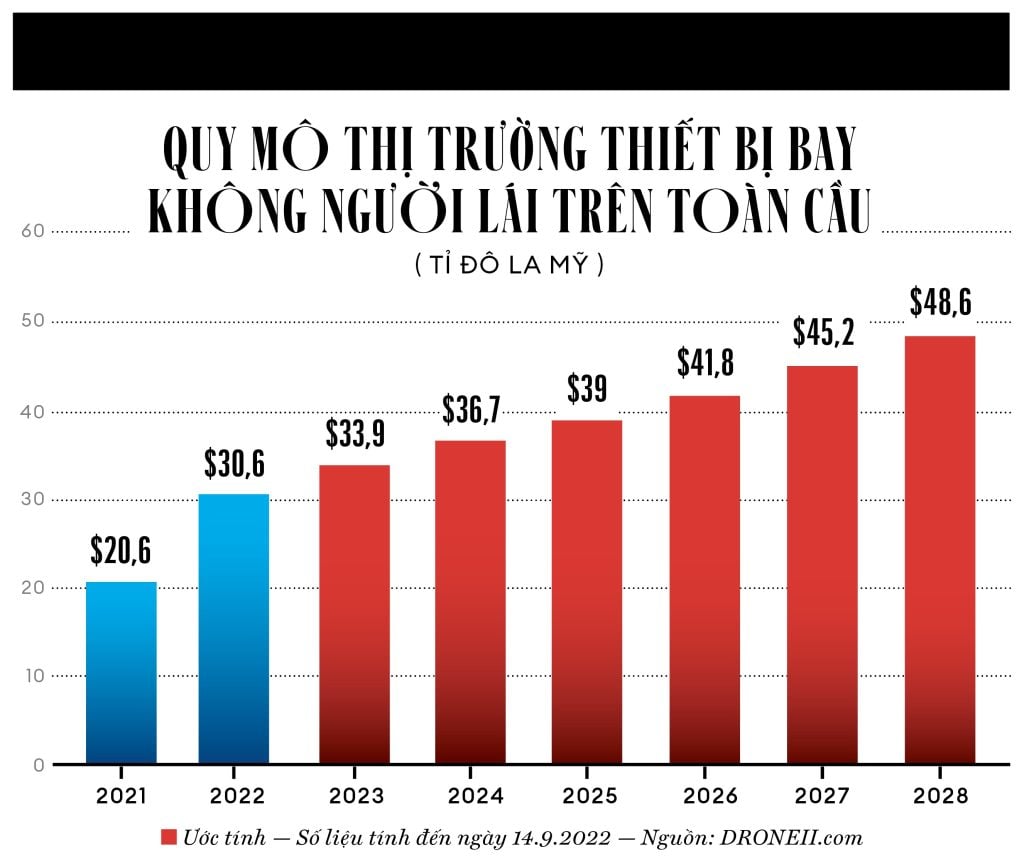
Drones are used for a wide range of purposes, from filmmaking and seed planting to construction monitoring, environmental surveillance, and rescue operations. However, businesses are facing numerous challenges, from legal hurdles related to cybersecurity, airspace safety, reliability, efficiency, and data.
The fledgling startup RtR will have to overcome the aforementioned obstacles if it wants to mass-produce. "Now we have to solve the problem of building a system with a production process that maximizes quantity in the shortest time and maintains consistent quality," said Phi Duy Quang.
Meanwhile, Idan Tessler assessed the challenge facing RtR as helping the market better understand the product, "making Western countries understand that excellent engineering and high-quality technology are being developed and manufactured in Vietnam."
The commercialization process for HERA has only just begun, with modest sales of around one million US dollars. RtR has set an ambitious goal of selling one thousand HERA products by the end of 2023 and doubling that number by 2024.
RtR's plan to build a 9,000m² manufacturing plant, including a research and manufacturing facility, in the Ho Chi Minh City High-Tech Park, with a total investment of US$13.5 million, is still in the design and construction permit application phase. They are currently raising capital to expand research and production. RtR has found a way to balance the delicate balance between aircraft size and payload capacity and immediately filed a patent.
In October 2021, RtR filed a patent application for HERA and is awaiting the results (this waiting period typically takes about 1.5 years for approval). They have also filed patent applications for five other inventions. “We must rely on invention to maintain our competitive edge and create value, not just compete by luck on a single invention,” the founder of RtR shared about their strategy for maintaining a rapid pace of innovation.
Forbes.vn
Source![[Photo] Prime Minister Pham Minh Chinh holds a phone call with the CEO of Russia's Rosatom Corporation.](/_next/image?url=https%3A%2F%2Fvphoto.vietnam.vn%2Fthumb%2F1200x675%2Fvietnam%2Fresource%2FIMAGE%2F2025%2F12%2F11%2F1765464552365_dsc-5295-jpg.webp&w=3840&q=75)































































Comment (0)