

Turkish President Recep Tayyip Erdogan confirmed that he will meet his Russian counterpart Putin at the BRICS+ summit later this month, following a recent phone call between the two leaders.
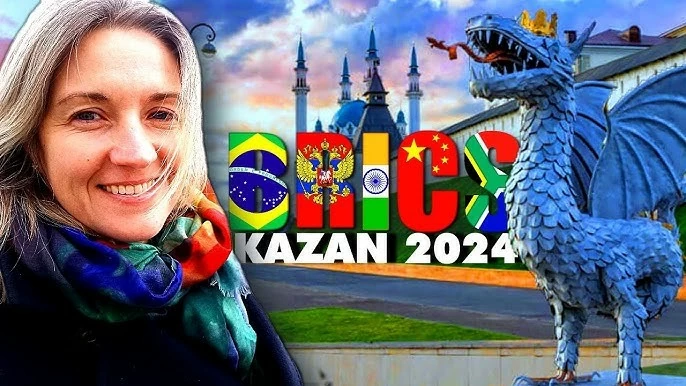 |
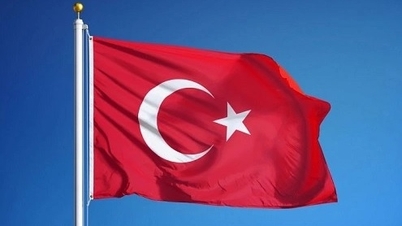
| NATO members congratulate Putin on his birthday, confirm attendance at the BRICS+ summit in Russia, bringing the goal of joining very close? (Source: YouTube) |
The BRICS summit, a meeting of the leading emerging economies , is scheduled to take place in Kazan, Tatarstan, in the Russian Federation, from October 22-24. The Kremlin hopes the summit will provide further strategic discussions, offering opportunities to expand influence and build closer economic alliances.
Türkiye's strategic move
Last month, reports and media outlets indicated that Türkiye, a member of the North Atlantic Treaty Organization (NATO), had officially submitted its application to join BRICS. The spokesperson for the Turkish President, Omer Celik, confirmed this information, adding that the application process is ongoing and will be considered and discussed at the BRICS+ Summit this October.
According to a statement shared on the social media account of the Turkish Presidential Communications Office, Erdoğan and Russian President Putin had a telephone conversation on October 7th. The statement revealed that bilateral relations, as well as regional and global issues, were discussed during the call.
"During the conversation, President Erdoğan expressed satisfaction with the strengthening and development of Turkish-Russian relations, emphasized the continuation of high-level political dialogue, and stated that they will continue to thoroughly address various regional and global issues in the coming period," the statement read.
The statement from the Turkish Presidential Press Office also mentioned that the country's leader had congratulated Putin on his 72nd birthday (October 7).
At the same time, the Kremlin also issued a statement regarding the conversation between the two Russian-Turkish leaders. The Kremlin confirmed that Mr. Erdoğan and Mr. Putin will have face-to-face meetings on the sidelines of the BRICS Summit in Kazan.
The world is undergoing a geopolitical reshaping. While tensions between major powers are shaping international relations, economic alliances are also evolving at an unprecedented pace. At the heart of this new world order, BRICS – a bloc of emerging major economies – is establishing itself as a key player capable of reshaping the global balance of power.
This group, previously limited to just five members, has recently opened its doors to new candidates, adding "giants" like Iran and the United Arab Emirates (UAE) to its ranks. In this context, Türkiye, led by President Recep Tayyip Erdoğan, is seeking to join this influential alliance.
International media commented that this was a strategic decision made when the prospect of joining the European Union was fading, prompting Ankara to diversify its economic and geopolitical partnerships.
President Erdoğan's calculations - do the BRICS agree?
However, on the BRICS side, as observers note, the key members appear to still be in the consolidation phase after the latest expansion. They may need to consolidate before making further decisions on admitting new members, even though BRICS is attracting significant interest from over 20 countries wishing to join, including about 10 countries that have already submitted formal applications, such as Türkiye.
At a recent press conference after the 79th Session of the United Nations General Assembly, Russian Foreign Minister Sergey Lavrov announced that BRICS is not currently considering admitting new members.
Confirming the number of countries that have expressed interest in joining BRICS, Lavrov also clarified the reasons, stating, "The current members believe that it is necessary to strengthen the bloc before considering further expansion. This adaptation phase is necessary to ensure the harmonious integration of new members into the organization."
This cautious stance underscores the importance of BRICS maintaining a balance between old and new members, in a rapidly changing global context.
The addition of five new countries to the original group has significantly expanded the geopolitical and economic reach of BRICS, which now accounts for 45% of the world's population and nearly 28% of global GDP. This rapid expansion necessitates internal adjustments before accepting new members, such as Türkiye – a country aiming to diversify its partnerships after numerous setbacks in its process of joining the European Union (EU).
From Türkiye's perspective, why does Ankara want to join BRICS+?
President Erdoğan's decision to join the BRICS+ group stems from the fact that he is facing a series of economic challenges, such as inflation and the devaluation of the Lira... Therefore, by joining this largest and most dynamic economic group, Ankara will be able to access larger markets and financial resources from other emerging economies, as a way to "heal" its economy, and at the same time achieve the goal of becoming increasingly less dependent on the West.
By joining BRICS+, the economy spanning both Eurasia and Asia could achieve strategic independence, as the country consistently strives to assert itself as an autonomous participant, avoiding excessive dependence on Western-imposed dynamics. Therefore, BRICS+ represents a valid alternative for political cooperation, allowing Ankara to more easily engage with various partners in the international arena.
Furthermore, over the years, the Turkish economy has increasingly turned towards Asia, Africa and the Middle East, which are essential markets for the country's exports and the recovery of the Turkish economy.
Becoming a member of BRICS+ will allow Ankara to strengthen trade relations and seize new opportunities in countries with constantly growing economies.
Therefore, Türkiye's strategy seems quite clear: to play on multiple fronts, to build diplomacy on multiple fronts. This is hardly surprising, as Ankara is caught in a dilemma due to, on the one hand, increasingly deteriorating relations, for example with Israel, and on the other hand, the wars in Gaza and Lebanon that are destabilizing the Middle East.
Moreover, President Erdoğan's goal is to turn this Eurasian country into a “bridge state,” in other words, a point of contact and dialogue between the dominant power blocs in the international community.
However, analysts say it is the tensions surrounding Türkiye's foreign policy, especially its ambiguous stance toward Russia and Ukraine, that are adding complexity to its goal of registering as a member of BRICS+.
Ankara, while not participating in Western sanctions against Moscow, maintains close ties with Kiev – which could complicate Türkiye's integration into a bloc where Russia plays a central role.
Currently, despite these obstacles, Türkiye hopes that its economic strength and strategic position between Europe and Asia will be a unique advantage, particularly in strengthening relations with other emerging BRICS members, in the hope of finding alternatives to Western alliances.
As international analysts have commented, while Türkiye's application to join BRICS reflects a clear desire to break free from the West's shadow, it raises questions about the unity of foreign policy and the ability to navigate between sometimes conflicting alliances. The BRICS summit in Kazan may offer some explanation, but for now, Turkey's integration into the group of leading emerging economies remains uncertain.
Source: https://baoquocte.vn/thanh-vien-nato-chuc-mung-sinh-nhat-ong-putin-xac-nhan-den-nga-hop-thuong-dinh-brics-co-hoi-gia-nhap-da-toi-rat-gan-289302.html
























![[Video] The craft of making Dong Ho folk paintings has been inscribed by UNESCO on the List of Crafts in Need of Urgent Safeguarding.](https://vphoto.vietnam.vn/thumb/402x226/vietnam/resource/IMAGE/2025/12/10/1765350246533_tranh-dong-ho-734-jpg.webp)















































Comment (0)