

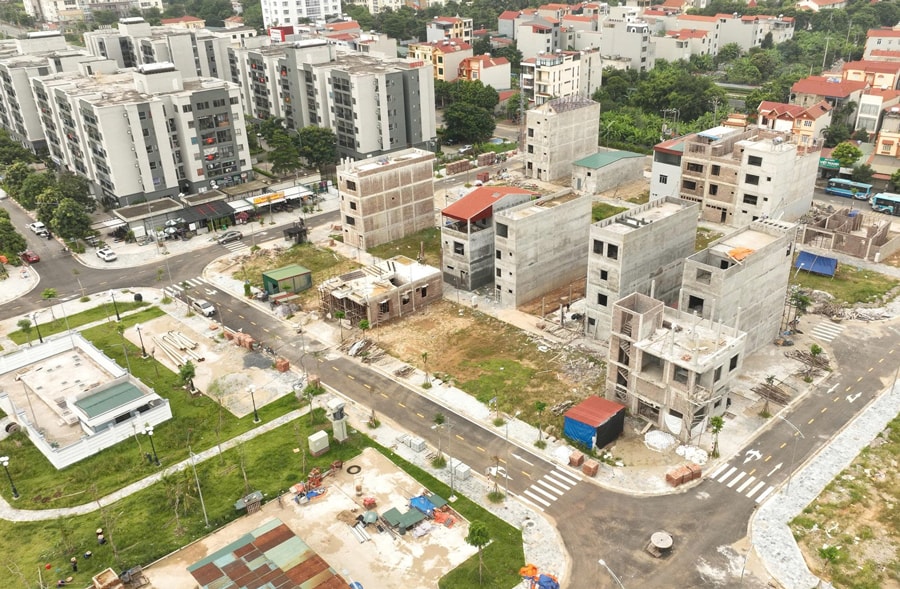
Major reforms to land valuation.
One of the major changes attracting public attention in the draft Law amending and supplementing several articles of the 2024 Land Law is the mechanism for determining land prices. The current Land Law divides land prices into specific land prices and land price tables, applicable in cases of leasing or changing land use purposes. However, in practice, many difficulties arise, especially for households and individuals when changing land use purposes, as this cost is often very high.
According to Mai Van Phan, Deputy Director of the Land Management Department ( Ministry of Agriculture and Environment ), the draft law closely adheres to the spirit of Resolution No. 69-NQ/TƯ of the Central Committee, aiming for strong reforms in land valuation and administrative procedures in the land sector. Accordingly, the land price table will be maintained but will be flexibly adjusted using coefficients, applied depending on the purpose such as compensation, land acquisition, or land use conversion. This aims to both support people with genuine needs and encourage investors, contributing to economic development. From there, it aims to ensure budget revenue, reduce investment costs, and create favorable conditions for attracting businesses.
"If land use fees are set too high, investors will be reluctant due to the high costs. But if they are too low, it will not guarantee revenue for the budget. Therefore, this law aims for balance, flexibility, and transparency," Mr. Mai Van Phan emphasized.
The draft also adds three cases in which the State can reclaim land for socio-economic development in the national and public interest. One such case is: If an investor has reached an agreement on land use rights with over 75% of the land area and number of land users, but a small portion remains unagreed upon after the deadline, the State will reclaim the remaining area to allocate or lease it to the investor.
Waiting for new breakthroughs.
Upon receiving this information, the Chairman of the Ho Chi Minh City Real Estate Association, Le Hoang Chau, assessed that, with a proactive approach in the drafting and appraisal process, and by fully listening to opinions from scientists , businesses, and the public, the draft Law amending and supplementing several articles of the 2024 Land Law is expected to become an important legal framework for the country's new development phase. The new proposal, if implemented, will resolve issues for thousands of projects that have been stalled for many years. “Some investors have reached agreements on 90-95% of the land area but still cannot complete the land clearance, causing projects to stall and land to be wasted. If the new regulations are approved, many unfinished projects will have the opportunity to be revived,” said Mr. Le Hoang Chau.
Furthermore, the draft also expands the cases for land reclamation to include urgent public investment projects, projects in free trade zones, international financial centers, logistics, cultural industries, and integrated urban-tourism-service zones… Representatives of the business community highly appreciate this amendment, considering it a driving force to attract investment.
However, the Vietnam Chamber of Commerce and Industry (VCCI) suggested that the mechanism for determining land prices in land acquisition cases needs clarification to avoid conflicts between the land price list and previously agreed-upon prices. VCCI also noted that the regulation stating "Provincial People's Councils may decide on other socio-economic development projects" could lead to overly broad application and is not truly consistent with the spirit of the Constitution.
The current market-based land valuation is causing difficulties for people needing to convert their land to residential use, as well as hindering their access to social housing. Many households are using land that is interspersed with garden and pond land, and when they need to convert it to residential land, they face many difficulties due to high costs. The Government Office recently issued Document No. 8160/VPCP-NN conveying the directive of Prime Minister Pham Minh Chinh to address press and public opinion regarding the excessively high financial obligations when changing land use purposes, affecting livelihoods. In this document, the Prime Minister assigned the Ministry of Finance, in coordination with the Ministry of Agriculture and Environment and other relevant agencies, to research and propose solutions using land price adjustment coefficients to collect land use fees appropriately and feasiblely, and report to the Prime Minister before September 10, 2025.
According to Mai Van Phan, Deputy Director of the Land Management Department (Ministry of Agriculture and Environment), to address the issue, along with amending the Land Law and implementing control and post-audit mechanisms to prevent abuse in implementation, the Government has assigned the Ministry of Finance to draft guidelines stating that: If people change the land use purpose within the allocated residential land limit, they will not have to pay land use fees. If they exceed the limit, they will pay a certain percentage, from 30% to 50% depending on the case. The Ministry of Finance is currently gathering feedback to finalize the draft. For low-income earners, access to housing will be linked to social housing development policies managed by the Ministry of Construction. This solution ensures consistency with related laws and harmonizes the interests of those whose land is expropriated and those who change the land use purpose.
Source: https://hanoimoi.vn/thao-go-diem-nghen-trong-quan-ly-dat-dai-tao-dong-luc-phat-trien-715258.html
![[Photo] Two flights successfully landed and took off at Long Thanh Airport.](/_next/image?url=https%3A%2F%2Fvphoto.vietnam.vn%2Fthumb%2F1200x675%2Fvietnam%2Fresource%2FIMAGE%2F2025%2F12%2F15%2F1765808718882_ndo_br_img-8897-resize-5807-jpg.webp&w=3840&q=75)














































































Comment (0)