

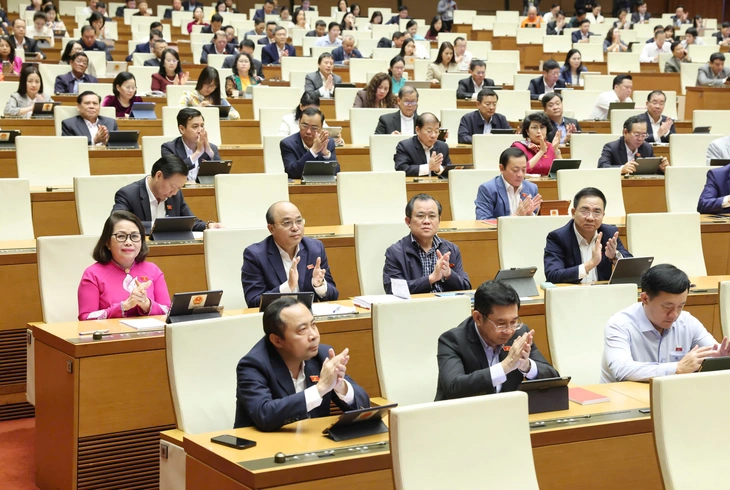
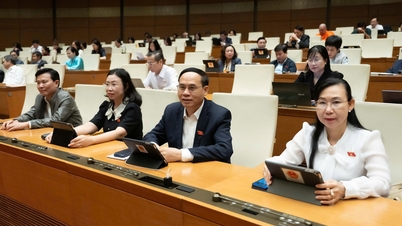
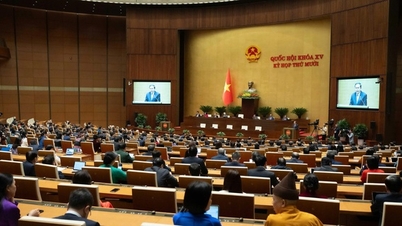
Delegates vote to pass laws and resolutions on the morning of December 11 - Photo: GIA HAN
The content outlined in the National Assembly Resolution stipulating a number of mechanisms and policies to remove difficulties and obstacles in the implementation of the Land Law was unanimously approved by the majority of delegates on the morning of December 11th.
Notably, the Resolution adds three cases in which the State can reclaim land for socio -economic development in the national and public interest, including:
Implement projects in free trade zones, projects in international financial centers.
In cases where land is used for a project through an agreement on land use rights that has expired or been extended, but more than 75% of the land area and more than 75% of the land users have been agreed upon, the Provincial People's Council shall consider and approve the revocation of the remaining land area to allocate or lease the land to the investor.
Creating land funds to pay for projects under build-transfer (BT) contracts, and to lease land for continued production and business activities in cases where organizations are using land that the State reclaims as stipulated in Articles 78 and 79 of the Land Law.
Notably, the Resolution also includes a provision on the exemption and reduction of land use fees and land rent; and the payment of land use fees and land rent when changing the purpose of land use. This is an issue of great concern to many delegates and voters.
According to the Resolution, in cases where land use fees and land rent are exempted, the procedures for determining land prices, calculating land use fees and land rent, and the procedures for requesting exemption from land use fees and land rent are not required, except in cases where the exemption is only granted for a certain number of years.
When changing the land use purpose as stipulated in the Land Law (points b, c, d, e, f and g of Clause 1, Article 121), land users must pay land use fees and land rent according to the following regulations:
In cases where annual land rent is reduced according to government regulations in the annual socio-economic management practice, land users are not required to go through the procedure of requesting a land rent reduction.
Land use fees and land rent are paid in a lump sum for the entire lease period, based on the difference between the land use fees and land rent of the land type after the land use change and the land use fees and land rent of the land type before the land use change for the remaining land use period;
Pay annual land rent according to the land type after the land use purpose has been changed.
In cases where garden land, pond land, or agricultural land within the same plot of land as residential land is identified when land use rights are recognized and the land use purpose is changed to residential land; or when land originally designated as garden or pond land attached to residential land is separated by the land user for transfer of land use rights; or when the surveying unit independently surveyed and separated the land into separate plots for residential land before July 1, 2014, the land use fee will be calculated at a rate equal to 30% of the difference between the land use fee calculated according to the price of residential land and the land use fee calculated according to the price of agricultural land at the time of the decision allowing the change of land use purpose for the area within the allocated residential land limit in the locality.
Land users pay 50% of the difference for land area exceeding the limit, but not exceeding one time the local residential land allocation limit; 100% of the difference for land area exceeding the limit but exceeding one time the local residential land allocation limit.
The land use fee mentioned above is calculated only once for each household or individual (per plot of land).
The time for determining land prices for BT payments is the time of the decision to allocate or lease land.
The resolution also stipulates the basis for calculating land use fees, land lease fees, and compensation when the State reclaims land; and the time of determining the land price of the land fund used to pay for projects under build-transfer (BT) contracts.
Accordingly, the time for determining land prices for the land area used for payment under a BT contract is the time when the State decides to allocate or lease the land.
In cases where the State delays the allocation or leasing of land for payment under a BT contract, the investor is entitled to an additional amount equivalent to the average interest rate of state-owned commercial banks on the value of the project item or the entire project.
The entitlement period is calculated from the time of acceptance of the completed project item or BT project to the time of the decision on land allocation or land lease.
Source: https://tuoitre.vn/bo-sung-quy-dinh-nha-nuoc-thu-hoi-du-an-da-thoa-thuan-tren-75-dien-tich-dat-20251211091931772.htm



![[Photo] Closing Ceremony of the 10th Session of the 15th National Assembly](/_next/image?url=https%3A%2F%2Fvphoto.vietnam.vn%2Fthumb%2F1200x675%2Fvietnam%2Fresource%2FIMAGE%2F2025%2F12%2F11%2F1765448959967_image-1437-jpg.webp&w=3840&q=75)








































![[OFFICIAL] MISA GROUP ANNOUNCES ITS PIONEERING BRAND POSITIONING IN BUILDING AGENTIC AI FOR BUSINESSES, HOUSEHOLDS, AND THE GOVERNMENT](https://vphoto.vietnam.vn/thumb/402x226/vietnam/resource/IMAGE/2025/12/11/1765444754256_agentic-ai_postfb-scaled.png)













































Comment (0)