

This information was provided by Professor Dr. Le Anh Vinh, Director of the Institute of Educational Sciences (Ministry of Education and Training), at the workshop "Developing Artificial Intelligence Capabilities for Learners," jointly organized by the University of Social Sciences and Humanities, the Vietnam Association of Science and Technology, etc., on October 28th in Hanoi.
According to Professor Dr. Le Anh Vinh, this unit has developed an AI curriculum for general education, from which schools can establish regulations for applying AI (artificial intelligence) in schools.
“Next, we will develop an AI competency framework for high school students and teachers. The framework has already been reviewed by the Department of General Education (Ministry of Education and Training), and we hope it will be implemented soon,” Mr. Vinh said.

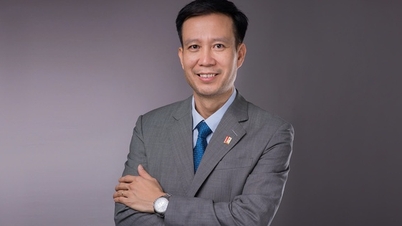
Professor Dr. Le Anh Vinh, Director of the Institute of Educational Sciences (Photo: Organizing Committee).
87% of middle school students know how to apply AI.
At the workshop, Professor Le Anh Vinh stated that, according to a survey of over 11,000 junior high school students at the end of 2023 - before the Institute developed the AI competency framework for learners - approximately 87% of students knew how to apply AI. Students rated AI in education as effective, for example, using GPT chat to answer difficult questions.
A survey conducted by this institute with nearly 35,000 middle and high school teachers at the end of 2024 showed that 76% of teachers reported using AI in teaching. The teachers rated the application of AI in teaching as highly effective.
"Even if we don't systematically introduce AI applications into high schools, this field is still very active, but if we don't research appropriate and effective educational methods, the results won't be as good as desired."
"So how should we use technology when applying it to education?" Professor Le Anh Vinh asked.
According to Associate Professor Hoang Minh Son, Chairman of the Council and Director of Hanoi National University, the university considers AI and digital technology as strategic pillars until 2030, with a vision for 2045.
According to Mr. Hoang Minh Son, AI is an essential skill, similar to foreign languages in the past.
More importantly, leadership skills and proactive creativity must be integrated into the teaching and learning process, so that students can use AI in their studies right away, not just after graduation.

Assoc. Prof. Dr. Hoang Minh Son, Chairman of the Council and Director of Hanoi National University (Photo: M. Ha).
The dilemma of integrating AI into general education.
According to Mr. Le Anh Vinh, integrating AI into general education needs to be based on three main pillars.
Firstly, there needs to be a consistent policy framework for integrating AI into schools. Secondly, the curriculum and materials must be comprehensive and flexible. Thirdly, there needs to be sufficient human and financial resources.
There are currently three approaches to implementing AI in the high school curriculum. First, fully integrate AI into all subjects. Second, treat AI as part of computer science. Third, treat AI as a separate subject.
"Our view is that AI should be integrated into general education subjects to avoid duplication. The approach must be step-by-step, clear, and based on research evaluation to ensure timely implementation," Mr. Le Anh Vinh further shared.
According to this expert, the AI program is being piloted by the Institute from grades 1 to 12 in experimental schools, with 16 lessons per school year.
Accordingly, at the primary school level, the focus will be on moral education and awareness of AI; at higher levels, the level of technical knowledge and skills will gradually increase.
Initial results suggest that teachers can effectively teach ethics and use AI safely, provided they have appropriate guidance materials.
Conversely, foundational knowledge and AI techniques pose a significant challenge, as most teachers lack technological expertise. Therefore, the Institute is proposing the standardization and digitization of teaching materials, so that teachers can play a supporting role rather than directly teaching.

The Institute of Educational Sciences' approach to AI education in the high school curriculum (Photo: My Ha).
At the workshop, Ms. Nguyen Thi Nhiep, Principal of Chu Van An High School for the Gifted in Hanoi, said that she was very concerned and struggling with organizing AI teaching in schools.
"Observing the situation in Hanoi and some other provinces and cities, we can see a clear differentiation; some schools have not paid attention to this, while others have invested heavily."
"In particular, this differentiation is clearly evident between schools in urban and rural areas, and between public and private schools, with many private schools having very good training organization," Ms. Nhiep said.
"We really want to incorporate AI into the training, and we could even allocate budget for it, but we're hampered by regulations on extracurricular tutoring. So, on what basis can the school teach it? Why are we allowed to collect fees? That's a difficult problem," the principal wondered.
Given these difficulties, Ms. Nhiep suggested the need for a legal framework, clear goals, and a roadmap for students, teachers, and schools to apply and develop AI in teaching and learning. Teacher training and infrastructure are also crucial factors for schools when implementing AI.
In his presentation, Dr. To Hong Nam, Deputy Director of the Department of Science, Technology and Information, Ministry of Education and Training, pointed out several challenges. Currently, learners mainly self-study AI through friends, social media, or online courses, but lack mechanisms for quality verification.
Many people "claim to be AI instructors" but lack expertise, leaving students unsure of their skill level and what is sufficient to learn. Therefore, according to Dr. To Hong Nam, a unified system of evaluation, recognition, and standardization is needed to ensure the quality of AI training.
Source: https://dantri.com.vn/giao-duc/thi-diem-dua-ai-vao-giang-day-o-bac-pho-thong-20251028195920804.htm

![[Image] Close-up view of the interchange connecting the two expressways and Long Thanh Airport.](https://vphoto.vietnam.vn/thumb/1200x675/vietnam/resource/IMAGE/2026/05/25/1779703378210_ndo_br_z7863716673926-224453a31600126cce10622af6290afd-4549-jpg.webp)



![[Image] Hanoi's urban life under the challenge of a "scorching hot" environment](https://vphoto.vietnam.vn/thumb/1200x675/vietnam/resource/IMAGE/2026/05/25/1779706979265_nang-nong-t5-2026-minh-duy-7-4636-jpg.webp)















































































Comment (0)