


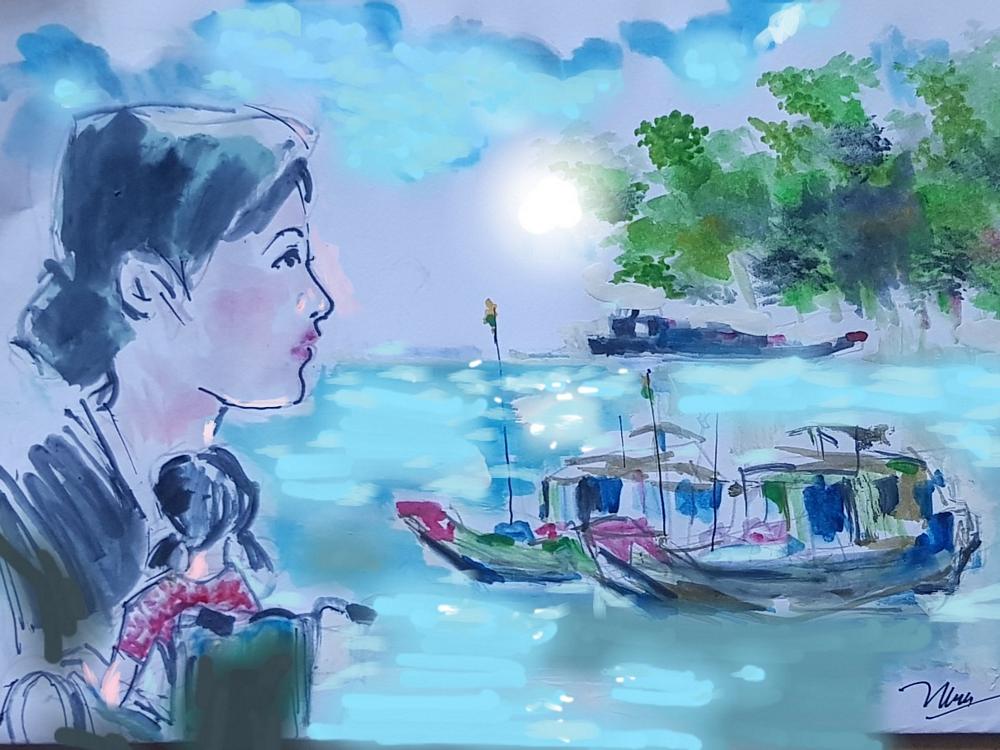
 |
| Illustration: Tran Thang |
The day was drawing to a close. The last rays of sunlight faded into the deep purple twilight as the crimson sun slowly sank below the river's edge. Diệu carefully covered the steaming hot evening meal under a food cover and stepped out into the yard, the scent of smoke still lingering on her clothes and hair.
A cool breeze blew through, carrying the damp scent of the earth after the first rain of the season. The old star trees creaked and swayed, dropping their tiny, delicate white blossoms. Dieu smiled faintly, looking into the distance—where a frail old man was playing with a little girl sitting motionless in a stroller.
It's been three years since Dieu first set foot on the islet. Having navigated the waterways and narrow canals of this alluvial land, it was her first time visiting this small strip of land that emerged at the end of the Ba Thac River before it flows into the sea. Who could have imagined, not even Dieu herself, that she would end up staying here forever?
Looking up at the vast expanse of calm water, dotted only with a few small ripples, the floating market now consists of only a few tourist boats bobbing gently on the water. Memories suddenly surge back, as if it were just yesterday that Diệu and her husband's coconut-buying boat had cut through the water and docked.
Diệu still thought it was just a rest after a long journey. Even weeks before, she hadn't noticed anything unusual about her husband. He was still diligently working, hardworking and resilient; as soon as the boat docked, he would rush up to the garden, straining his neck to check on the coconut trees.
His feet still moved nimbly like a squirrel's, climbing and gliding. While counting coconuts and passing them down to the boat, Được was still playfully singing. Even that morning, he was still happily doting on his disabled daughter, calling her "Daddy's little darling." It wasn't until he gave Diệu several large banknotes and told her to go ashore to buy some good meat for the memorial feast for Diệu's parents that she still thought he was a truly loving and filial man.
The man extended his hand to help Dieu when her parents both fell ill and passed away. It seemed that Dieu's life and the coconut-buying boat that Dieu used in his life as a traveling merchant would be intertwined for life, but then that day came.
Before Diệu turned away with her shopping bag, her husband affectionately handed her little daughter to her. He said, "She loves crowded places; her eyes light up every time we take her to the market." Diệu smiled and reached out to take the baby. The poor girl had contracted polio when she was only a few months old; luckily she survived, but lost her mobility for life.
Back then, Dieu often blamed herself for her lack of knowledge about vaccinating her daughter, which led to this unfortunate situation. It took her husband's gentle encouragement for her to gradually calm down. Seeing Duoc still cradling and cherishing Nhan like a precious treasure, what more could a mother like Dieu worry about?
Just like when she took her child from her husband's arms and stepped ashore, Dieu didn't think about anything else. She leisurely went to the market to buy meat and vegetables. Knowing that Duoc liked the dish of sesbania flowers cooked in sour fish soup with snakehead fish, Dieu immediately went to the fresh fish stall, determined to make a fancy meal. Absorbed in her shopping and letting her little one enjoy the market, by the time Dieu returned to the riverbank, the sun had already risen high in the sky.
The boats at the floating market continued to bustle back and forth, but only Duoc's coconut-buying boat was nowhere to be seen. Dieu sat in the scorching sun, convinced that someone had called out to sell coconuts, and that her husband would be back soon. She sat there, gazing out at the dock until dusk, the fish in her basket drying and becoming foul-smelling, but her husband still hadn't returned.
Many people claimed to have seen a boat buying coconuts passing through Tra On and heading straight to Saigon, but Dieu didn't believe it. At this moment, she had completely collapsed onto the ground, next to a basket of fish and meat reeking of fish and meat. Fortunately, her daughter was well-behaved; even amidst the swirling wind and dust on the riverbank, she remained sound asleep.
An old man with a limp, who worked as a boatman at the floating market, approached Dieu and told her not to wait any longer, that the boat that bought the coconuts probably wouldn't come back. Dieu looked up, staring blankly at the man with a kind, gentle face, a face easily found in this riverside region.
Knowing that Dieu had nowhere else to go, the old man told her to come to his house for now, and they would figure things out in the morning. The old man lived alone in a simple but extremely neat and tidy thatched hut. He and his wife lived there alone, with no children, but his wife had left him the previous year after succumbing to a serious illness.
Every day, at dawn, when he went to the floating market to pick up and drop off passengers, Dieu would follow him. Many boats from all over the country stopped at the islet to resupply for their journey, but none of the boats Dieu was looking for were there. Asking around among the traveling merchants, some said they saw Duoc picking up a beautiful woman in Mieu village, and then the two headed upstream.
Diệu told the old man, "We must settle this once and for all." He slipped a few banknotes into Diệu's hand, telling her to go, but that if one day she had nowhere to return to, this island would always be open to her. Although he was poor, with his small garden full of fruit trees, even with just simple porridge and vegetables, Diệu and her mother would never go hungry.
As he saw Dieu off at the ferry, he waved his toothless hand dismissively. A feeling of reluctance welled up inside Dieu, preventing her from turning back to look at his wrinkled face, his dull eyes gazing intently into the distance. The months he had sheltered her, the months she had spent living in a house on land, made Dieu feel as if she had returned to the days when her parents were still alive, before their family had fallen on hard times and had to pack up all their belongings and flee their homeland on a boat.
During those long, arduous years of wandering, sleeping night after night amidst the crashing waves, Dieu often yearned for peaceful times and sometimes longed for a stable home to settle down in. But when she met Duoc, Dieu continued to be content with the present, as long as the two of them were together. However, that simple life, once thought to be perfect, is probably only remembered by Dieu herself now.
The ferry drifted silently, the old man still not gone. Suddenly, Dieu felt a pang of fear and turned back, tears streaming down her face. When the coconut-buying boat left the dock and the man reluctantly abandoned his wife and children, Dieu thought she was the unhappiest person in the world. That was until she heard the old man recount his life as a soldier returning from battle with crippled legs.
Biểu Diệu touched the top of his head—where his hair no longer grew—and said, "A bullet once grazed that spot." He couldn't remember the exact circumstances, amidst the constant shelling and the acrid smell of gunpowder on the smoke-filled battlefields of the Eastern Front. He only knew that when he regained consciousness, the nurse told him, "You were lucky; if it had gone just one more centimeter, it would have been dangerous."
Then, with peace restored , he returned to his old home on the island. His relatives were scattered, none remaining. With his injured legs and wounds that ached whenever the weather changed, he toiled day after day, clearing land and rebuilding his house. He married a widow whose husband had died in battle.
The children were born one after another, but the old couple had to bury them very quickly. The poison that had seeped into his body during his years on the battlefields of Bu Dop and Ma Da prevented him from having normal children.
His wife grieved for years, but ultimately could not escape the judgment of heaven. During the days that Dieu and her daughter stayed with him, he felt as if he had family. Dieu's disabled daughter reminded him of his own unfortunate children, and he felt even more deeply for her. Sometimes, jokingly, he would say, "Why don't you stay and be my daughter?"
Diệu left the day before, and the next day she returned to the island looking dejected. There was no one home, and the old man was too sad to go to the floating market to ferry passengers. When Diệu arrived, she hurried to the riverbank but couldn't find him. It turned out that some encounters in life happen naturally, like destiny. Diệu had met the person she needed to meet, and even with a thousand disappointments, nothing could change that. But there are some connections that, if she didn't hold onto them in time, would be lost.
When Diệu returned home, she found everything empty. She didn't know where her father had gone. Inside, the wood-burning stove was cold and silent, and beside the teapot were only a few crumbs of sponge cake—probably dry because they used too few eggs. Diệu walked around the front yard, calling out, "Uncle Tư!" A figure emerged from somewhere, stepping through the hibiscus-covered gate, his feet shuffling as he reached out to embrace the smiling child, playfully teasing, "When will your mother finally call me 'Dad'?"
Diệu unconsciously smiled as memories of the past played back in her mind like a film reel. She looked towards the small house, the peaceful haven nestled amidst the wind-sheltering trees, then her gaze drifted towards it as she called out, "Dad, let's go home for dinner!"
SUNNY
Source: https://baovinhlong.com.vn/van-hoa-giai-tri/tac-gia-tac-pham/202505/truyen-ngan-ben-binh-yen-c810802/
![[Photo] National Assembly Chairman Tran Thanh Man inspects election preparations in Hai Phong city.](https://vphoto.vietnam.vn/thumb/1200x675/vietnam/resource/IMAGE/2026/02/26/1772095420401_ndo_br_bnd-8016-jpg.webp)
![[Photo] Thousands of tourists visit the Quang Trung Emperor Temple in Nghe An during the early spring season.](https://vphoto.vietnam.vn/thumb/1200x675/vietnam/resource/IMAGE/2026/02/26/1772095410680_img-9305-3882-jpg.webp)
![[Photo] National Assembly Chairman Tran Thanh Man working with the Hai Phong City Election Committee](https://vphoto.vietnam.vn/thumb/1200x675/vietnam/resource/IMAGE/2026/02/26/1772103806795_ndo_br_bnd-8224-jpg.webp)




















































Comment (0)