

The above results are the product of the project "Research on the application of bioelectrochemical technology for in-situ control of the presence of pathogenic Vibrio bacteria in brackish water aquaculture ponds", led by the Faculty of Science , Vietnam National University, Hanoi (VNU-Hanoi), in collaboration with the Institute of Microbiology and Biotechnology, VNU-Hanoi and experts from the Korea Institute of Science and Technology (KIST).
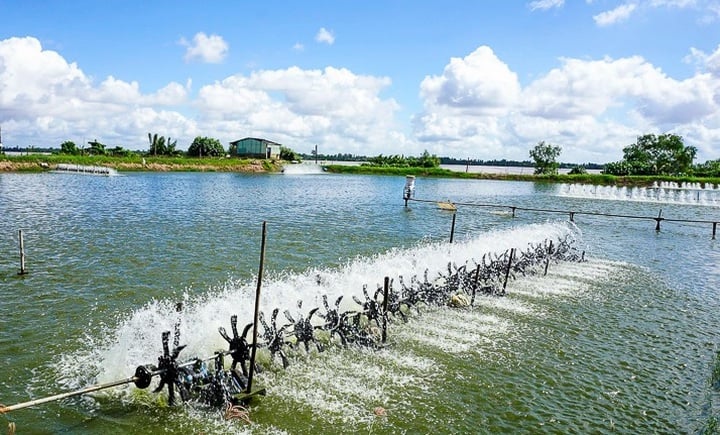
The study established a bioelectrochemical model that reduces the growth of pathogenic Vibrio bacteria in brackish water aquaculture ponds.
The project focuses on evaluating the potential of an electrochemical biosystem when integrated into a brackish water aquaculture model to reduce the growth of Vibrio bacteria in water and bottom sediment, optimize operating parameters, and ultimately develop a pilot-scale application model under real-world conditions.
Based on a scientific overview and production practices, the task is to identify Vibrio as the most common and dangerous pathogenic bacteria in brackish water aquaculture ponds, especially Vibrio harveyi and Vibrio parahaemolyticus , which are two agents leading to luminous disease and acute hepatopancreatic necrosis.
In the context of the increasing limitations of using chemicals and antibiotics, bioelectrochemical technology was chosen due to its ability to create an anode environment with negative redox potential and low pH, conditions unfavorable to the survival and growth of Vibrio. International scientific findings on the inhibitory effects of BES on pathogenic bacteria in an anode environment provided a crucial basis for conducting this research.
The bioelectrochemical system was designed with the anode placed at the bottom of the model, where the Vibrio density was highest, and the cathode near the water surface. This arrangement is based on the operating principle of a membrane-less BES system, ensuring that the electrochemical bacteria are enriched and maintained in stable activity, thereby generating an electric current and changing the redox potential in the pond. In experiments, the electrode position, the anode-cathode distance, and the external resistance value were adjusted to determine the optimal conditions for Vibrio inhibition. When necessary, a potentiostat was used to apply the anode voltage, facilitating a more in-depth assessment of the mechanism of action.
The research project covered six main areas: establishing an experimental model; electrochemical enrichment of bacteria; evaluating the ability to treat V. harveyi and V. parahaemolyticus ; clarifying the nature of the inhibition process; optimizing operating parameters; and building a pilot model.
Experiments have shown that when operating stably, the electrochemical system is capable of reducing Vibrio density in both water and bottom sludge, with the effectiveness clearly dependent on the redox potential at the anode and cathode. Changes in substrate concentration, pH, electrode position, and external resistance all showed differences in the degree of inhibition, contributing to the determination of the optimal parameters for in-situ Vibrio treatment.
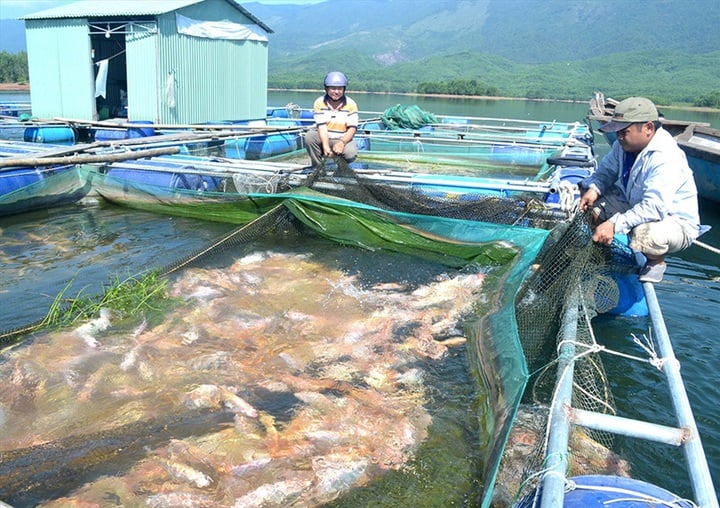
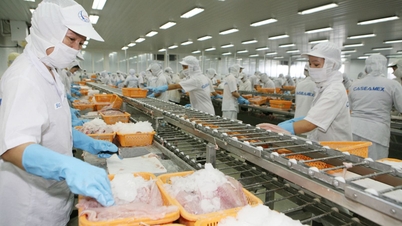
The pilot model was constructed using actual pond water from brackish water aquaculture areas in the North. (Illustrative image.)
Based on the laboratory results, a pilot model was developed using actual pond water from brackish water aquaculture in the North. The model allows for the assessment of the system's adaptability to natural conditions, including its impact on the health of whiteleg shrimp, the effectiveness in reducing existing or added Vibrio bacteria, and the influence on beneficial bacteria in the pond. This is a crucial step in determining the feasibility of the technology before its practical application.
The results of this mission lay the foundation for a new approach to aquatic disease control, leveraging the advantages of electrochemical biotechnology, which has a simple structure, low operating costs, long lifespan, and the ability to treat diseases on-site without disturbing the pond environment.
The successful application of this technology promises to provide effective and sustainable tools for farmers in the context of the increasingly urgent need to control diseases and reduce reliance on antibiotics.
Source: https://mst.gov.vn/ung-dung-cong-nghe-sinh-dien-hoa-kiem-soat-vi-khuan-vibrio-trong-ao-nuoi-thuy-san-nuoc-lo-197251211125407475.htm

![[Image] Close-up of the newly discovered "sacred road" at My Son Sanctuary](/_next/image?url=https%3A%2F%2Fvphoto.vietnam.vn%2Fthumb%2F1200x675%2Fvietnam%2Fresource%2FIMAGE%2F2025%2F12%2F13%2F1765587881240_ndo_br_ms5-jpg.webp&w=3840&q=75)








































































Comment (0)