

 |
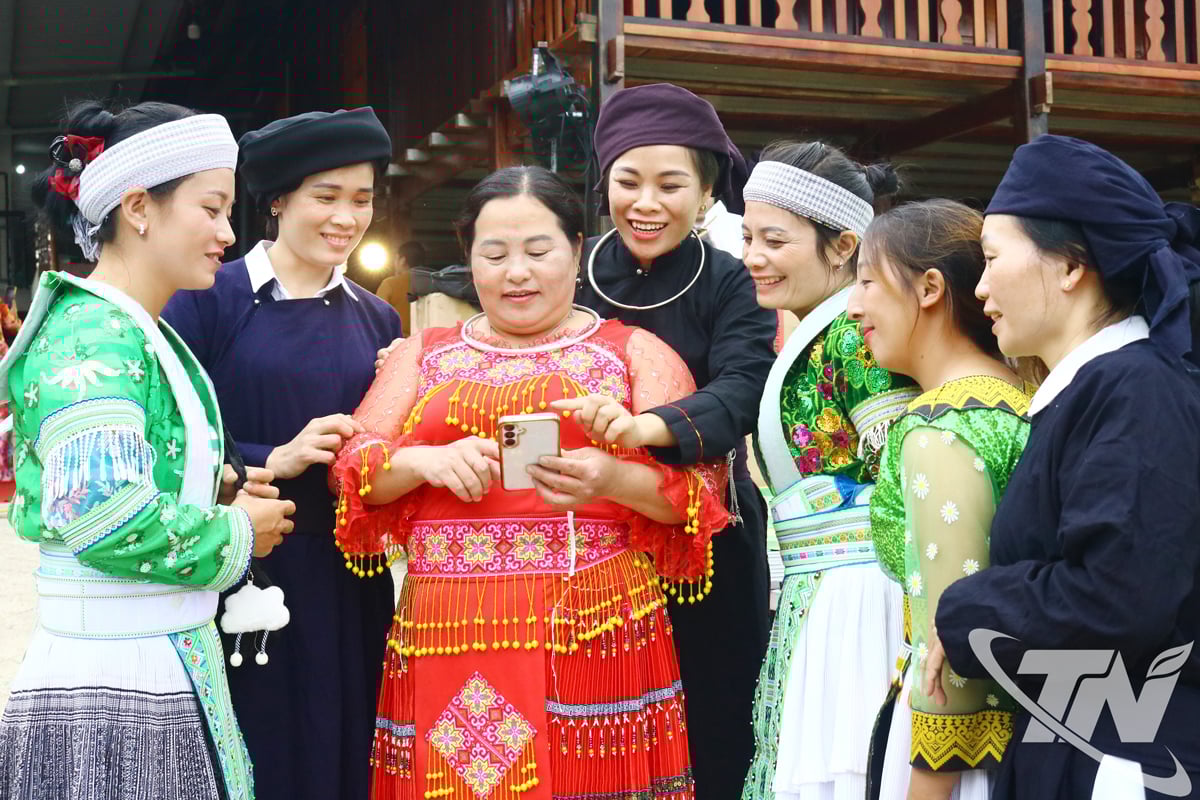
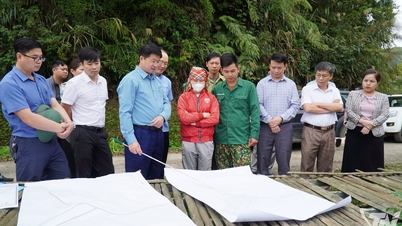
| People of ethnic minority backgrounds in Van Lang commune share their experiences using smartphones to find information. |
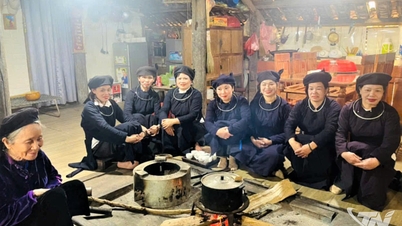
Stirring the firewood to make the fire in his stilt house flare up, 75-year-old Dinh Nhu Phung from Na Duong village murmured: "The younger generation is changing the land of Van Lang commune every day. Many young farmers 'dare' to break away from the monoculture of food crops; abandoning mixed crops to convert land to planting fruit trees and medicinal plants, building livestock pens, creating more jobs locally, and increasing income for local laborers. Thanks to this, the agricultural products of the people have become commodities with higher economic value."
Looking through the window of the stilt house, I could see towering ranges of rocky and earthen mountains. I remember that all the way back to the commune, the car drove for almost an hour before reaching the top of the slope. Countless generations have carved through the mountains to build roads to Van Lang; countless generations of officials have brought agricultural science and technology to transfer to the people, hoping to transform this difficult land.
Sharing with us, Mr. Nong Van Hoi, Secretary of the Party Committee of Van Lang commune, said: By taking advantage of state support funds and developing the internal resources of the people, the land of Van Lang commune is flourishing day by day. Currently, the entire commune still has 746 poor and near-poor households. However, many households also achieve an income of 300 to over 500 million VND/year.
Van Lang commune currently has 19 villages, over 1,600 households, and more than 7,500 inhabitants, comprising 5 ethnic groups: Tay, Nung, Kinh, Dao, and Mong. Thanks to actively participating in training courses on scientific and technical transfer organized by the local government in coordination with relevant agencies, the farming skills of the people have improved.
Mrs. Ma Thi Vong, 84 years old, from Na Duong village, said excitedly: "In Van Lang, looking up at the hills, besides the ginger plants that yield tubers, there are also fruit trees like seedless persimmons, dragon fruit, large apples, and precious medicinal plants. Looking out at the village fields, you see the changing seasons, from rice, vegetables, tobacco, to watermelons. And looking down lower, you see fish swimming in the ponds."
Concentrated production has gradually created agricultural commodity zones. As a result, the agricultural products of the local people have higher economic value and are purchased by traders directly at the production sites at fair prices. Currently, the commune has 5 OCOP products that have achieved 3 stars: vermicelli from Viet Cuong Cooperative and Tham Luong Cooperative; Huy Hung rice noodles; and Giao Co Lam tea and Ca Gai Leo tea from Bao Chau Cooperative.
For a mountainous, remote area like Van Lang, far from the provincial center, this is a significant development. The rotation of crops means that the income of the local people is increasing.
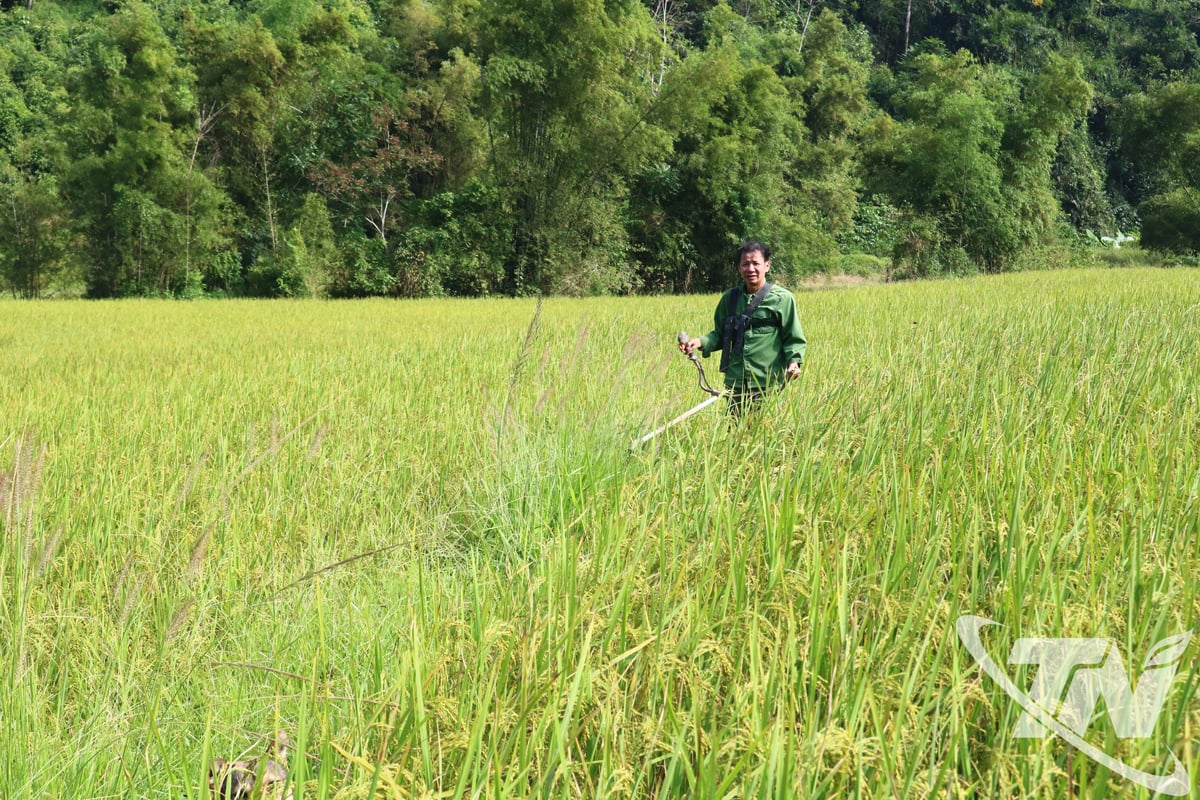 |
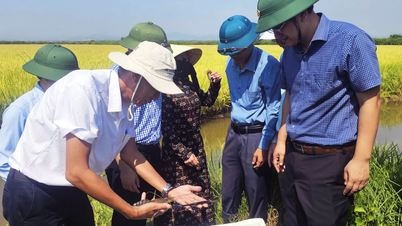
| The improved organic rice cultivation model SRI has been widely adopted across most of the double-cropping rice land in Van Lang. |
Mr. Vy Van Phuong from Coc Phja village said: "To support the people in achieving sustainable poverty reduction, many models, projects, and national target programs have been implemented by various levels and sectors in the locality. Through these, the people receive support in science and technology, and improve their production skills."
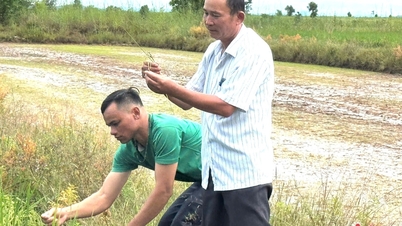
Mr. Phan Van Minh from Na Diec village shared: "Simple models like the improved SRI rice cultivation model following organic farming methods have helped people reduce costs, increase productivity, and reduce labor." Also present, Ms. Duong Thuy My from Khuoi Noc village added: "The models of fruit tree cultivation, medicinal plant farming, and livestock raising implemented in the locality have brought people increased income, and many families have escaped poverty sustainably."
Through our conversation, we also learned that: In the period from 2020 to 2025, Van Lang commune has implemented many models that bring high economic efficiency, such as: the seedless persimmon cultivation model with 137 participating households and an area of nearly 14 hectares; and the project to support tools and equipment for agricultural production in the field of crop cultivation, with 21 participating households.
Projects involving the breeding of pigs for meat, native pigs, horses, and goats have attracted 260 participating households. The commune also has 4.4 hectares of model cultivation of purple velvet leaf plants and 1 hectare of model cultivation of milk thistle plants using organic methods.
According to assessments by authorities: Most models and projects have yielded high economic efficiency and have been well received by the local people. Regarding this, Ms. Nguyen Thi Le from Quoc Tuan village candidly stated: "If we see the effectiveness with our own eyes, we will follow suit."
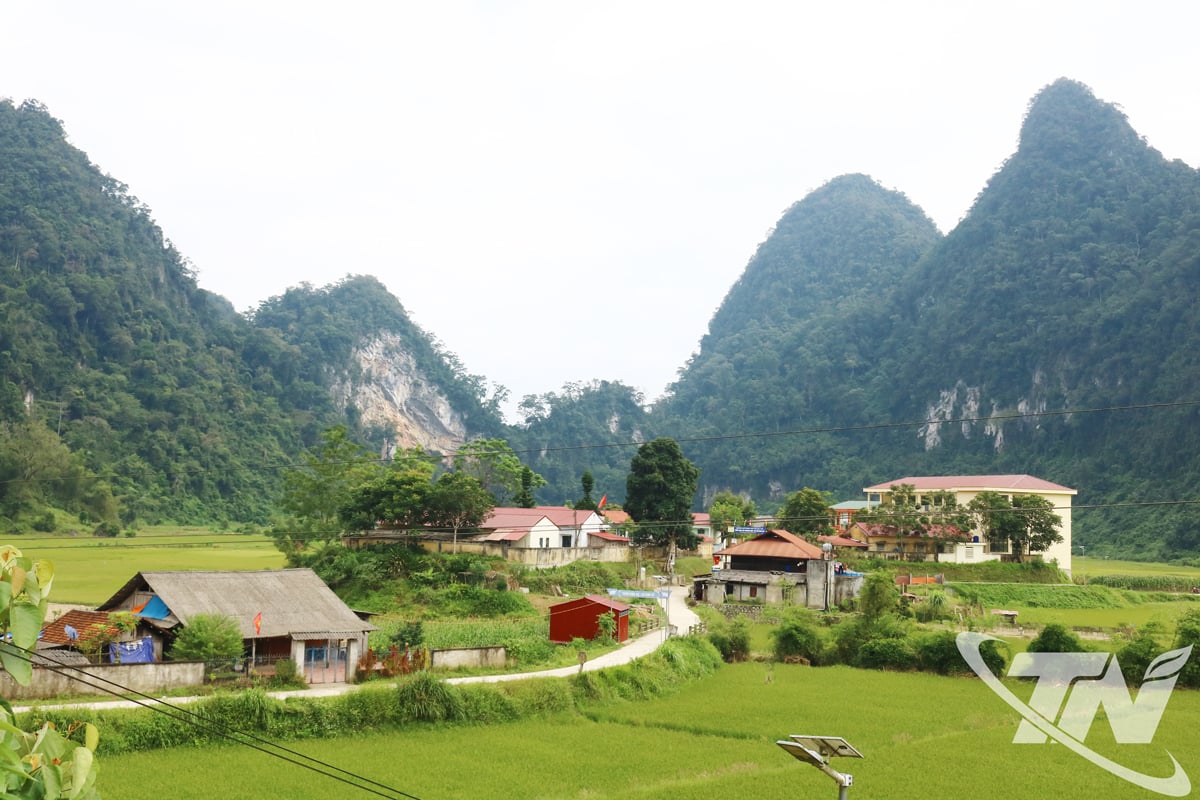 |
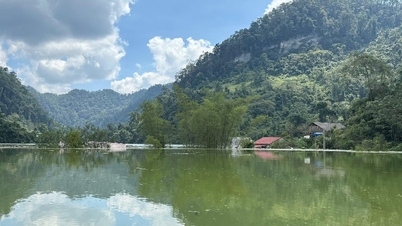
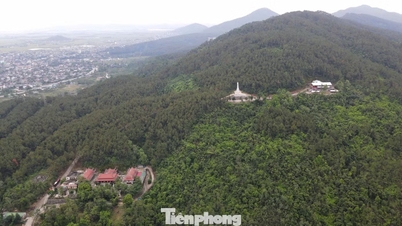
| A view of Van Lang commune. |
Through the effective use of state-funded support and the mobilization of local resources, the new rural landscape is becoming a reality in Van Lang. It is noteworthy that in the last four years, the National Target Program for New Rural Development has disbursed over 2.4 billion VND.
Thanks to this funding, irrigation systems were upgraded in the Khau La, Cho Moi, Na Diec, and Pan Xa fields; production roads were built from National Highway 279 to Khuoi Kich, Khuoi Noc village, making farming work easier for the local people.
To support people in overcoming difficulties, the National Target Program for Sustainable Poverty Reduction has disbursed nearly 4 billion VND for 8 projects supporting production development, with approximately 500 people from poor households, near-poor households, and newly-escaped-from-poverty households participating.
In addition, the National Target Program for socio-economic development in ethnic minority and mountainous areas has disbursed nearly 8 billion VND for 6 projects, including housing support for 60 households; support for 6 households to purchase machinery and agricultural tools; support for 199 households with decentralized water supply; and support for 8 households to develop production linked in the sturgeon value chain.
In particular, the commune has built 14 essential infrastructure projects in ethnic minority and mountainous areas; established 14 community communication teams, 1 trusted address, 3 change leaders' clubs, and implemented many other meaningful activities.
Lost in conversation, the afternoon sun began to set in the west, casting a sweet aroma of freshly cooked rice from the stilt houses in the mountain valleys during the October harvest. As if by habit, Mr. Dinh Nhu Phung, the homeowner, stirred the firewood in his stilt house, igniting a blaze of fire that evoked a sense of abundance. I silently thought to myself: The land of Van Lang commune is entering a new, sustainable phase of development, thanks to the very people who own this land.
Source: https://baothainguyen.vn/xa-hoi/202511/van-lang-no-am-da-ve-18748c8/
![[Photo] General Secretary and President To Lam presides over a meeting on assessing national development resources.](https://vphoto.vietnam.vn/thumb/1200x675/vietnam/resource/IMAGE/2026/05/20/1779253785852_a1-bnd-2943-8519-jpg.webp)


























































Comment (0)