

A necessary trend when participating in FTAs.
The story of global consumers' shifting fashion choices towards greener options is nothing new. Especially after the pandemic, consumers have become more concerned about environmental and health issues. Many brands have been and are shifting towards producing and using green, sustainable materials in their products.
In recent statements, Mr. Vu Duc Giang, Chairman of the Vietnam Textile and Garment Association (VITAS), has repeatedly emphasized that Vietnam is participating in many new-generation Free Trade Agreements (FTAs), but under these FTAs, our textile and garment products will have to meet stricter standards, including green standards set by importers.
Mr. Giang cited the following examples: New generation free trade agreements such as the Comprehensive and Progressive Trans- Pacific Partnership (CPTPP) and the Vietnam-EU Free Trade Agreement (EVFTA) have included provisions on green practices and recycling, requirements that brands demand Vietnamese manufacturers adapt to. According to Mr. Giang, leading Vietnamese businesses have already had to accept the "rules of the game" set by importing countries to maintain and retain market share.
Sharing the same viewpoint, Ms. Vu Kim Hanh - President of the Association of High-Quality Vietnamese Goods Businesses - stated: Green fashion and sustainable fashion are part of the global trend, from production and design to distribution and consumption, forming a chain of sustainable economy .
However, according to Ms. Hanh, green fashion is still quite new in Vietnam. Vietnam is currently dominated by fast fashion, while in Europe, green and sustainable fashion is no longer a pioneer; it has become a mainstream trend. "I believe that in Vietnam, we still have a lot of work to do to promote green and sustainable content," Ms. Hanh said.
Ms. Hanh believes that fashion using green, sustainable materials helps protect the environment, saves money for the economy, prevents waste, and reduces litter... However, there are not many pioneers in this industry. Those who are pioneers in this field must have faith and persistent investment.
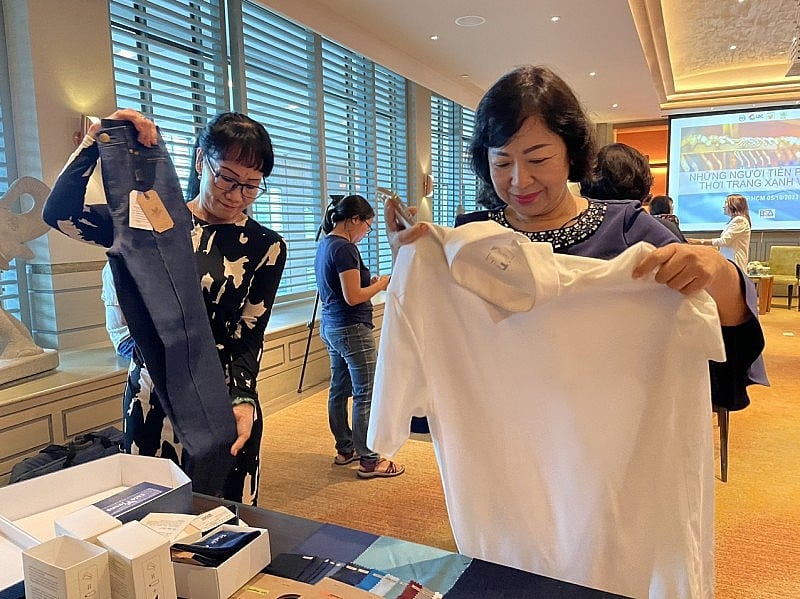 |
| Green fashion products made from materials such as lotus fiber fabric and mint fabric are produced by Vietnamese businesses. |
Catching the pace to bring Vietnamese eco-friendly fashion to the world.
That's not to say that businesses in Vietnam's fashion industry haven't kept up with global trends, because in reality, many businesses are already catering to consumer tastes.
According to VITAS statistics, in addition to large enterprises such as Viet Tien Garment, May 10, Bao Minh Garment, Dong Tien, Thanh Cong, etc., many medium-sized enterprises such as Faslink, Tsafari, Trung Quy, VitaJean, etc., are also following this trend and have initially achieved certain successes. Accordingly, thanks to timely "greening," these businesses have secured relatively stable orders amidst declining market demand in the early months of this year.
Speaking at a recent seminar in Ho Chi Minh City on "Pioneers of Green Fashion in Vietnam," organized by the Association of High-Quality Vietnamese Goods Businesses and related parties, Mr. Vo Thanh Phuoc, Head of Product Development at Faslink, stated that Faslink has been supplying green and sustainable fashion materials to the market for over 10 years.
According to Mr. Phuoc, Faslink has many large corporations and businesses as clients in the Vietnamese market, with its best-selling line being men's office wear. "We currently have over 40 domestic fashion brands to supply to businesses. The product materials are diverse, ranging from plastic bottles, coffee grounds, lotus fiber fabric, mint fiber fabric, oyster shells, etc.," Mr. Phuoc said.
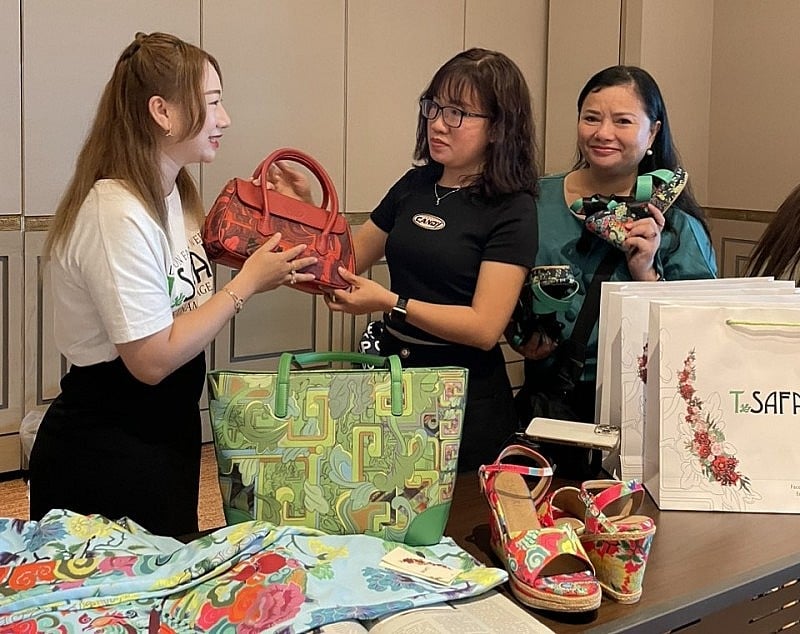 |
| Consumers experience eco-friendly fashion products. |
Reportedly, in mid-September 2023, during London Fashion Week 2023, Faslink and Tsafari showcased their unique eco-friendly fashion designs at the event, attracting the attention of fashion enthusiasts worldwide.
At this launch event, Faslink collaborated with the fashion brand Tsafari to introduce collections made from lotus fiber fabric. This type of fiber is highly valued for its comfort and coolness, and especially for its collagen content which helps moisturize the skin and create a comfortable feeling when worn.
Fashion designer Ho Tran Da Thao, owner of the Tsafari brand and the designer of the company's collections at London Fashion Week, said: "The products my company brings to London are tailored to suit the customers of each brand, such as Owen and Faslink. We not only take photos and perform at the event but also on the streets of London, the world's fashion capital, to promote our products. We pay attention to information from analysts and industry experts around the world about our product lines, so we know if we are ready to enter the global market," Ms. Thao explained.
Source link


![[Image] Vietnam's colorful journey of innovation](/_next/image?url=https%3A%2F%2Fvphoto.vietnam.vn%2Fthumb%2F1200x675%2Fvietnam%2Fresource%2FIMAGE%2F2025%2F12%2F14%2F1765703036409_image-1.jpeg&w=3840&q=75)




















































![[Image] Vietnam's colorful journey of innovation](https://vphoto.vietnam.vn/thumb/402x226/vietnam/resource/IMAGE/2025/12/14/1765703036409_image-1.jpeg)
























Comment (0)