

Trekking through the forest to find forest products.
Towards the end of the year, the Central Highlands enter the dry season. Nights are gloomy and cold, while days are sunny and windy. The forests, having experienced a rainy season, become lush and vibrant.
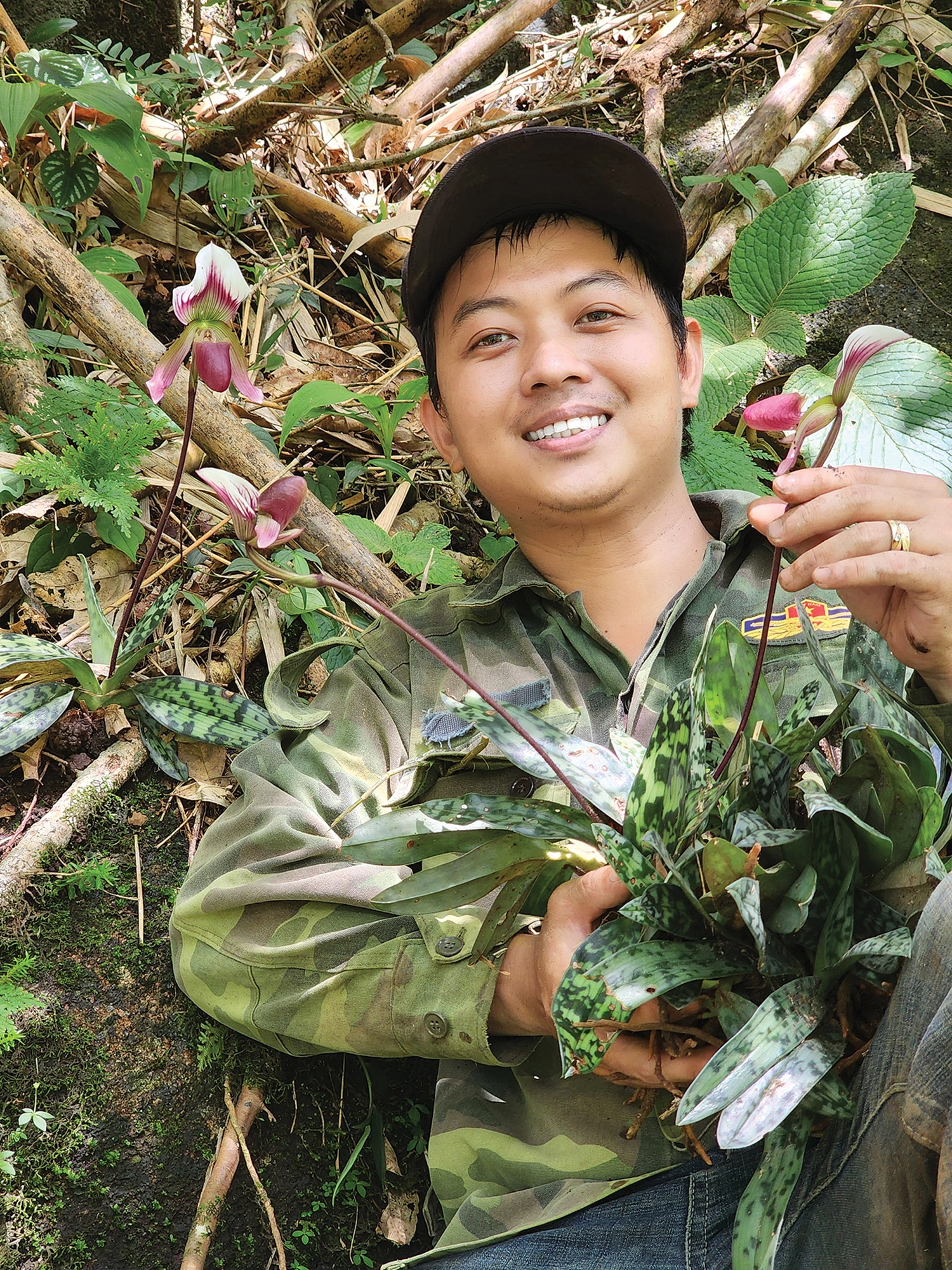
Forest worker Nguyen Sy Dac stands next to the slipper orchid from Yunnan, Gia Lai, that he found.
In mid-December, also the coldest season in the Central Highlands, we had the opportunity to accompany Nguyen Sy Dac (24 years old, residing in Ia Ly town, Chu Pah district, Gia Lai province) into the forest. The journey to hunt for rare orchids began at 5 am. Dac went with another friend, named Ro Cham Ban (residing in Ia Ka commune, Chu Pah district).
Both were renowned foresters, intimately familiar with every tree and patch of forest, and skilled at climbing tall trees and cliffs with remarkable speed.
At dawn, the group, carrying rice, protective gear, ropes, small hoes, and other supplies, headed towards the summit of Ia Kreng mountain in Chu Pah district.
Along the approximately 20km journey, which was mostly difficult dirt roads (we traveled by motorbike), Mr. Dac confided that, lacking arable land, for many years they had formed a group specializing in hunting for non-timber forest products such as orchids, honey, and mushrooms. Their daily income could reach 5-6 million dong, but there were also days when they worked hard all day and returned empty-handed.
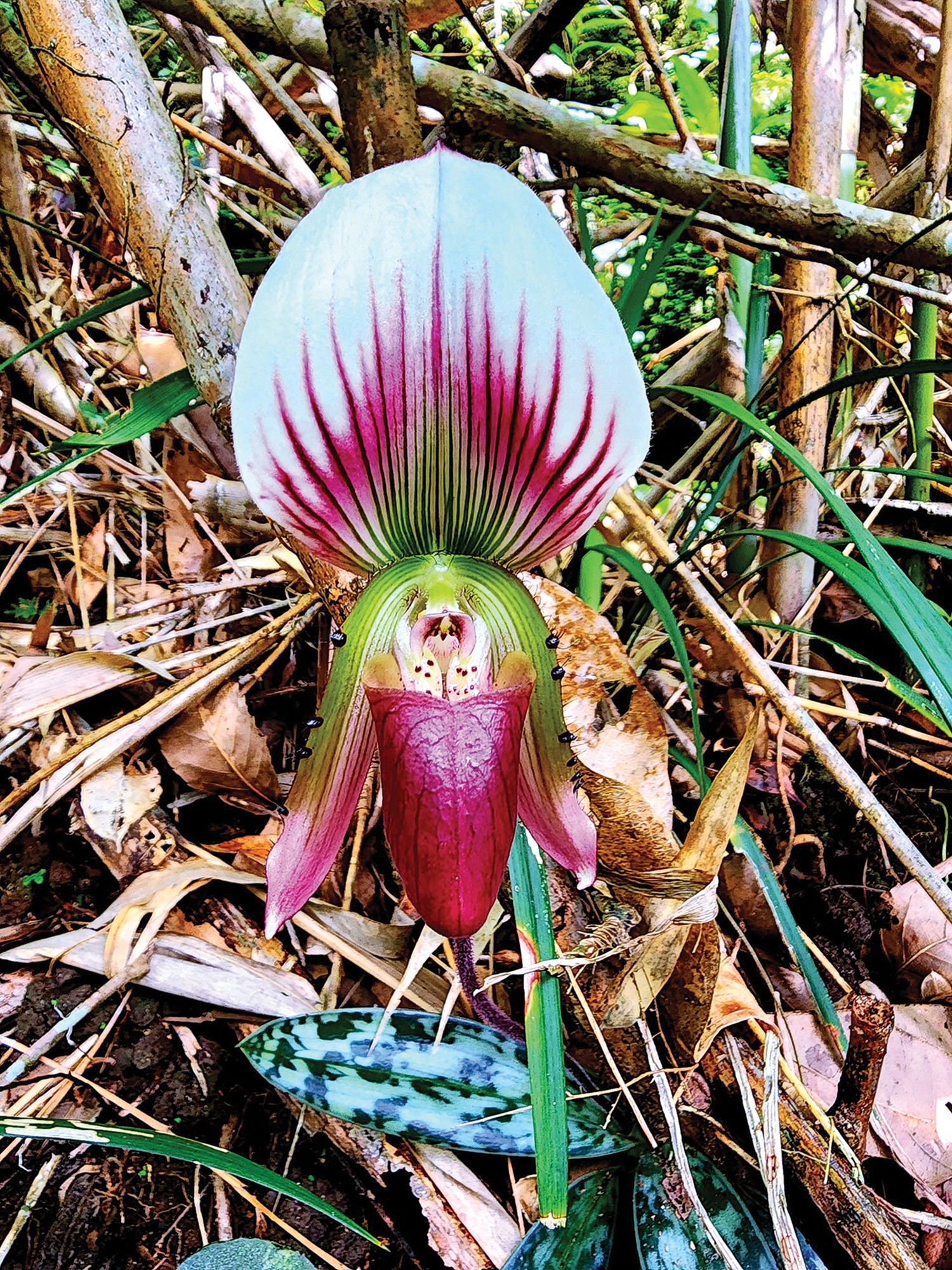
The Phalaenopsis orchid from Yunnan, Gia Lai, is in bloom. Photo: Ho Sy Dac.
Continuing on, heading towards the headwaters of the Ia Ly hydroelectric power plant, then to the headwaters of the Se San hydroelectric power plant, the vast forest finally appeared before our eyes.
According to Mr. Dac, in addition to his ability to climb mountains, cross waterfalls, and his experience in the forest, conquering tall trees has helped him find and harvest valuable products, providing him with additional income to support his family.
"The goal of this trip is to 'hunt' down the orchid species called 'Yunnan Slipper Orchid' which is currently being ordered by some customers in Ho Chi Minh City and Lam Dong . This orchid, when in bloom, has a very beautiful pink color and costs from 800,000 to 1,000,000 VND/kg."
"This slipper orchid species is very rare, more expensive than others, and has a very attractive, harmonious color. It is distributed on high mountain peaks, with some plants only appearing at altitudes above 1,000m," Mr. Dac said.
Sitting behind Mr. Dac on his motorbike, Mr. Ro Cham Ban recounted that in the past, when the forests were still abundant, finding the Yunnan slipper orchid wasn't too difficult. However, now that the forests are sparser, they have to trek from one mountaintop to another, and only with great luck can they find a cluster of a few dozen plants.
"Now they are only found in pristine forests, and to get them you have to cross waterfalls and climb high mountain peaks. That's why when we come across this orchid species, we only take half, leaving the rest to continue growing and multiplying new shoots," Ban shared.
Danger lurks
According to Mr. Dac, those who hunt for forest products must be patient, hardworking, and always willing to face and accept danger. Those who are skilled at navigating the forest can earn between 400,000 and 600,000 VND per day. If they find large, valuable orchid or mushroom patches, the amount earned can be several times higher.
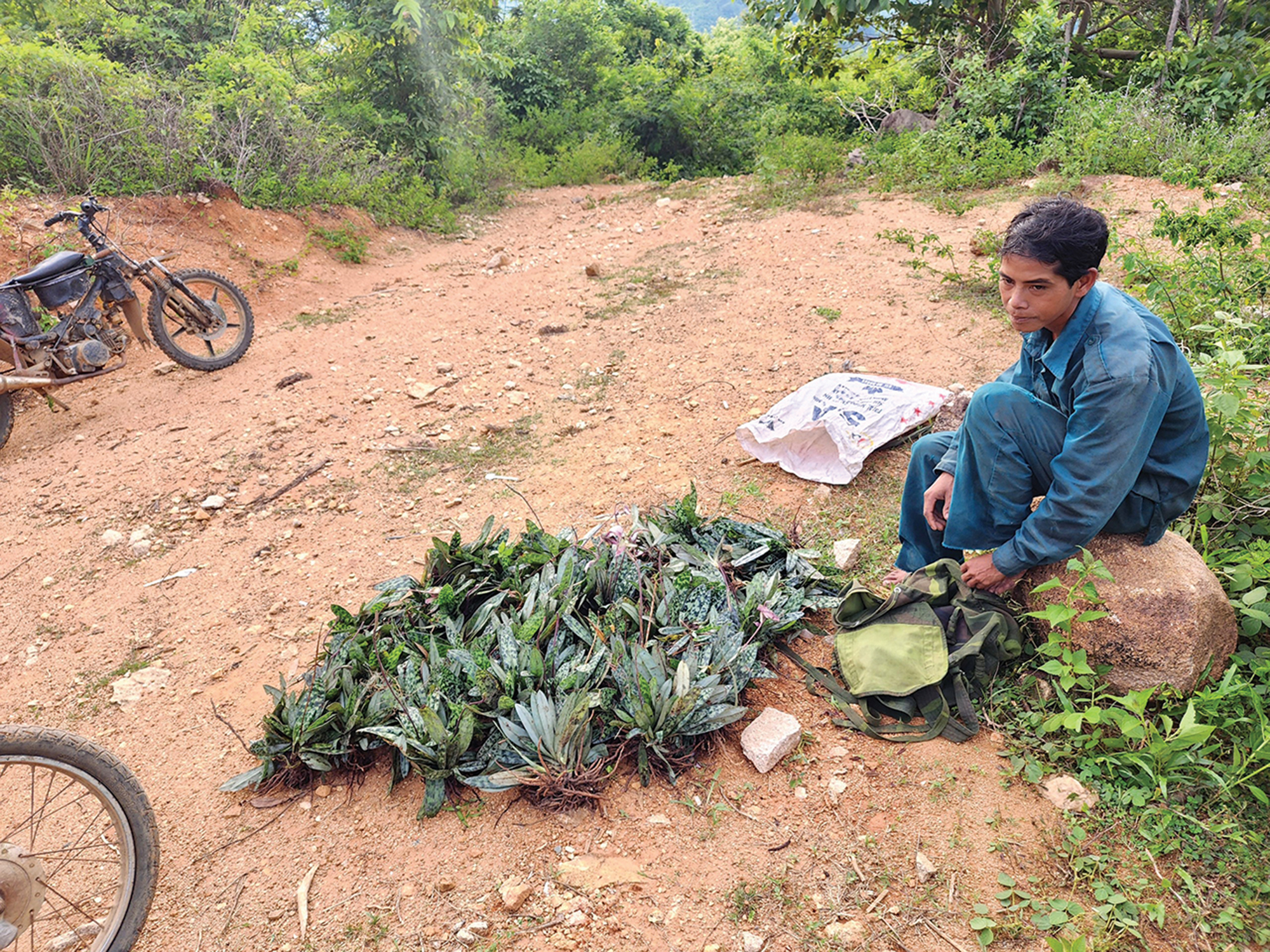
The forest worker stands beside his prized achievement: the Yunnan slipper orchid.
"A few months ago, my group discovered a patch of Hai Van Nam orchids, which sold for 6 million dong. Before that, we also found many types of reishi mushrooms, green wood mushrooms, crane's neck mushrooms, and ginseng... which sold for several million dong per kilogram," Dac boasted.
He said that in the past, many people flocked to the forest to hunt for "gifts from nature." To improve their family income, they sometimes had to gamble with their lives on high trees or towering cliffs. However, nowadays fewer people go into the forest, as most have gone to the South to work as laborers, and besides, this profession is very dangerous.
"I know it's dangerous, but there's no other way. Only by taking such risks can we have a chance to earn millions of dong and support our family," Dac shared, adding that forest workers must have skills because there are no other tools to assist them. Besides being strong and agile, forest workers must also be good at climbing and have "nerves of steel," not afraid of heights.
Moreover, venturing deep into the forest can easily lead to encounters with dangerous reptiles such as snakes, centipedes, and insects, or the touching of poisonous plants like Strychnos nux-vomica, poisonous trees, and poisonous mushrooms. Many people from his village have lost their lives while collecting orchids in the deep forest.
Then, pointing towards a rocky outcrop by the stream, where a large, decaying tree, its trunk thicker than a man's embrace, had fallen a decade ago, Mr. Dac said, "Last year we dug up a few trees there, but we left some smaller ones to grow. I'm sure there will be a big one if we go in now." He then took out his hoe, grabbed his machete, and gestured for us to follow him.
Just as Dac had said, a cluster of slipper orchids appeared around the decaying tree trunk. Dac said that last year these plants were only the size of a fingertip. Then, Dac gently used the tip of his machete to pry around them, uprooting them and showing them to everyone: "One of these should be worth 200,000 dong; they won't bloom until the end of the rainy season. Now let's use the machete to dig up the roots of the larger plants. We'll leave the smaller ones for next year."
After a day of trekking in the forest, our group only managed to find a few small slipper orchids from Gia Lai. Along the way, everyone also took the opportunity to pick some crane's neck mushrooms and blood-boosting herbs like the vine plant...
"Today was a complete failure. That's the life of a forest dweller! If we're lucky, we might earn a few million dong per trip, but sometimes we don't get anything for days. We know this, but we still accept it for the sake of making a living," Dac confided.
Speaking with us, Mr. Pham Thanh Phuoc, Head of the Ia Ly Protective Forest Management Board, said that people living near the forest often form small groups to go into the forest to find non-timber forest products. Because this is also a source of income for the people, the management board often promotes and encourages them to harvest only enough orchids and mushrooms, creating a balance for the development of forest resources.
"Many groups of forest workers have also become more conscious of this, only taking half of the forest products they find. They leave the rest to grow and thrive to avoid depleting genetic resources. When they discover rare plant species, they immediately report it so that the forest protection force can take measures to protect them," Mr. Phuoc said.
Source






























































































Comment (0)