

Previously, Viet Duc Friendship Hospital admitted patient BVL (43 years old, Phu Tho ) with severe headache, diagnosed with a large brain parenchymal glioma (~8 cm), the tumor spread deep into many important functional areas of the right hemisphere, including the motor area, language area and internal capsule area - the place that controls movement of half the body.
Dr. Nguyen Duy Tuyen, Head of Department of Neurosurgery 2, Viet Duc Friendship Hospital, said the challenge for the surgical team was how to remove as much of the tumor as possible while still preserving nerve function.
In particular, with high-grade malignant gliomas, surgical standards recommend removing an additional 4–5 mm of invasive tissue around the tumor to limit recurrence, but the closer to the functional area, the greater the risk of sequelae.
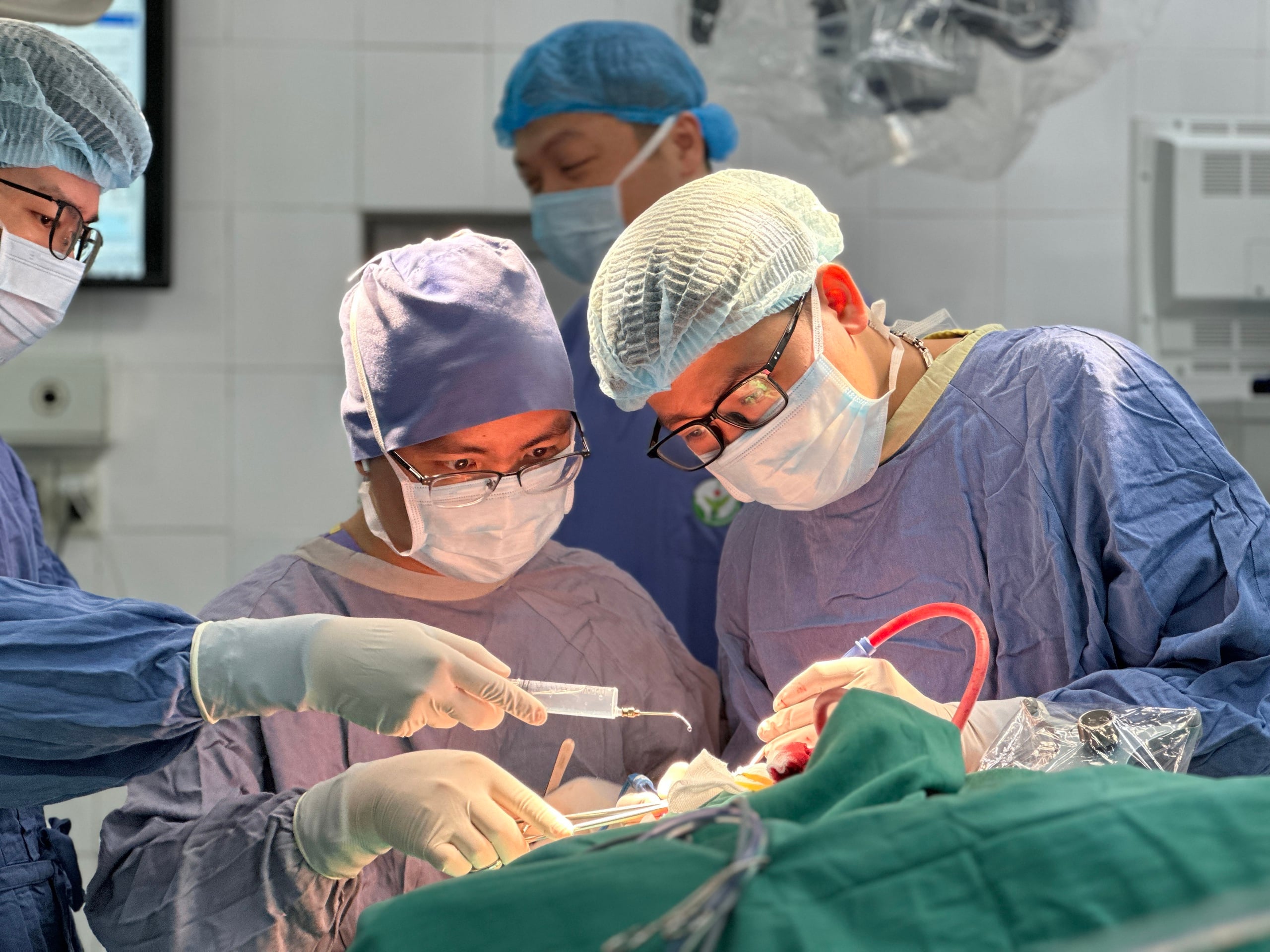
Doctors at Viet Duc Friendship Hospital perform surgery on a patient. Photo: BVCC
For the first time at Viet Duc Friendship Hospital, the team applied the technique of placing electrodes to continuously monitor the patient's function while the patient was under general anesthesia, replacing the awake surgery method which is difficult to apply to large tumors and requires a long surgery time.
Doctors said the surgical procedure was carried out in strict steps, starting with mapping the cerebral cortex to guide the approach through the "non-functional" area, then when reaching the central gray nucleus - where motor pathways are located, the surgeon used probe electrodes to both aspirate the tumor and detect functional signals.
The electrode system is attached to the corresponding muscle groups (the right hemisphere is attached to the left arm and leg and vice versa) to monitor motor response in real time. When approaching the functional area about 3-4 mm, the device gives a warning and when only 1 mm away, the signal is transmitted directly to help the surgeon stop at the right time, preserving maximum nerve function while removing maximum tumor tissue.
Thanks to this technique, the team can safely control even when the tumor invades almost the entire hemisphere, and at the same time assess movement during surgery.
Before the incision was closed, electrical stimulation testing showed that the patient's limbs were still functioning well; after surgery, the patient was re-evaluated and noted to have completely preserved motor function despite extensive tumor dissemination.
Source: https://suckhoedoisong.vn/ap-dung-ky-thuat-moi-trong-phau-thuat-u-than-kinh-dem-lan-toa-rut-ngan-thoi-gian-mo-169251202180700604.htm




![[Photo] Worshiping the Tuyet Son statue - a nearly 400-year-old treasure at Keo Pagoda](/_next/image?url=https%3A%2F%2Fvphoto.vietnam.vn%2Fthumb%2F1200x675%2Fvietnam%2Fresource%2FIMAGE%2F2025%2F12%2F02%2F1764679323086_ndo_br_tempimageomw0hi-4884-jpg.webp&w=3840&q=75)
![[Photo] Parade to celebrate the 50th anniversary of Laos' National Day](/_next/image?url=https%3A%2F%2Fvphoto.vietnam.vn%2Fthumb%2F1200x675%2Fvietnam%2Fresource%2FIMAGE%2F2025%2F12%2F02%2F1764691918289_ndo_br_0-jpg.webp&w=3840&q=75)













































































Comment (0)