

Germany, Europe's engine of growth, continues to face a series of economic challenges, shaking its already fragile recovery momentum in 2024.
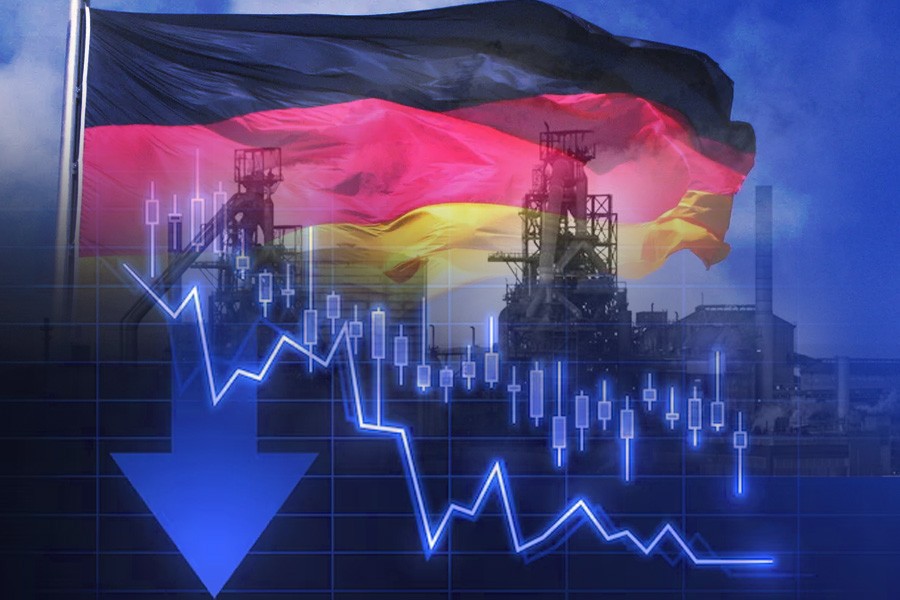 |
| The German economy contracted by 0.1% in the second quarter, after growing by 0.2% in the first four months of the year, according to Destatis. (Source: Collage The Gaze) |
The German economy and the economic sentiment across the Eurozone plummeted in August, driven by a slowdown in global trade, stock market volatility, and tensions in the Middle East.
The European Centre for Economic Emotions (ZEW) index – a key indicator of financial experts' expectations – plummeted from 41.8 points in July to just 19.2 points in August.
The sentiment of disappointment reflects growing pessimism about the prospects of Europe's leading economy and highlights broader concerns for the entire Eurozone.
Are expectations for the German and Eurozone economies worsening?
The problem here is that this decline in sentiment was so unexpected, not only falling below market expectations of just 32 points, but also marking the sharpest monthly decline since July 2022.
Similarly, economic sentiment in the Eurozone also deteriorated significantly, with the corresponding index falling from 43.7 to just 17.9 points, the lowest level since February and far below the expected 35.4 points. The 25.8-point drop represents the most severe monthly decline in the bloc's economic morale since April 2020.
Assessments of Germany's current economic situation have also worsened, with the relevant index falling 8.4 points to negative -77.3 points. However, the Eurozone economic situation index showed a slight improvement, rising 3.7 points to -32.4 points.
Europe's leading economy has faced a series of challenges, shaking its already fragile recovery momentum in 2024. A slowdown in global trade, exacerbated by weak demand in key markets such as China, has placed significant pressure on Germany's export-oriented economy.
"The German economic outlook is collapsing. In the current survey, we see that economic expectations have fallen most sharply in the last two years," said Professor Achim Wambach, President of ZEW, regarding the survey results. Professor Wambach emphasized that ongoing uncertainty, stemming from ambiguous monetary policy, disappointing business data, and escalating tensions in the Middle East, is also contributing to this destabilizing sentiment.
"Most recently, instability has also manifested itself in the turmoil of international stock markets," he added. The ZEW survey indicated that deteriorating sentiment was immediately visible across key stock market indices, with the morale of experts in the DAX and STOXX 50 falling by 6.5 and 4.6 points, respectively.
Financial market analysts have also turned pessimistic about the US dollar, predicting that the weakening economy and the possibility of a Federal Reserve interest rate cut will continue to put pressure on the greenback. The sentiment index for the strength of the US dollar against the euro has fallen 24.2 points from last month to -7.9 points.
By sector, sentiment declined across most key industries. The most significant drops were recorded in economically sensitive sectors such as retail and consumer goods, down 24.2 points, reflecting concerns about weakening consumer demand amid high inflation and rising interest rates. Other sectors that also saw sharp declines included electronics, down 18.1 points, and chemicals and pharmaceuticals, down 17.2 points.
Europe's "sickly" locomotive
This is the second time in a quarter century that Germany has been called "Europe's sickly." While still Europe's largest economy, Germany is one of the weakest in the region.
The German manufacturing sector is heavily dependent on global trade. The German economy is more export-dependent than other developed countries, with industrial production accounting for a large proportion of the economy. In particular, its leading manufacturing sector (automobiles) has become overly reliant on the Chinese market and has been slow to adapt to the growing demand for electric vehicles.
In a short period, Europe's economic powerhouse faced a series of headwinds, global trade weakened, China's growth struggled, and it lost access to cheap energy from Russia due to the Russia-Ukraine conflict.
Analyzing the situation, Tim Wollmshershauser, Head of Forecasting at the Ifo Institute – a leading German research organization – commented: “As a business destination, Germany has become less competitive in recent years. Besides rising energy prices, several other factors have contributed to this, including an unchanging high tax burden, increasing administrative costs, slow digitalization progress, and a worsening shortage of highly skilled labor…”
Meanwhile, China's demand for German industrial goods is expected to weaken permanently as the world's second-largest economy shifts toward strengthening the role of domestic manufacturing. The consequences of over-reliance on Russian gas have become clear over the past two years, exposing the Achilles' heel of the German growth model.
Key EU members are closely monitoring everything that happens in Berlin. Currently, the outlook is far from promising. Consulting firm BCA Research believes that slowing growth in Germany could drag the Eurozone down or have a ripple effect on other economies, such as France or Italy.
Global growth momentum over the past 12 months appears to have bypassed Europe. The region is grappling with the consequences of high energy prices, high interest rates to control inflation, and weak consumer confidence.
According to the latest data, the Eurozone economy is progressing slowly but steadily. However, this is not true for Germany. A comparison of the four largest Eurozone economies reveals a clear difference. Spain's economy is growing particularly strongly, with GDP increasing by 0.8%, France's by 0.3%, and Italy's by 0.2%. Conversely, Germany's economy is declining, with GDP down 0.1%.
Source: https://baoquocte.vn/bi-bo-lai-phia-sau-bi-quan-bao-trum-kinh-te-duc-dang-keo-lui-ca-khu-vuc-dong-euro-282678.html

![[Photo] Prime Minister Pham Minh Chinh attends the Conference summarizing and implementing tasks of the judicial sector.](/_next/image?url=https%3A%2F%2Fvphoto.vietnam.vn%2Fthumb%2F1200x675%2Fvietnam%2Fresource%2FIMAGE%2F2025%2F12%2F13%2F1765616082148_dsc-5565-jpg.webp&w=3840&q=75)













































































Comment (0)