

Scientists in the US have filmed a super-black anglerfish, capable of absorbing at least 99.5% of light, in the deep waters off the coast of California.
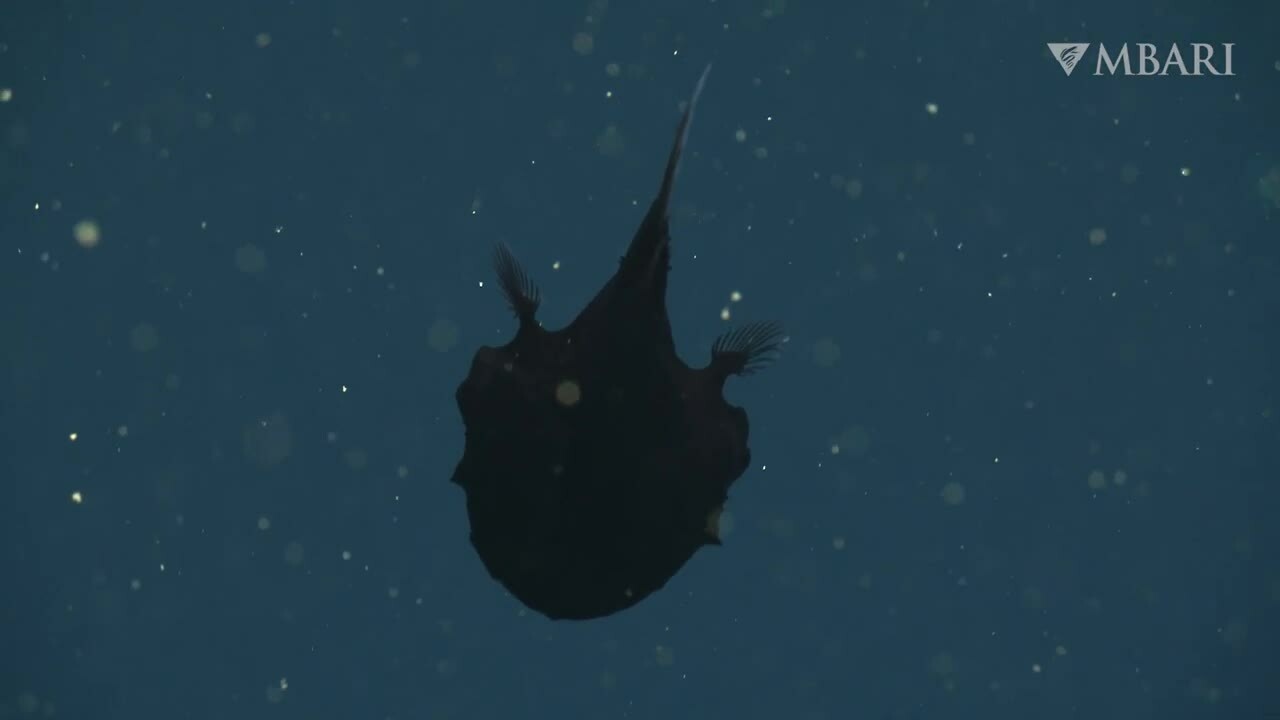
A super black anglerfish swims in the deep waters off the coast of California, USA. Video : MBARI
Scientists from the Monterey Bay Aquarium Research Institute (MBARI) discovered an unidentified fish belonging to the genus Oneirodes , order Lophiiformes (Fin-footed fish or Anglerfish), Live Science reported on November 15. They filmed the animal at a depth of 781 meters underwater using a remotely operated vehicle (ROV) in Monterey Canyon, a massive underwater canyon stretching over 470 kilometers off the coast of California, USA.
The research team stumbled upon this ball-sized fish while collecting small, spiny creatures called phaeodarians – which float in water columns and feed on fallen organic debris (sea snow). According to an MBARI statement, this is the first Oneirodes fish observed in Monterey Gorge since 2016.
In the video, sea snow hovers around the creature, but viewers can barely see its details except for its body outline. The reason is that the fish's skin is so dark that it absorbs a large amount of light and acts like a cloak of invisibility, according to Bruce Robinson, a senior scientist at MBARI.
This fish belongs to a group of "ultra-black" deep-sea creatures, absorbing at least 99.5% of the light that reaches it. According to a 2020 study in the journal Current Biology , 15 other marine species are capable of absorbing such a large amount of light. The study revealed that their skin contains a large number of melanosomes – cells containing the pigment melanin, which is also the pigment that gives human skin its color. The shape and structure of these cells allow them to absorb most wavelengths of light that hit their skin.
"Their ultra-black skin absorbs all light, including the bright light from the fish's lure-like appendages, which resemble streetlights. There's nothing to reflect, revealing their location," explains study co-author Karen Osborn, a zoologist at the Smithsonian National Museum of Natural History and MBARI. This allows the Oneirodes fish to remain hidden while waiting and use its bioluminescent lure-like appendages to attract prey.
Their remarkable camouflage abilities also help them evade predators. When the MBARI team spotted the Oneirodes fish, it was using bait. But the animal quickly "turned off its lights" when it realized it was being watched. The scientists identified it as a female based on its size. Female Oneirodes can grow up to 37 cm in length, while males are only about 1.3 cm long.
Thu Thao (According to Live Science )
Source link


![[Photo] Prime Minister Pham Minh Chinh attends the Conference summarizing and implementing tasks of the judicial sector.](/_next/image?url=https%3A%2F%2Fvphoto.vietnam.vn%2Fthumb%2F1200x675%2Fvietnam%2Fresource%2FIMAGE%2F2025%2F12%2F13%2F1765616082148_dsc-5565-jpg.webp&w=3840&q=75)


































































































Comment (0)