

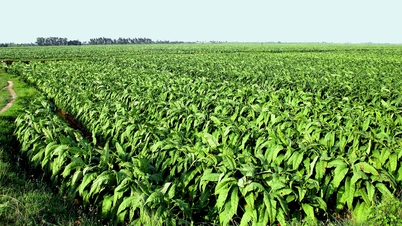
After the safe vegetable farming project, funded by the New Zealand Embassy, ended in 2021, the local people continued to maintain it to improve economic efficiency.
As someone deeply involved in safe vegetable farming in Vinh Son commune, Mr. Dang Van Khanh (K3 village) said: After the project ended, the villagers gradually became familiar with safe vegetable farming techniques, including many temperate vegetables. Some households in K3 and K2 villages continue to maintain safe vegetable farming to supply the market.
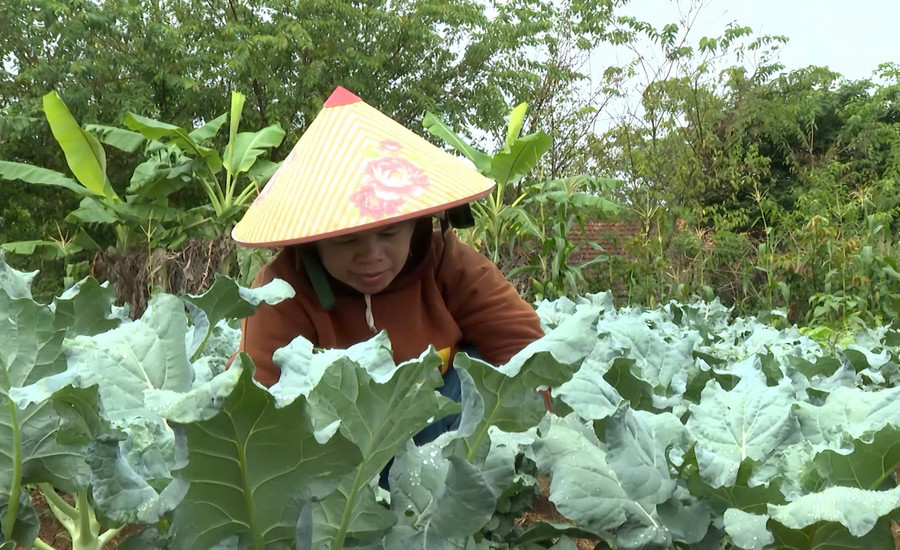
On her plot of land, spanning over 4 acres, Ms. Dinh Thi Boi (from K3 village) previously only grew mung beans and black beans, resulting in a rather unstable income. After participating in a safe vegetable farming project funded by the New Zealand Embassy, she received technical training and access to new farming methods, leading her to gradually switch to growing temperate vegetables such as cauliflower, Chinese cabbage, carrots, and lettuce.
Thanks to her persistent learning and accumulation of practical experience, she gradually overcame pests and diseases, and her production became increasingly stable.
Her vegetables not only meet the needs of local residents but are also ordered by companies and distributors in quantities ranging from tens to hundreds of kilograms.
“Thanks to the support of many people, the income from growing safe vegetables is becoming increasingly stable. From a few hundred square meters participating in the project, I have now expanded the area for growing safe vegetables to 1,000 square meters . I also feel more secure and committed to this profession in the long term,” Ms. Boi shared.
Many other households in Vinh Son are also actively changing their crop structure. Bui Ngoc Thanh (in K2 village) is a prime example. Initially, he only planted a few acres of vegetables, applying a staggered planting method to both control weeds and ensure a year-round supply. Later, he expanded the area for growing temperate vegetables to nearly 2 hectares.
Thanks to its connection with community tourism , Mr. Thanh's vegetable products have a unique advantage; some are sold to tourists who come to experience Vinh Son, and some are sold seasonally through partnerships with shops and mini-supermarkets.
Building on that foundation, for the Lunar New Year season of 2025, Mr. Thanh invested in planting 1,000 m² of strawberries combined with experiential tourism. “Visitors to Vinh Son not only admire cherry blossoms and apricot blossoms, but also have the experience of picking strawberries in the garden. The more visitors come to visit and experience, the more widely known local agricultural products, especially safe vegetables, will become, opening up greater sales opportunities,” Mr. Thanh said.
According to Mr. Dinh Cu, Vice Chairman of the People's Committee of Vinh Son commune, initial results show that temperate vegetables are perfectly suited to the local climate and soil. Identifying this as one of the main directions, the commune will coordinate with specialized units to transfer scientific and technological advancements and build linkages between vegetable growers and consuming businesses to stabilize output.
“After the safe vegetable production project, the people have changed their mindset and methods, becoming more proactive in production and knowing how to take advantage of the climate and land to develop clean agriculture. In the long term, temperate vegetables and fruit trees not only create stable livelihoods for the people, but can also be combined with ecotourism to contribute positively to the socio-economic development of the locality,” Mr. Cu emphasized.
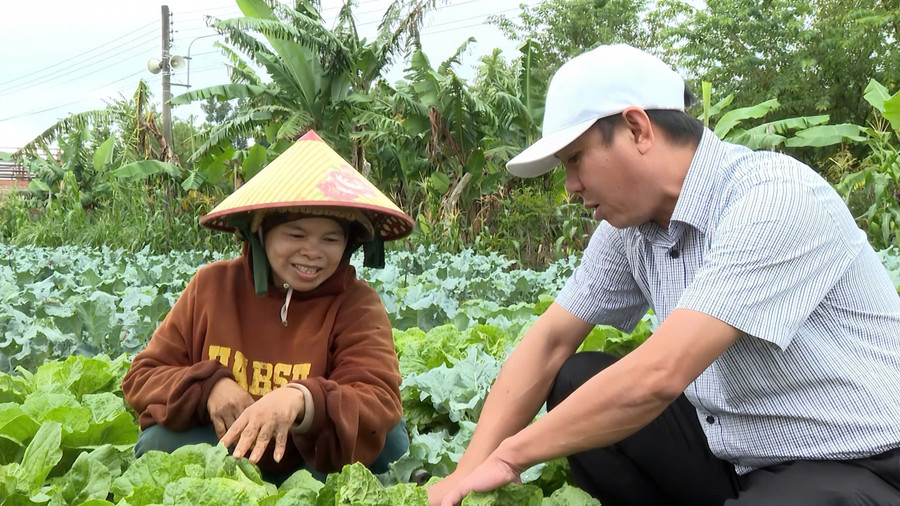
However, to realize this direction, many difficulties still need to be overcome. Mr. Le Van Thuan, Head of the Economic Department of Vinh Son commune, said that the biggest challenge currently is irrigation water. The locality is seeking suitable sources of capital to invest in an irrigation system, helping farmers cultivate more efficiently.
Simultaneously, the commune has also incorporated temperate vegetables into its agricultural and forestry development plan, linking them with other key crops such as macadamia nuts, durian, oranges, lemons, and avocados.
Source: https://baogialai.com.vn/cai-thien-thu-nhap-tu-rau-an-toan-post567195.html

![[Photo] The heat at the fireworks display site on the opening night of the Da Nang International Fireworks Festival 2026](https://vphoto.vietnam.vn/thumb/1200x675/vietnam/resource/IMAGE/2026/05/27/1779889741485_ndo_br_z7872039145157-fecaba5112f39e8352544099d7ef4738-5140-jpg.webp)
![[Photo] Life on both banks of the river returns to its bustling pace on the day the Long Bien Bridge opens to traffic.](https://vphoto.vietnam.vn/thumb/1200x675/vietnam/resource/IMAGE/2026/05/28/1779949763708_cau-long-bien-minh-duy-7-3610-jpg.webp)
![[Image] Checking the security conditions at the exam site, ready for the 10th grade exam.](https://vphoto.vietnam.vn/thumb/1200x675/vietnam/resource/IMAGE/2026/05/28/1779943458889_z7872507660648-d764421a26e8cd7b61d70d142a48a685-jpg.webp)













![[Photo] Opening Ceremony of the National People's Council Conference on the Implementation of Directions and Tasks for the 2026-2031 Term](https://vphoto.vietnam.vn/thumb/1200x675/vietnam/resource/IMAGE/2026/05/28/1779939257690_ndo_br_bnd-1991-jpg.webp)









































Comment (0)