

(CLO) The economics of journalism are playing an increasingly important role as media organizations must become financially independent. Entering the digital age, journalism faces heavy pressure from declining revenue while production and distribution costs continue to rise. This necessitates a more appropriate tax incentive policy in this new context to continue fulfilling the political tasks entrusted by the Party, the State, and the People.
The challenge in the “dual mission…”
In reality, the revenue of media organizations largely depends on advertising, but advertising revenue at media organizations is currently declining while production costs are increasing. Meanwhile, media organizations still have to fulfill their political duties as stipulated by regulations. Therefore, the proposal to reduce corporate income tax for media organizations is receiving attention from leaders of media organizations and journalists nationwide.
Discussing this issue, journalist Phung Cong Suong, Editor-in-Chief of Tien Phong newspaper, stated that media organizations are public service agencies, not businesses, but currently most of them have to simultaneously fulfill the political tasks of the Party and the State, carry out the tasks assigned by their governing bodies, and be financially self-sufficient.
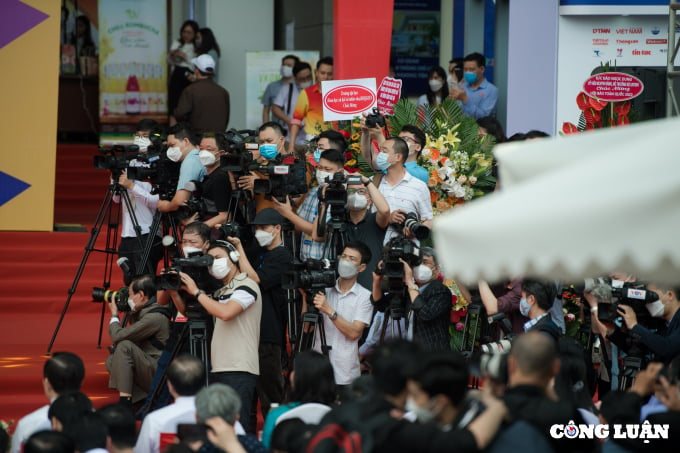
Journalists are working tirelessly day and night, with high intensity and great creativity, to fulfill the tasks and missions entrusted to them by the Party, the State, and the People.
In fulfilling its mission, the press is facing various challenges. Objectively, this includes fierce competition from cross-border advertising platforms such as Facebook, TikTok, and YouTube, as well as other social media sites that are attracting readers and advertisers.
Regarding subjective pressures, journalist Phung Cong Suong believes that most newspapers face difficulties in generating revenue from advertising. He analyzed: For print newspapers, media organizations that own print publications are currently operating at a loss. They maintain print publications to fulfill political objectives, but in reality, very few or no media organizations can balance their revenue and expenses or make a profit from distribution through market channels… The number of newspapers sold cannot increase, while the number of employees in media organizations cannot be reduced. Not to mention, producing print newspapers also involves printing costs, distribution costs, and royalties that cannot be cut to maintain a newspaper.
Regarding online newspapers, Mr. Phung Cong Suong observed that currently, most newspapers do not charge readers; users access them for free. Only a few newspapers charge fees, but they do not have a real source of revenue from readers. Even without charging fees, these media outlets still have to produce a large amount of content and maintain operations related to internet connectivity, bandwidth, cybersecurity technology, information security, and data systems. All of these costs remain the same as those of a business, without any external support.
And importantly, regarding the mechanism of autonomy, the Tien Phong newspaper has been autonomous since 1974 and has enjoyed full autonomy for decades. Thus, the press has been and is falling into a paradox: it must simultaneously fulfill its propaganda and political tasks while also ensuring funding to maintain publications that are not effective.
From the perspective of a reputable media organization striving to fulfill its "dual mission," the Editor-in-Chief of Tien Phong newspaper emphasized: "In terms of role and position, both the press and businesses are important forces, but their operating mechanisms have fundamental differences, so they cannot be treated the same when applying tax rates. Businesses can operate in all fields not prohibited by law, while the press operates like an autonomous business, paying taxes but only allowed to operate according to its stated principles and objectives, thus almost being 'constrained' and finding it very difficult to develop like a business ."
Of course, the Editor-in-Chief of Tien Phong newspaper also stated that, amidst those difficulties, the Party and State have implemented policies to support the press by issuing regulations on policy communication. However, the participation of media outlets in the policy communication market is limited, only a trickle, insignificant compared to the expenses incurred by these media organizations.
“The press is currently facing great difficulties. Some newspapers are lucky enough to make a profit, but most are breaking even or losing money, barely scraping by, lacking long-term revenue streams for investment and development, or for accumulation. We have to find many ways to generate income, but honestly, we still find ourselves spending every penny we earn, and sadly, this is a common situation. Even if corporate income tax for the press is reduced to 0% for one or two years, I think it would only be symbolic because, fundamentally, the press doesn't generate income to be taxed. However, reducing corporate income tax for the press would certainly be a valuable encouragement for journalists who work tirelessly day and night, with high intensity and great creativity. Therefore, I propose that not only should the tax be reduced to 10% for all types of media, but the Party and State should also have a roadmap for tax exemption for the press. This would demonstrate their concern.” "This concerns the Party and the State regarding journalistic activities, and also allows the press to confidently carry out its political tasks, fulfill its mission as an organ for disseminating laws, and as a propaganda tool of the Party, the State, and the People..." – journalist Phung Cong Suong pondered and proposed.
Businesses should not be equated with media organizations.
Sharing the view that there needs to be a more "fair mechanism" for the press, journalist Le Van Toa - Chairman of the Lam Dong Provincial Journalists Association - argued that all media outlets, regardless of type, whether radio or television, print or online, have unique characteristics; they are revenue-generating public service organizations, not necessarily businesses. Businesses primarily focus on profit. Media organizations, on the other hand, have a political mission: to disseminate the Party's guidelines and policies, and the State's laws and regulations, playing a crucial role in raising awareness among officials, Party members, and the people. Applying the same tax rate as businesses would be unreasonable and unfair.
“We shouldn’t equate businesses with media organizations. The press performs a unique function, not a business, and media leaders are not entrepreneurs. Therefore, tax policies must take this unique characteristic into account. I hope that state tax authorities will continue to research and significantly reduce corporate income tax and VAT to better suit journalistic activities. Only then will the press have the strength to improve its quality and compete with current social media platforms,” journalist Le Van Toa shared.
In reality, social media platforms like TikTok, YouTube, and Facebook are creating fierce competition, causing the revenue of news organizations to continue to decline sharply. To compete for a share of the economic pie, many news organizations are forced to restructure a portion of their revenue to invest in infrastructure, personnel, and content planning. Many news organizations are boldly diversifying their revenue sources, including: traditional advertising; fee-based revenue; media partnerships; event organization; e-commerce; providing IT services; conducting research, etc. However, news revenue has not yet shown significant improvement. Given this reality, and considering that the tax applied to the press for many years has remained relatively high, Associate Professor Dr. Dinh Trong Thinh - Senior Lecturer at the Academy of Finance, commented: “Before the tax rates are issued, state management agencies need time to study them. This will ensure that when they are issued, they will serve as a basis for state management agencies in charge of the press and press agencies to apply and implement. When the tax rate is at the most reasonable level, the tax sector will collect tax revenue, and press agencies will also find it easier to implement. The field of journalism is a relatively special field, providing a special service, therefore thorough research is needed to apply an appropriate tax rate.”
Therefore, along with the practical difficulties, especially with the draft Corporate Income Tax Law (amended) officially being submitted to the National Assembly for comments at this 8th session, the proposal to reduce corporate income tax for the press is urgent. This time, amending the Corporate Income Tax Law is also an opportunity to revise tax regulations for press agencies. Press agencies hope to receive attention and consideration to have appropriate tax policies that enhance the competitiveness and development of the press, and continue to serve even better in the journey towards its 100th anniversary.
Ha Van - Le Tam
Source: https://www.congluan.vn/can-co-co-che-cong-bang-hon-nua-voi-bao-chi-post318021.html



































































































Comment (0)