

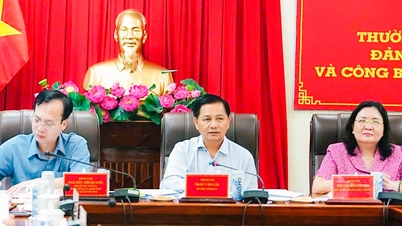
National Assembly Delegate Huynh Thi Hang Nga - Deputy Chief of Office of Vinh Long Provincial Party Committee participated in the discussion at the Delegate Group (afternoon of December 3, 2025) on the investment policy of the National Target Program (NTP) on new rural areas, sustainable poverty reduction, and socio -economic development in ethnic minority and mountainous areas by 2035.
|
|

National Assembly Delegate Huynh Thi Hang Nga said that in the past time, with the strong direction of the National Assembly, the Government, the Prime Minister, the Central Steering Committee and localities, along with the determination of the entire political system, especially the unanimous response of all classes of people, all 3 National Target Programs have basically achieved and exceeded the assigned targets for the period 2021-2025. The poverty rate according to the multidimensional poverty standard by the end of 2024 will be 1.93%, an average decrease of 1.03%/year, achieving the target of reducing from 1-1.5% assigned by the National Assembly and the Government. The rate of poor ethnic minority households by the end of 2024 will be 12.55%, an average decrease of 4.45%), achieving the target assigned by the National Assembly and the Government to reduce by 3%/year. By 2025, 19 extremely disadvantaged communes in coastal and island areas will be freed from the extremely disadvantaged situation, reaching 35%, exceeding the target assigned by the National Assembly and the Government.
Based on the achievements of the National Target Program in the past time, delegates agreed to promulgate the National Target Program on new rural construction, sustainable poverty reduction and socio-economic development in ethnic minority and mountainous areas for the period 2026-2035. To contribute to the completion of the draft Resolution, delegates contributed a number of specific issues as follows:
Firstly, to implement the National Target Programs approved at the 10th Session, according to delegates, the resources for implementation are very large (drugs are 22,450.194 billion VND, education and training is 560,000 billion VND, health care is 705,000 billion VND, new rural areas, sustainable poverty reduction, socio-economic development in ethnic minority and mountainous areas is 240,697 billion VND), the important thing is to arrange capital from the local budget to implement the program. Therefore, delegates suggested that the Government pay attention to closely evaluating to allocate the budget to appropriate localities, in order to contribute to achieving the goals of the programs, especially the resources to implement the goals of the project to ensure stability, continuity, and not interrupt the policies, projects, and tasks being implemented. At the same time, there should be a mechanism to monitor, evaluate, and adjust promptly to improve the efficiency of capital use.
The National Target Program for Ethnic Minorities and Mountainous Areas is a major policy of the Party and State on ethnic policies. The disbursement results up to 2025 have also made certain progress with a high total disbursement budget. Integration is the right policy.
The delegates also agreed on the policy of only prescribing the framework contents of principles for the Government to implement. However, if some contents are already clear and necessary, it is proposed to assign tasks immediately, in the Resolution of the National Assembly on assigning specialized ministries to preside over each component of this Program, directly assigning the Ministry of Ethnic Minorities and Religions to preside over the content of Component 2 to ensure the organization and implementation of ethnic policies are continuous and promote the highest efficiency.
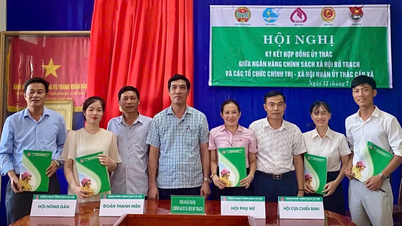
Second, at point d, clause 5, Article 1 of the draft Resolution, the delegate proposed to continue to pay attention to balancing the central budget to prioritize additional support for the Program, including social policy credit capital, in accordance with actual conditions to have enough resources to support the implementation of assigned goals and tasks. To effectively implement the program, the delegate suggested to pay attention to expanding the beneficiaries to the group that has just escaped poverty and near poverty. Because when the communes achieve the National Target Program on New Rural Communes, the rate of poor and near-poor households will naturally decrease, and the loan programs of the Social Policy Bank will not lend again for reinvestment in production, which will affect the capital for production and business of households.
In addition, some loan programs for job creation, clean water, environmental sanitation, and social housing have not yet met the demand. Therefore, delegates suggested reviewing and evaluating the actual loan programs for poor and near-poor households to improve the mechanism; increase the loan limit, extend the loan support period for households that have just escaped poverty and near-poor; and convert the "free" support into preferential loans suitable to the actual situation. Pay attention to applying information technology in managing and monitoring capital sources to create transparency, improve credit efficiency, contribute to sustainable poverty reduction, and develop the socio-economy of each locality.
Third, in Article 3 of the draft Resolution, delegates proposed to supplement the responsibilities of ministries and branches in coordinating with localities and inter-sectoral coordination to ensure the implementation of the National Target Program, because this Program is large-scale, multi-sectoral, and long-term, it will certainly cause many problems in terms of procedures, norms, finance, investment, planning, and land. Therefore, delegates proposed to clearly stipulate the inter-sectoral coordination mechanism, delineate responsibilities, and focal points for handling problems.
Through the implementation of the National Target Programs for the period 2021-2025, many localities have reported that the guidance documents issued by ministries and branches are not consistent, even have overlapping content, causing the project preparation and disbursement progress to be delayed by 6-12 months; some projects to build schools and laboratories in difficult areas have been extended by 1-2 years just because they have to wait for opinions from many different ministries. This affirms that without a unified inter-sectoral coordination mechanism, no matter how well designed the program is, it will be difficult to achieve the set goals. From the above shortcomings, delegates agreed to establish a joint Steering Committee for the National Target Programs, unified from the Central to the local level, but it is necessary to establish it soon after the resolution is passed so that the Steering Committee has the task of coordinating and integrating tasks between programs to avoid overlap, checking and monitoring progress, and advising on timely solutions to difficulties.
Delegates also agreed to extend the implementation and disbursement period of the National Target Programs in 2025, including capital from previous years transferred to 2025, until December 31, 2026. They agreed to continue implementing specific mechanisms in program implementation and assign the Government to prescribe. However, it is also necessary to clearly assess the reasons for slow disbursement, subjective or objective responsibilities, and consider appropriate specific responsibilities so that when extending the disbursement period to December 31, 2026, all the remaining capital sources in the past must be disbursed, avoiding the situation where, when summarizing, it is necessary to request an extension of the disbursement period of the Program's capital sources in the coming time, except in cases of objective or force majeure.
YEN NHU (recorded)
Source: https://baovinhlong.com.vn/thoi-su/202512/can-dam-bao-nguon-luc-trien-khai-hieu-qua-chuong-trinh-muc-tieu-quoc-gia-5893257/
![[Photo] Cat Ba - Green island paradise](/_next/image?url=https%3A%2F%2Fvphoto.vietnam.vn%2Fthumb%2F1200x675%2Fvietnam%2Fresource%2FIMAGE%2F2025%2F12%2F04%2F1764821844074_ndo_br_1-dcbthienduongxanh638-jpg.webp&w=3840&q=75)


































![[VIMC 40 days of lightning speed] Da Nang Port: Unity - Lightning speed - Breakthrough to the finish line](https://vphoto.vietnam.vn/thumb/402x226/vietnam/resource/IMAGE/2025/12/04/1764833540882_cdn_4-12-25.jpeg)






































Comment (0)