

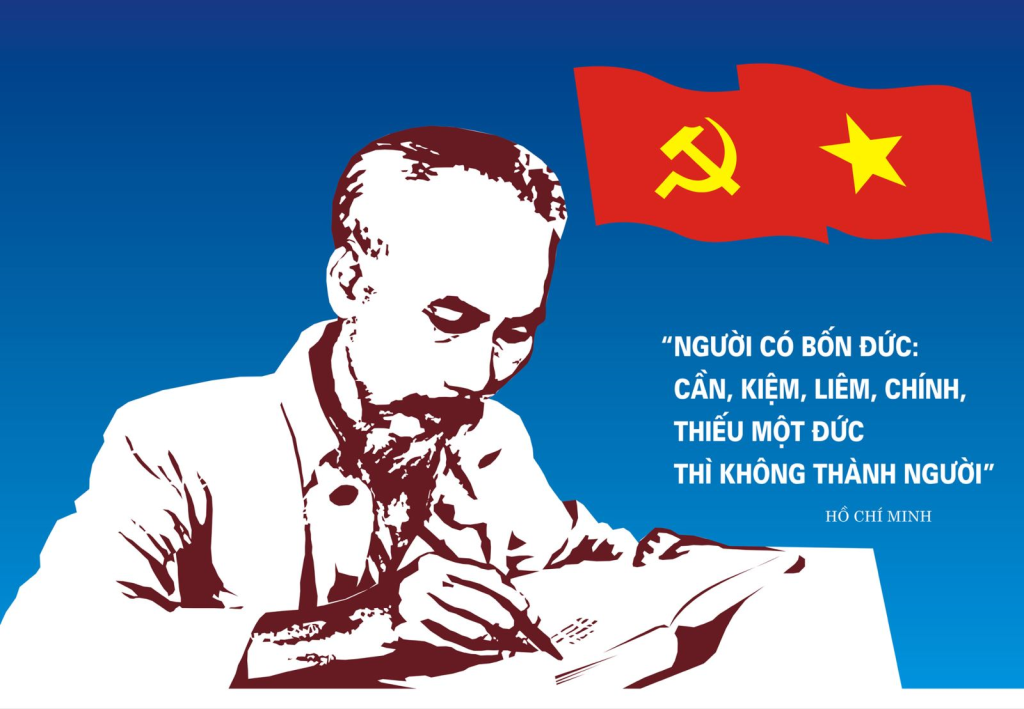
Illustrative image, source: Tuyengiao.vn.
One day after reading the Declaration of Independence that gave birth to the Democratic Republic of Vietnam, on September 3, 1945, at the Northern Government Palace, President Ho Chi Minh presided over the first meeting of the Government Council. It was at this crucial meeting that President Ho Chi Minh outlined six urgent tasks for the Democratic Republic of Vietnam.
Notably, in the fourth task, after stating: “The colonial regime poisoned our people with alcohol and opium. It used every means to corrupt our nation with bad habits, laziness, deceit, corruption, and other vices. We have the urgent task of re -educating our people. We must make our nation a brave, patriotic, hardworking nation, a nation worthy of an independent Vietnam,” President Ho Chi Minh emphasized: “I propose launching a campaign to re-educate the people's spirit by implementing: DILIGENCE, FRUGALITY, INTEGRITY, AND RIGHTEOUSNESS.” Amidst the overwhelming workload of the early days of nation-building, the fact that Uncle Ho emphasized “DILIGENCE, FRUGALITY, INTEGRITY, AND RIGHTEOUSNESS” shows how much he valued these “four virtues.”
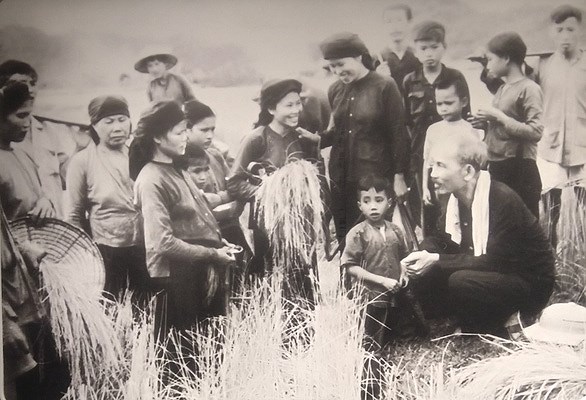
President Ho Chi Minh visits Hung Son Cooperative, Dai Tu district, Thai Nguyen province (1954). Archival photo.
Two years later, in his work "New Life" (March 1947), President Ho Chi Minh clearly stated that the essential task during the resistance war and national reconstruction was to practice a new way of life. The purpose of this new way of life was to make the lives of our people more materially fulfilling and spiritually joyful, so that all our compatriots could live prosperously and build a strong and wealthy Vietnam.
In his work, President Ho Chi Minh emphasized the need to practice "Diligence, Frugality, Integrity, and Righteousness," clearly stating that practicing this new way of life is the responsibility of all sectors, all classes, and all people. In particular, he clearly defined what "Diligence, Frugality, Integrity, and Righteousness" means. “…Practicing the new way of life means Diligence, Frugality, Integrity, and Righteousness. The army must diligently train and fight. The people must increase production and work diligently, then the resistance will surely be victorious, therefore Diligence is necessary. Soldiers must conserve ammunition, one bullet for one enemy. The people must conserve materials to help the army and the displaced people. Therefore Frugality is necessary. Everyone must be clean, not greedy, and not use public funds for private purposes, then everything will run smoothly. Therefore, everyone must be Honest. Every citizen must forget their family for the sake of the country, enthusiastically support the resistance, strive to increase production, eliminate traitors who harm the people, and resolutely make the Fatherland unified and independent. That is Righteousness” – The author wrote in the work.
In October 1947, when writing the work "Correcting Working Methods," President Ho Chi Minh also emphasized that: Every Party member, first and foremost every cadre, must honestly self-criticize and correct their own shortcomings. The interests of the Party and the nation must be placed above all else. They must resolutely combat complacency, self-sufficiency, selfishness, arrogance, and boastfulness. They must practice the slogan: "Impartiality, diligence, frugality, integrity, and righteousness!"
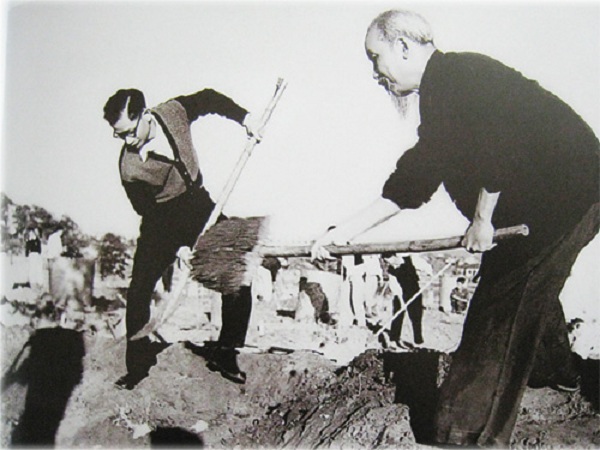
President Ho Chi Minh participating in labor activities at Thong Nhat Park, Hanoi. Photo: Archival.
Two years later, in 1949, President Ho Chi Minh wrote the work "Diligence, Frugality, Integrity, and Righteousness," consisting of four articles under the pseudonym Le Quyet Thang, published in the newspaper "Cuu Quoc" on May 30, 31, June 1, and June 2, 1949. In this work, he considered the "four virtues" as the foundation of the New Life, the foundation of patriotic emulation, and analyzed the "four virtues" in the overall context of heaven, earth, and humanity, and the relationship between seasons and heaven; between directions and earth; and between virtue and people. He affirmed: "Heaven has four seasons: Spring, Summer, Autumn, Winter / Earth has four directions: East, West, South, North / People have four virtues: Diligence, Frugality, Integrity, and Righteousness / Lacking one season, heaven is incomplete / Lacking one direction, earth is incomplete / Lacking one virtue, people are incomplete."
In four articles, President Ho Chi Minh further clarified the meaning of the four virtues: Diligence, Frugality, Integrity, and Righteousness. In the article "What is Diligence?", he clearly explained: "Diligence means being industrious, hardworking, and persistently striving. A knife that is diligently sharpened is sharp. A field that is diligently weeded will have good rice. That is very easy to understand. Diligent study leads to quick learning. Diligent thinking leads to good ideas. Diligent work certainly leads to success. Diligent activity leads to good health." He pointed out: "To make diligence more fruitful, there must be a plan for all work. That means careful calculation and neat arrangement… Therefore, diligence and planning must go hand in hand. Planning, in turn, goes hand in hand with division of labor"; "Diligence and specialization must go hand in hand. Specialization means persistence and perseverance." He also affirmed: "Laziness is the enemy of diligence... Therefore, laziness is also the enemy of the nation. Thus, a lazy person is guilty of betraying their compatriots and their country."
In the article "What is Frugality?", the author analyzes: "What is frugality? It is saving, not being extravagant, not wasteful, not reckless, and not being stingy or, in other words, not being wasteful. In this, Diligence must go hand in hand with Frugality "like the two legs of a person"; because "Frugality" without "Diligence" will not increase or develop. The author explains how to save, and further analyzes: "Time also needs to be saved like wealth. If wealth runs out, it can be replenished. Once time has passed, it can never be brought back. Can anyone bring back yesterday? To save time, we must do everything quickly and efficiently. We should not be slow. We should not procrastinate." Concluding the article, the author summarizes the results of saving as follows: “The result of NEED combined with the result of FRUGALITY is: the army will be well-fed, the people will be prosperous, the resistance will be quickly victorious, nation-building will be quickly successful, and our country will quickly become rich and strong, on par with advanced countries in the world. The result of NEED and FRUGALITY is so great. Therefore, patriotic people must compete in practicing frugality.”
In his article "What is Integrity?", Uncle Ho analyzed that "integrity" means being clean and not greedy for money or possessions. Actions that lead to greed for position, fame, or a life of luxury and comfort are all "unintegrity." Integrity must go hand in hand with frugality. Because extravagance breeds greed, and greed leads to unintegrity, therefore, officials must practice integrity first to set an example for the people. He clearly stated: "The people must know their rights, they must know how to control officials, to help officials practice integrity. The law must severely punish those who are unintegral, regardless of their position or profession." He concluded: "A nation that knows how to be thrifty, honest, and diligent is a nation rich in material wealth, strong in spirit, and a civilized and progressive nation."
The last of the four virtues is Righteousness. In the article "What is Righteousness?", he explained: "Righteousness means not being evil, it means being honest and upright. Anything that is not upright and honest is evil." He concluded: "Diligence, Frugality, and Integrity are the roots of Righteousness"; "Just as a tree needs roots, branches, leaves, flowers, and fruit to be complete, a person must be diligent, frugal, and honest, but also righteous to be a completely exemplary cadre."
Later, in his Last Will and Testament, Uncle Ho once again emphasized: "Every Party member and cadre must truly internalize revolutionary ethics, truly practice thrift, integrity, honesty, and selflessness."
President Ho Chi Minh was an exemplary communist, always consistent in his words and actions. During his lifetime, he lived simply, from his speech and deeds to his style, from his clothing to his daily life, even when he held the position of President. He only wore a few khaki suits of the same style, some with torn collars that had been patched and mended repeatedly, yet he still refused to change them. Once, he sincerely told a high-ranking Party leader: "Listen! The Chairman of the Party and the President of the country wearing a patched shirt like this is a blessing for the people; don't throw that blessing away." In 1954, when he moved to the Presidential Palace, he refused to live in the Governor-General's house and chose instead a house belonging to an electrician. In July 1968, the Politburo met and issued a resolution on organizing four major holidays of the year: the founding of the Party; National Day; Lenin's birthday; and President Ho Chi Minh's birthday. Upon hearing this news, he suggested: “I only agree to three-quarters of the Resolution. I do not agree to make May 19th a major anniversary next year. Currently, the students are about to start the new school year, and the paper, ink, and money used to publicize my birthday should be used to print textbooks and buy school supplies for the children, so as not to be wasted.”
“A person possesses four virtues: Diligence, Frugality, Integrity, and Righteousness. Without one season, heaven is incomplete. Without one direction, earth is incomplete. Without one virtue, a person is incomplete.” – These words of President Ho Chi Minh still resonate. The question is, how can we effectively put into practice what he taught?
According to Professor and Doctor Hoang Chi Bao, the Party must focus on education, especially among cadres and Party members, particularly those with important responsibilities. Based on incorporating ethics into Party building, it is necessary to promote education on honor, integrity, and the sense of shame when involved in wrongdoing or impropriety.
In June 2021, at the conference summarizing the five-year implementation of Directive 05 of the Politburo on "Promoting the study and emulation of Ho Chi Minh's thought, morality, and style," General Secretary Nguyen Phu Trong emphasized that one of the things to learn from and emulate President Ho Chi Minh is to maintain integrity, honor, and purity. Because integrity is the foundation of human morality.
General Secretary Nguyen Phu Trong emphasized: "That purity and integrity is what integrity is all about. An honest person, no matter the circumstances, will not be swayed by greed or covet material possessions. Furthermore, it is the spirit of selflessness and impartiality, prioritizing the public good and forgetting oneself to do what is beneficial to the common good. An honest person always maintains their integrity and reputation, not exploiting their position for personal gain, or harassing and exploiting their fellow human beings. An honest public servant must: possess virtue and talent, respect their profession, be cheerful with everyone, be just and impartial; know proper etiquette and customs, discern right from wrong. Ultimately, an honest person is someone whose talent and virtue are worthy of their title, position, and role."
Integrity also means seeing what belongs to others and the nation without the desire to illegally seize it. That is, knowing how to discern the boundaries between public and private interests, and refraining from doing evil or things contrary to national law and moral principles. Above all, not concealing wrongdoing means having complete virtue. Without integrity, one would dare to take anything; without shame, one would do anything without regard for consequences. Such a person would not only bring about ruin and disgrace, but what other calamity would not befall them? Especially if an official plots to seize everything and uses any means necessary, how could the world not be in chaos and the nation not be lost?
Nguyen Ha
Source
![[Photo] First session of the 14th Congress of the Vietnam Trade Union](https://vphoto.vietnam.vn/thumb/1200x675/vietnam/resource/IMAGE/2026/06/03/1780465947883_ndo_br_img-3852-jpg.webp)
![[Photo] Secretary of the National Assembly Party Committee, Chairman of the National Assembly presides over the meeting of the Standing Committee and Executive Committee of the National Assembly Party Committee.](https://vphoto.vietnam.vn/thumb/1200x675/vietnam/resource/IMAGE/2026/06/03/1780480353201_ndo_br_bnd-2585-jpg.webp)

![[Photo] General Secretary and President To Lam presides over a meeting with the Central Organizing Committee.](https://vphoto.vietnam.vn/thumb/1200x675/vietnam/resource/IMAGE/2026/06/03/1780482764658_a1-bnd-4741-3342-jpg.webp)




![[Photo] Delegation attending the 14th Congress of the Vietnam Trade Union visits the Mausoleum of President Ho Chi Minh.](https://vphoto.vietnam.vn/thumb/402x226/vietnam/resource/IMAGE/2026/06/03/1780451842301_ndo_br_img-3824-jpg.webp)





















![[Video] Sunset at Lap An Lagoon – Where the sun sets over the fishing nets](https://vphoto.vietnam.vn/thumb/1200x675/vietnam/resource/IMAGE/2026/05/31/1780192137701_beach-landscape-sea-water-nature-grass-745871-pxhere-com.jpeg)























Comment (0)