

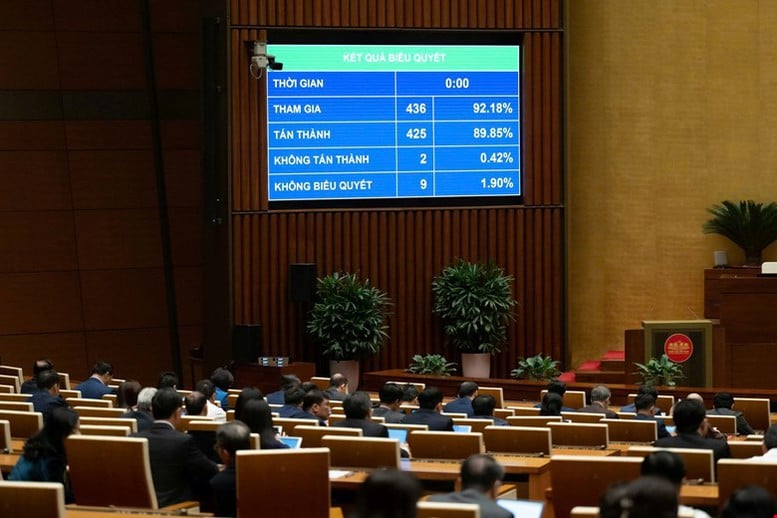
The National Assembly passed the amended Investment Law.
On the morning of December 11th, continuing the work program of the 10th Session, the National Assembly voted to pass the amended Investment Law with 425 out of 436 delegates voting in favor, achieving a rate of 89.85%.
The law, comprising 7 chapters, 52 articles, and 4 appendices, is considered a significant reform aimed at simplifying procedures, expanding investment opportunities, and increasing transparency in investment and business activities.
Streamline investment approval procedures, focusing on sensitive sectors.
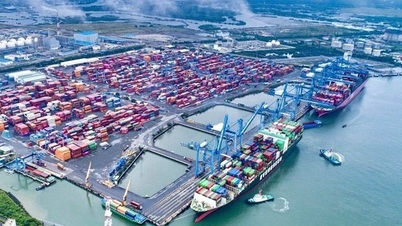
Before the National Assembly voted to approve the draft law, Minister of Finance Nguyen Van Thang presented a report on the acceptance and explanation of the draft law. The draft significantly narrows the scope of projects requiring investment approval, applying it only to important and sensitive sectors such as seaports, airports, telecommunications, press, publishing, and projects related to national defense and security. This narrowing aims to reduce procedural layers, shorten processing time, and accelerate project implementation.
A major reform of the amended Investment Law is the review and significant reduction of the list of conditional business sectors. The government has cut 38 sectors and adjusted the scope of 20 sectors, in line with the spirit of Resolutions 68 and 198 on improving the business environment. At the same time, the government will announce two new lists: a list of sectors requiring pre-licensing before business operations and a list of sectors transitioning to a post-inspection management mechanism, helping to reduce the burden of entry procedures and enhance corporate responsibility in complying with the law.
The draft law continues to propose a groundbreaking provision: allowing foreign investors to establish economic organizations before applying for an investment registration certificate. This is considered a major step forward in improving the investment environment, helping to reduce the time to start a business and increase the attractiveness of the Vietnamese market. However, to ensure state management, the Government will specify reporting responsibilities, market access requirements, and security and defense conditions in the guiding decree.
Simplify procedures for overseas investment.
Regarding overseas investment activities, the draft law significantly simplifies procedures, abolishes investment policy approval, and narrows the scope of projects requiring investment certificates. A specific list of projects will be stipulated to avoid the need for overseas investment registration certificates, creating favorable conditions for Vietnamese businesses to expand their markets. In addition, the Government will add regulations to ensure foreign exchange management and economic and financial security in accordance with practical requirements.
During the drafting process, the Government reviewed the regulations of the Railway Law to ensure consistency in investment approval; at the same time, it added provisions prohibiting the trading of cigarettes and heated tobacco products, as well as clarifying regulations related to real estate investment projects, ensuring compliance with specialized laws and land management requirements.
The amended Investment Law has been revised to fully institutionalize the Party's policies, synchronize the legal system, and create a favorable legal foundation for domestic and foreign investors. With streamlined procedures, expanded incentives, and reformed management methods, the law is expected to contribute to improving the quality of investment attraction, promoting economic growth, and enhancing the competitiveness of Vietnam's business environment.
Phuong Lien
Source: https://baochinhphu.vn/cat-giam-38-nganh-nghe-kinh-doanh-co-dieu-kien-sua-doi-20-nganh-nghe-102251211091556943.htm
![[Photo] Prime Minister Pham Minh Chinh holds a phone call with the CEO of Russia's Rosatom Corporation.](/_next/image?url=https%3A%2F%2Fvphoto.vietnam.vn%2Fthumb%2F1200x675%2Fvietnam%2Fresource%2FIMAGE%2F2025%2F12%2F11%2F1765464552365_dsc-5295-jpg.webp&w=3840&q=75)



![[Photo] Closing Ceremony of the 10th Session of the 15th National Assembly](/_next/image?url=https%3A%2F%2Fvphoto.vietnam.vn%2Fthumb%2F1200x675%2Fvietnam%2Fresource%2FIMAGE%2F2025%2F12%2F11%2F1765448959967_image-1437-jpg.webp&w=3840&q=75)





































































Comment (0)