

Lesson 1: Perfecting the Supply Chain
CONNECTING CONSUMER ACTIVITIES LEADS TO POSITIVE CHANGES
During the period 2021-2025, the collaborative program between Ho Chi Minh City and Dong Thap province in managing and connecting the consumption of safe agricultural products achieved many positive results.

Ten businesses and cooperatives from Dong Thap province were commended by the Ho Chi Minh City Department of Food Safety.
Many supply chains, from production to consumption, have been formed, effectively mobilizing farmers, cooperatives, businesses, and distribution units to participate.
This is also part of the "Safe Food Chain" project that Ho Chi Minh City is implementing across provinces, contributing to building a food safety management model along the "from farm to table" chain.
This pilot model has created a synchronized monitoring system, gaining the consensus of producers in Dong Thap and the trust of consumers in the city.
The volume and quality of agricultural products from Dong Thap consumed in Ho Chi Minh City have steadily increased over the years. The promotion of OCOP products and processed agricultural products has significantly expanded the range of goods entering the city's market.
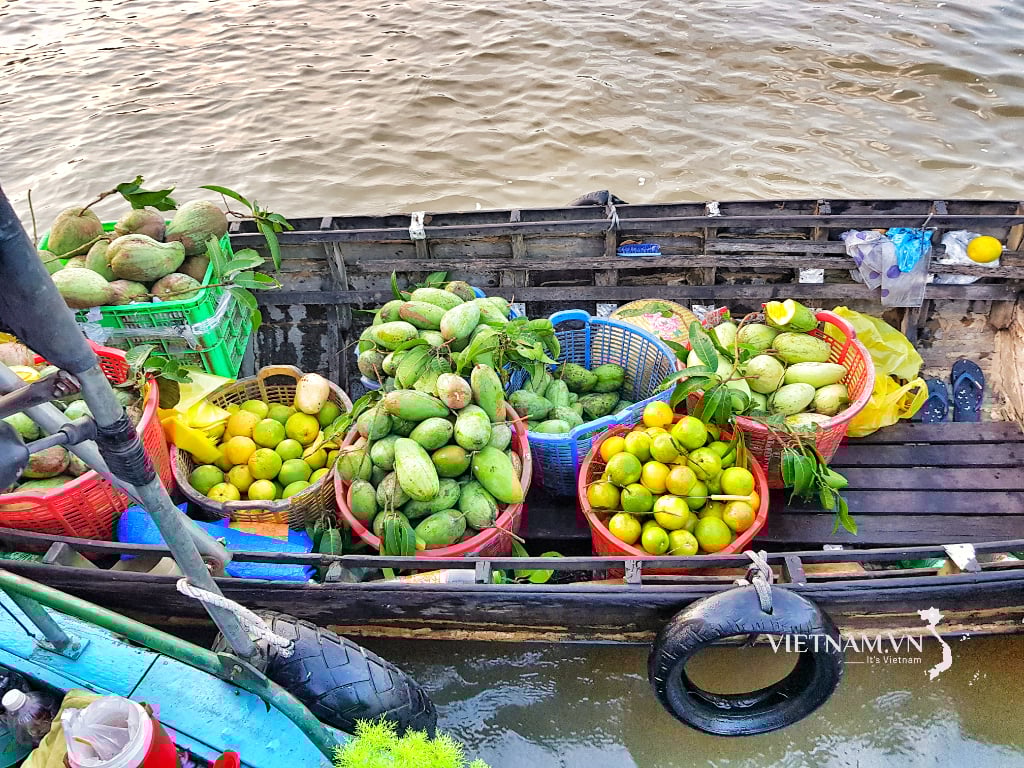
Many distinctive products such as Thap Muoi lotus, Cao Lan mango, Hoa Loc sand mango, Lai Vung tangerine, durian, etc., have built strong brands and gained consumer trust.
Distribution channels have also undergone significant changes: from wholesale through traders, many products are now sold in supermarkets, safe food stores, and online. Currently, OCOP products from the province are available on various e-commerce platforms, making it easier for consumers in Ho Chi Minh City to access them.

Participating establishments will display and introduce their products.
The province also actively participates in supply-demand connection programs organized by Ho Chi Minh City, thereby signing many memoranda of understanding and long-term consumption contracts.
As a result, the market share and output of Dong Thap agricultural products in Ho Chi Minh City have expanded significantly, especially in the categories of rice, vegetables, fruits, seafood, and lotus products.
Coordination in managing food quality and safety has been carried out closely and promptly. Through the mechanism of information exchange between functional agencies (Department of Agriculture and Environment, Department of Industry and Trade, Ho Chi Minh City Food Safety Management Board...), emerging food safety issues have been handled quickly. There have been no serious food safety incidents involving agricultural products from Dong Thap in Ho Chi Minh City during the recent period.
Despite achieving many remarkable results, some difficulties still exist in the linkage between agricultural production and consumption.
Specifically, while there are many safe supply chains, most are small-scale, with each chain consisting of only a group of households or a cooperative linked to a business, and the supply volume is not large. The links between production, processing, transportation, and distribution are not very strong, making them easily disrupted when fluctuations occur.
During the Covid-19 pandemic in 2021, many consumption chains were disrupted due to transportation restrictions. Besides the pandemic, climate change and rising logistics costs also affected the stability of these chains.
The area under VietGAP certification has expanded but still accounts for a modest percentage of the total production area, due to the high costs and procedures for certification for small-scale farmers.
Product quality is therefore inconsistent, making control difficult. Although traceability labels have been implemented, they are not yet widespread, and some small establishments have not complied, leading to limitations in getting goods into Ho Chi Minh City's distribution system.
Most agricultural products shipped to Ho Chi Minh City are still in raw form, with low added value. Local processing and packaging facilities are lacking, making it difficult for products to compete in the urban market. The packaging and labeling of some OCOP products and specialties from Dong Thap are not truly attractive or suitable for the tastes of city consumers.
Businesses and cooperatives participate in many networking fairs, but maintaining contracts after the event is limited due to differences in price, production volume, and technical requirements.
Market information between Ho Chi Minh City and producers is not synchronized, making it difficult for farmers to understand demand and easily leading to localized surpluses or shortages.
Competitive pressure in Ho Chi Minh City is also high as many neighboring provinces and imported goods enter the market, while there are not many large-scale inter-provincial promotional programs for Dong Thap agricultural products.
IMPROVING LINKAGE EFFECTIVENESS
To enhance connectivity with Ho Chi Minh City, Dong Thap province has proposed several key solutions. For the period 2026-2030, Dong Thap aims for each key product group (rice, fruits, vegetables, seafood, etc.) to have 1-2 large, stable supply chains in Ho Chi Minh City. The province encourages regional linkage models to ensure year-round supply.

OCOP products are displayed at trade promotion events and fairs.
Simultaneously, research is being conducted on establishing a Safe Agricultural Product Connection Center to act as a central hub for collecting, quality-controlling, and distributing products into the city's distribution system, aiming to reduce intermediaries and increase proactive response to market fluctuations.
The goal is that by 2030, over 90% of agricultural products supplied to Ho Chi Minh City will be traceable. The province will continue to expand the area of production meeting VietGAP, GlobalGAP, and organic standards, while coordinating with Ho Chi Minh City to provide training on food safety regulations for farmers and cooperatives.
The two localities are building a common database on the supply chain; continuing to affix labels/QR codes and aiming towards applying Blockchain technology to high-value products such as mangoes, durians, and catfish fillets.
To increase value and reduce the risk of bumper harvests leading to price drops, Dong Thap province has requested Ho Chi Minh City's support in attracting investment in high-quality rice processing plants, frozen and canned fruit factories, and value-added seafood processing plants.
Adding more processing steps will make it easier for the product to penetrate supermarket and convenience store systems.
The two localities will jointly organize regular supply-demand connection conferences and Dong Thap agricultural product weeks in Ho Chi Minh City to support businesses in signing long-term contracts.
At the same time, continue to introduce the province's agricultural products into major distribution systems such as Co.opmart, AEON, MM Mega Market, etc., combined with building Dong Thap's own booth on e-commerce platforms, linked with fast delivery services.
Communication efforts focus on building the image of "Safe agricultural products from Dong Thap" through the press and social media, associated with the province's distinctive products.
For the period 2026-2030, it is recommended to maintain a regular coordination channel between the Department of Agriculture and Environment, the Department of Food Safety, and the Department of Industry and Trade of the two localities, and to establish an inter-agency working group that meets quarterly.
When quality issues are detected (such as pesticide residue), both parties must immediately communicate to address them promptly and ensure consumer safety.
With clear direction and proactive implementation, Dong Thap expects the period 2026-2030 to create a breakthrough in market connectivity, bringing higher value to farmers, cooperatives, and local businesses.
THIEN LY
Source: https://baodongthap.vn/bai-cuoi-tang-cuong-lien-ket-chuoi-cung-ung-nong-san-lon-a234001.html













![[Photo] Prime Minister Pham Minh Chinh holds a phone call with the CEO of Russia's Rosatom Corporation.](/_next/image?url=https%3A%2F%2Fvphoto.vietnam.vn%2Fthumb%2F1200x675%2Fvietnam%2Fresource%2FIMAGE%2F2025%2F12%2F11%2F1765464552365_dsc-5295-jpg.webp&w=3840&q=75)










































Comment (0)