

Ho Chi Minh City: The Soài Rạp River overpass connecting Cần Giờ district to Nhà Bè district, with a total investment of 10,000 billion VND, is expected to start construction in April 2025, breaking the monopoly of the existing, overloaded ferry service.
This information was provided by the Director of the Ho Chi Minh City Department of Transport, Tran Quang Lam, on the morning of July 11th, when answering questions from city council representatives at the 10th session of the 10th term.
Previously, delegate Doan Thi Ngoc Cam stated that the Can Gio Bridge project was included in the medium-term public investment plan for the 2021-2025 period and received investment preparation funding from 2022. This is a key project for the development of Can Gio, helping to realize the city's plan to expand towards the sea, and has been awaited by the people for many years, so what is the current progress of its implementation?
According to the Director of the Department of Transportation, Can Gio has many advantages for developing green transportation and tourism , but the requirement is that infrastructure must be prioritized because the area still has many limitations. Among these, the Can Gio bridge is a crucial large-scale project that needs early investment.
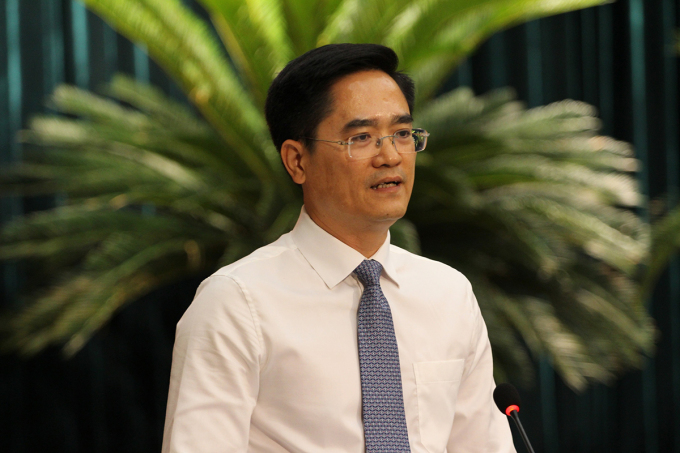
Director of the Department of Transport Tran Quang Lam at the questioning session, morning of July 11. Photo: Thanh Nhan
Mr. Lam stated that previously, the project was studied with a total investment of approximately 10,000 billion VND, to be invested using the PPP method, specifically a BT contract (exchanging land for infrastructure). However, this form of payment in land ceased after the PPP Law came into effect, so the city is considering other investment methods. Among the options being considered for the bridge construction are: BOT (build-operate-transfer); BT (deferred payment in cash), or public investment.
Currently, the city government has assigned the Department of Transportation to handle the investment preparation procedures, along with updating relevant content to complete the feasibility study report. "Regarding the technical aspects of the project, it is basically complete. The Department is working with the local authorities to review compensation and land clearance costs, and we expect to submit the investment plan to the City People's Council for approval at the end of this year and commence construction around April 30, 2025," Mr. Lam said.
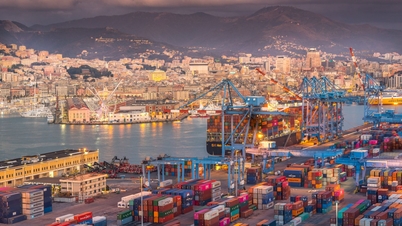
Alongside the plan to build the Can Gio bridge, the head of the Department of Transportation also stated that the city will consider investing in and upgrading other bridges on the local Rung Sac road and synchronizing the interchange on this route with the Ben Luc - Long Thanh expressway. In addition to road infrastructure, an urban railway line connecting this area through Nha Be district will also be studied for investment. This is part of the plan to connect transportation with the Can Gio "super transshipment port," which is being planned for construction with a scale of over 5.4 billion USD.
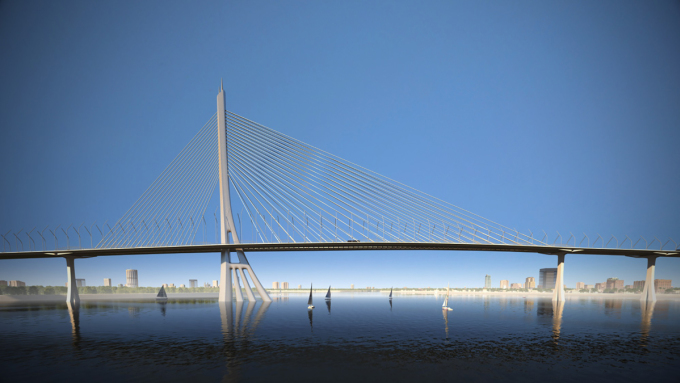
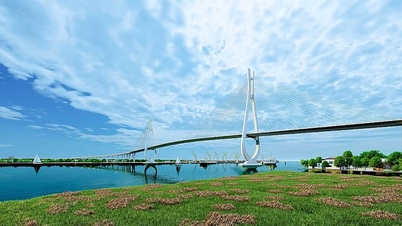
The architectural design for the Can Gio Bridge was selected in April 2019. Photo: Ho Chi Minh City Department of Planning and Architecture.
Seven years ago, the Prime Minister agreed to assign the Ministry of Transport to review and add the Can Gio Bridge project to the Ho Chi Minh City Transport Development Plan until 2020, with a vision beyond 2020. The city then organized a design selection process and chose a cable-stayed bridge with a single tower shaped like a mangrove tree – a characteristic feature of Can Gio.
According to the plan, the Can Gio bridge will be 3.4 km long with 4 lanes. The project's starting point is at the intersection of Road 15B and Road 2 (Nha Be District), and the end point connects to the Rung Sac Road, approximately 2 km from the Binh Khanh ferry terminal in Binh Khanh commune, Can Gio district. Upon completion, the project will replace the Binh Khanh ferry, which has been overloaded for many years.
Regarding this project, the Chairwoman of the Ho Chi Minh City People's Council, Nguyen Thi Le, requested the city government to pay attention and direct the Department of Transport to expedite the completion of procedures for submitting the investment plan for approval at the next meeting. "As planned by the city's transport sector, the project's commencement in April 2025 is an important milestone to celebrate the 50th anniversary of national reunification," Ms. Le said.
Also at the questioning session, in response to a question from delegate Le Minh Duc about solutions to promote waterway transport to eliminate the situation of "many rivers but few ferries," the leader of the Department of Transport affirmed that developing waterway transport and tourism is one of the top priorities.
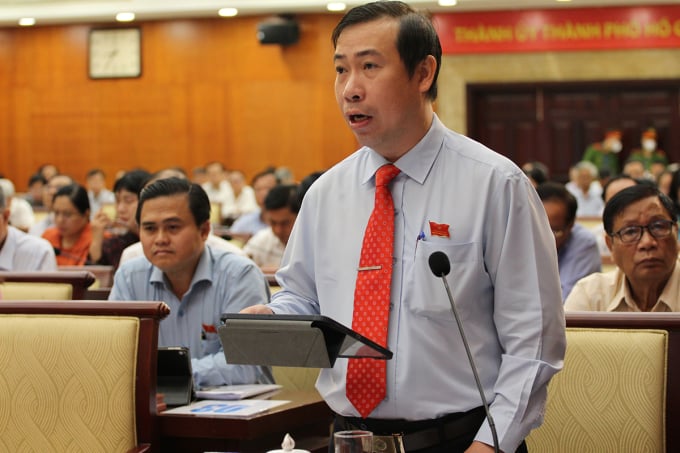
Representative Le Minh Duc at the questioning session. Photo: Thanh Nhan
According to Mr. Lam, waterway transport currently plays a significant role, sharing more than 20% of passenger traffic with road transport. Waterway passenger transport in the area serves approximately 60 million passengers annually. The city also has waterway routes to Vung Tau, Binh Duong, and other destinations, along with shorter routes and several riverside tourist routes.
"However, to fully exploit the advantages of waterways, we still have a lot to strive for," Mr. Lam said. Currently, the city's transportation and tourism sectors have discussed development solutions, including the establishment of at least five waterway routes combining tourism within the city and inter-provincial routes between now and 2025. At the same time, the banks of the Saigon River will be renovated, with the addition of mooring areas and boat docks... helping to improve the landscape and develop the economy .
Also at the meeting, in response to questions from several other delegates regarding the development of transportation infrastructure in the area, the leaders of the Department of Transportation stated that Resolution 98 on piloting a special mechanism for Ho Chi Minh City, approved by the National Assembly, includes many policies to unlock investment resources, creating opportunities for many urgent infrastructure projects to be implemented soon.
In addition to the BOT and BT models under the new policy, the piloting of the Transport-Oriented Development (TOD) model at the intersections of Ring Road 3, expressways, and metro stations will create a major impetus for infrastructure development in the city. Accordingly, the new resolution allows land acquisition through independent projects instead of requiring a separate construction project before implementation. At the same time, the city is also given the autonomy to research and adjust local planning and invest in infrastructure, which forms the basis for effectively utilizing land along the projects and generating investment resources...
Le Tuyet - Gia Minh
Source link



![[Image] Nearly 125,000 Hanoi students completed the Literature exam for the 10th grade entrance exam.](https://vphoto.vietnam.vn/thumb/1200x675/vietnam/resource/IMAGE/2026/05/30/1780117233041_ndo_br_thiet-ke-chua-co-ten-2-png.webp)

















































































Comment (0)