

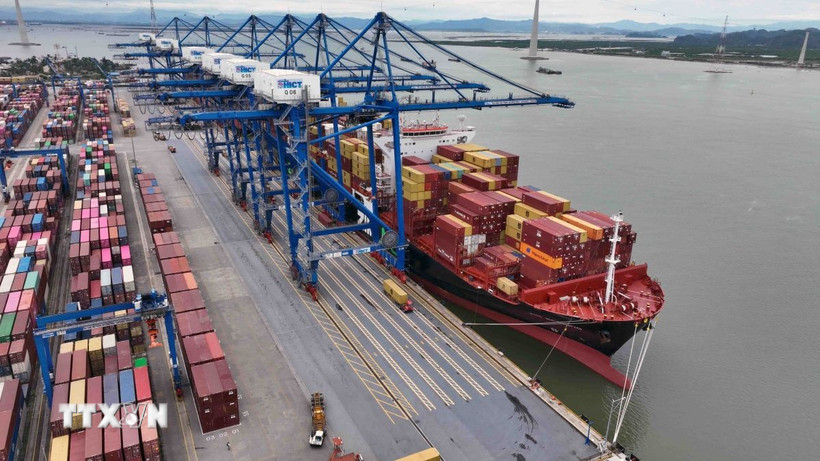
Loading and unloading export goods at Hai Phong International Container Port, Cat Hai town, Cat Hai district, Hai Phong city. (Photo: Vu Sinh/VNA)
In a global economic context under pressure from slowing trade and policy instability, Vietnam is emerging as a regional exception.
Recently published international reports have recorded increasing confidence in Vietnam's economic prospects in 2025, as key growth pillars continue to demonstrate strong and sustainable resilience.
With a Gross Domestic Product (GDP) growth of 8.23% in the third quarter of 2025, Vietnam continues to lead the six largest economies of the Association of Southeast Asian Nations (ASEAN-6), surpassing Thailand, Indonesia, Malaysia, the Philippines and Singapore.
This is also Vietnam's second highest growth quarter in the 2011-2025 period, only after the strong breakthrough period after the COVID-19 pandemic. In the first 9 months, the Gross Domestic Product increased by 7.85%, maintaining its position as one of the fastest growing economies in the region.
The point that is particularly appreciated by international organizations lies not only in the growth rate but also in the balance in the growth structure.
All three economic sectors expanded strongly: industry and construction increased by 8.69% (of which processing and manufacturing increased by nearly 10%), services increased by 8.49% thanks to vibrant trade and tourism, and agriculture increased by 3.83%, a moderate increase but playing a key role in stabilizing food supply and reducing inflationary pressure.
Even in the context of complex natural disasters and floods in the third quarter of 2025, the manufacturing industry still maintained a stable growth rate. The Purchasing Managers' Index (PMI) in November 2025 reached 53.8 points, lower than the previous month, but still maintained firmly above the 50-point threshold, showing that business conditions continued to improve and the processing and manufacturing industry maintained a continuous recovery momentum for 5 consecutive months.
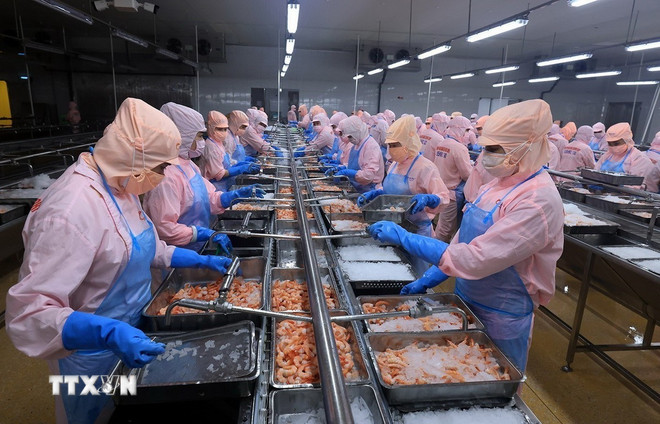
Processing shrimp for export. (Photo: VNA)
The latest data from the Customs Department also shows that Vietnam's trade volume continues to expand impressively.
As of November 15, 2025, import-export turnover reached over 801 billion USD, the highest level ever. The export structure has shifted strongly towards deeply processed and high-tech products, reflecting the process of upgrading position in the global value chain.
Vietnam's export market map has also changed significantly: from more than 20 markets in 1991, mainly in Asia-Pacific, by 2025 Vietnam had established trade relations with more than 230 countries and territories.
The recovery is also reinforced by other important drivers. Foreign direct investment (FDI) inflows into Vietnam in the first 10 months of 2025 are estimated at 21.3 billion USD, the highest rate in a 10-month cycle in the past 5 years.
Domestic consumption recovered strongly, retail sales increased by 9.3% in the first 10 months compared to the same period last year, while the tourism industry rebounded with 15.4 million international arrivals in the first 9 months of 2025, among the top destinations with the highest growth rate in the world.
On that basis, a series of international financial institutions have adjusted and raised Vietnam's growth forecast. At the end of October 2025, HSBC and Standard Chartered Bank raised their 2025 forecasts to 7.9% and 7.5%, respectively. By November 2025, UOB Bank raised it to 7.7%.
Most recently, S&P Global raised its growth forecast for Vietnam to 7.7% in 2025 and 6.7% in 2026.
The Organisation for Economic Co-operation and Development (OECD), despite noting challenges from weakening global demand, still affirmed that Vietnam's economy maintains positive momentum, with growth forecast at 6.2% in 2026 and 5.8% in 2027.
However, international organizations also note risks that Vietnam cannot avoid. Weakening global demand in 2026 could affect exports, especially as the US considers raising transit tariffs and tightening rules of origin. Natural disasters and supply chain disruptions could increase input costs, putting pressure on businesses.
Domestically, inflation may rise again due to strong domestic demand and the impact of the end of the value-added tax (VAT) reduction incentive at the end of 2026, before the tax adjustment in 2027. Moreover, the progress of public investment disbursement, although improved, still needs to be accelerated to ensure spillover effects.
Faced with these challenges, the Organization for Economic Cooperation and Development recommends that Vietnam continue institutional reforms to increase productivity and growth quality.
Key recommendations include improving the market-oriented monetary policy framework, increasing competition in the service sector, ensuring a level playing field between private and state-owned enterprises, and reducing the size of informal employment to increase resource allocation efficiency.
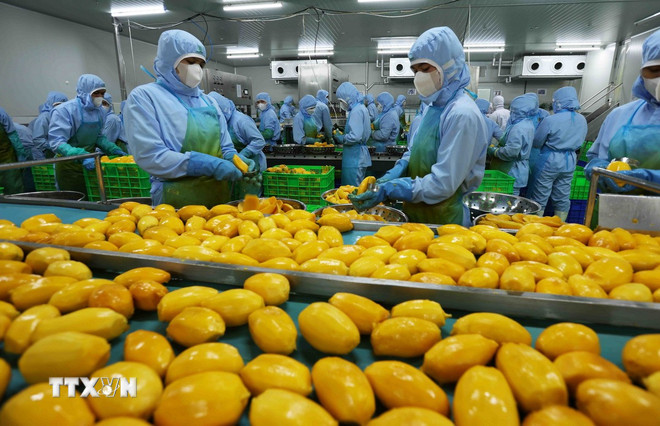
Processing mango products for export to the US, Europe, South Korea and Japan at the factory of An Giang Vegetable and Fruit Joint Stock Company (Lam Dong province). (Photo: Vu Sinh/VNA)
From a regional perspective, the sharp divergence of ASEAN-6 economies further highlights Vietnam’s position. In the third quarter of 2025, Malaysia recorded a growth rate of 5.2% and Indonesia maintained a stable trajectory around 5% – two rare cases that still maintained expansion momentum amid a global trade slowdown.
In contrast, many other major economies are facing downward pressure on growth. The Philippines’ GDP contracted sharply to 4%, much lower than forecast, reflecting weaker household consumption and private investment. Singapore – the most developed economy in ASEAN – also saw a slowdown, with GDP growth falling to 2.9%, down sharply from 4.5% in the second quarter of 2025, as the manufacturing sector was clearly affected by fluctuations in international taxes and trade.
Thailand remains the region’s lagging performer, with GDP growth in the third quarter of 2025 projected to be just 1.2%, the weakest since 2021. The slowdown in manufacturing and tourism growth is not strong enough to offset structural weaknesses, leading to a downgrade of the 2025-2026 outlook to just 1.2-2.2%.
In that picture, Vietnam's outstanding growth helps position the economy as one of the new driving forces of ASEAN, with its economic expansion rate many times higher than that of other countries in the region.
The difference in growth momentum, according to international observers, shows that Vietnam is entering a new development phase, where policy flexibility, quality of production-service infrastructure and the openness of the economy will continue to be key factors, helping maintain its position as one of the fastest growing economies in Asia in the coming years./.
(TTXVN/Vietnam+)


![[Photo] Cat Ba - Green island paradise](/_next/image?url=https%3A%2F%2Fvphoto.vietnam.vn%2Fthumb%2F1200x675%2Fvietnam%2Fresource%2FIMAGE%2F2025%2F12%2F04%2F1764821844074_ndo_br_1-dcbthienduongxanh638-jpg.webp&w=3840&q=75)
































































































Comment (0)