

Khanh Hoa province will invest more than 205 billion VND to build projects, protect and promote cultural heritage values; teach, train, and develop the Cham pottery market.
Of which, the central and local budget sources are about 163.5 billion VND, the rest is mobilized from domestic and international organizations.
This is one of the main contents of the Project on Management, Protection and Promotion of the Value of Intangible Cultural Heritage "Cham Pottery Art" for the period 2025-2028 and the following years, recently approved by the People's Committee of Khanh Hoa province.
The project's subjects are the community, state agencies, and organizations involved in the management, protection, and promotion of the intangible cultural heritage "Cham pottery art".
The project implementation area is Bau Truc village and village 12 (Ninh Phuoc commune) where Cham people are practicing pottery making.
The project's goal by 2026 is to remove the intangible cultural heritage "Cham pottery art" from the danger of needing urgent protection; by 2027, to develop product quality standards, register the trademark "Cham pottery" for Bau Truc Cham pottery products, and at the same time complete the planning for the protection of Bau Truc pottery village's cultural space and plan a tourism model to develop the Bau Truc pottery village community; from 2028 to 2030 and the following years, aim to register "Cham pottery art" as a representative intangible cultural heritage of humanity.
Cham pottery art was inscribed by UNESCO on the List of Intangible Cultural Heritage in Need of Urgent Safeguarding on November 29, 2022.
UNESCO's recognition of the traditional Cham pottery art as a cultural heritage in need of urgent protection not only honors the value of a traditional craft but also affirms the cultural value of the community, and the joint efforts to preserve and maintain this unique art.
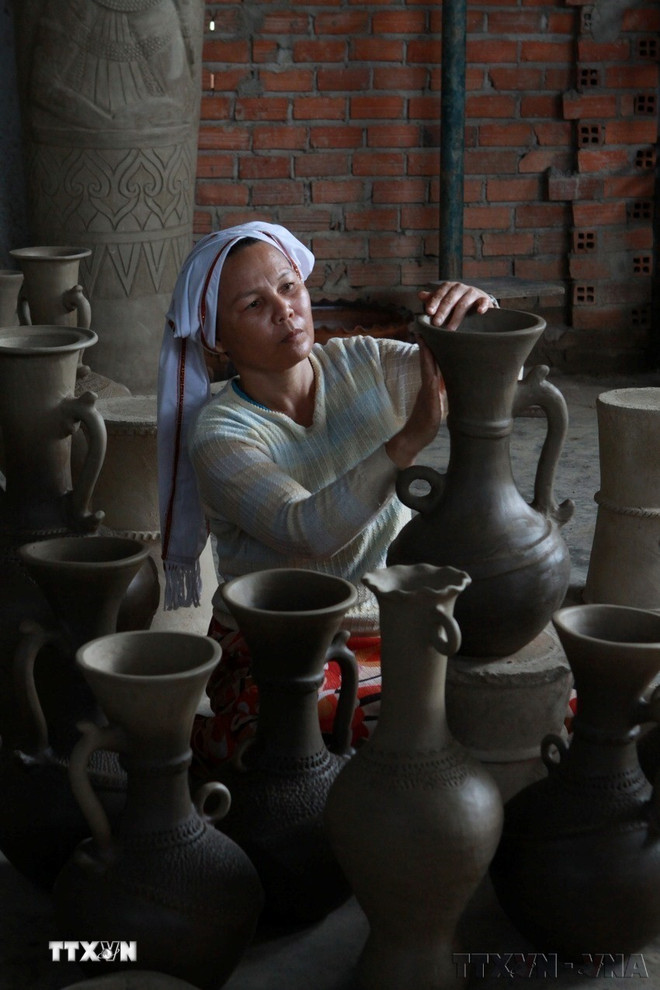
Existing from around the end of the 12th century until now, Bau Truc is considered one of the very few ancient pottery villages in Southeast Asia that still retains the primitive production methods from thousands of years ago.
The entire pottery making process of the Cham people exudes a unique artistic value. Thanks to that, despite the ups and downs in the development process, traditional Cham pottery still exists over time, preserving the quintessence and the pristine beauty of ancient pottery hundreds of years ago. That is the unique and everlasting value of Cham pottery.
Nowadays, Cham people make pottery with traditional manual techniques and processes that have been maintained by Cham families here for many generations.
The traditional Cham pottery making process includes many stages and steps connected together. The first is the selection and collection of soil. The treatment of soil before making pottery determines the quality and performance of the product after firing.
After taking the soil, people break it into small pieces to filter out the impurities, taking only the yellow clay and then incubating it to keep it soft.
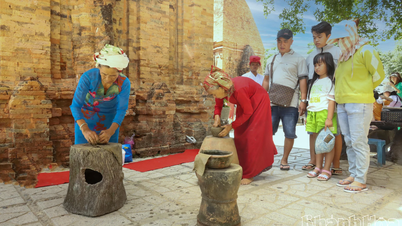
Taking a sufficient amount of soil, the Cham woman gently kneads it until it becomes soft, then places it on a large jar to create a block.
The ceramic products are completely handcrafted "Hand-shaped, no turntable." The artisan walks backward around the table to shape the ceramic. Because of walking around to shape the ceramic, the Cham artisans' way of shaping the ceramic is straight, different from the horizontal way in pottery villages that use turntables.
With skillful and skillful techniques, in just a few rounds, the worker has completed the block for the product. The shape of the product will be decided by the worker's backward movement around.
Next, they use a “circle” to brush around the body of the pottery, then use a wet cloth rolled up in their hands to rub the outside of the pottery until it is shiny. Next comes the step of decorating with patterns.
The skillful hands carve patterns on the ceramic body with themes of rivers, plants, or images of nature, the earth and the gods in the spiritual beliefs of the Cham people.
After shaping, the product is left in the shade for 24 hours, then rubbed thinly and dried for another 7 days until completely dry, then fired. Thanks to this, the product will be "cooked" thoroughly and will not crack.
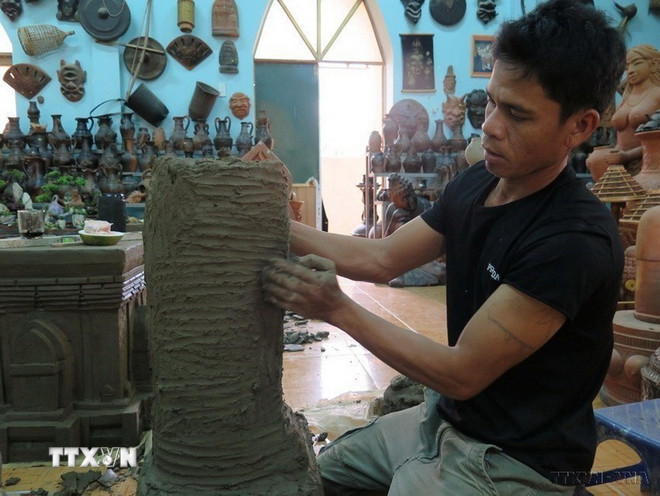
The products are fired in the open air after being crafted. The difference of Cham pottery is that the products are fired completely in the open air. Depending on the conditions of sunlight and wind combined with the process and technique of spraying color (extracted from cashew nut oil, dong tree...), the products will have characteristic colors such as red-yellow, pink-red, gray-black, strange and beautiful brown streaks, clearly showing the ancient Cham culture.
Because they are made entirely by hand, no two Cham ceramic products are alike. Each product reflects the style, craftsmanship, ingenuity, and even the emotions and moods of the craftsman during the process of making the product.”
For centuries, the Cham people in Bau Truc village have preserved intact the traditional craft of their ancestors with the skills and secrets passed down from generation to generation. Therefore, this place is affectionately called a “living museum” of Cham pottery by researchers and domestic and foreign tourists./.
Source: https://www.vietnamplus.vn/khanh-hoa-hon-205-ty-dong-cho-phat-huy-gia-tri-di-san-nghe-thuat-lam-gom-cham-post1081235.vnp
![[Photo] 60th Anniversary of the Founding of the Vietnam Association of Photographic Artists](/_next/image?url=https%3A%2F%2Fvphoto.vietnam.vn%2Fthumb%2F1200x675%2Fvietnam%2Fresource%2FIMAGE%2F2025%2F12%2F05%2F1764935864512_a1-bnd-0841-9740-jpg.webp&w=3840&q=75)


![[Photo] Cat Ba - Green island paradise](/_next/image?url=https%3A%2F%2Fvphoto.vietnam.vn%2Fthumb%2F1200x675%2Fvietnam%2Fresource%2FIMAGE%2F2025%2F12%2F04%2F1764821844074_ndo_br_1-dcbthienduongxanh638-jpg.webp&w=3840&q=75)




















































































Comment (0)