


The biosecure chicken farming model in Quan Son commune has helped many households escape poverty.
To ensure the effectiveness of poverty reduction efforts, the commune established a poverty reduction steering committee, assigning specific tasks to each member, each socio- political organization, and each village. The steering committee maintains a regular meeting schedule, especially for reviewing poor and near-poor households periodically and annually, aiming to accurately assess the current situation, identify the causes, and propose appropriate solutions for each case. The review process is conducted openly and democratically, with community participation and supervision to ensure transparency and accuracy. Based on the reviewed list, the commune develops support plans for target groups, prioritizing poor households lacking livelihoods, single-parent households, and households affected by natural disasters. Simultaneously, the commune intensifies propaganda and mobilization efforts to encourage people to change their mindset and enhance self-reliance; integrating resources from national target programs, providing loan support, vocational training, and job creation. Thanks to this coordinated effort, the commune's poverty reduction work has become increasingly effective. As a result, during the past term, the total production value of the commune reached over 500 billion VND, an increase of nearly 1.5 times compared to 2020; and the average per capita income reached 41 million VND.
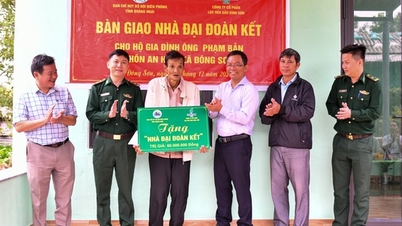
Most notably, the social welfare program has been strongly implemented. With the construction and renovation of 287 houses for poor, near-poor, and policy-beneficiary households, hundreds of families have been provided with stable and safe housing, thereby encouraging them to be more proactive in their business and economic development. As a result, the average poverty rate has decreased by over 5% per year – a figure demonstrating the effectiveness of the right approach.
Besides the achievements, the commune still faces some difficulties and limitations, including the fact that the percentage of poor and near-poor households still accounts for 53.1%; agricultural and forestry production is fragmented and lacks linkages; young people lack jobs; and the risk of falling back into poverty is ever-present whenever natural disasters or epidemics strike.
Not only are there objective factors stemming from natural conditions, but subjective factors also include the sometimes lax implementation of policies, the lack of thoroughness on the part of some officials, and the mentality of dependence and reliance among some poor households.
To address this, the commune identified key solutions as continuing to strengthen the leadership role of the Party committee and government; fostering the will to escape poverty among the people; effectively implementing support policies in healthcare, education , housing, clean water, and information and communication; and simultaneously providing livelihood support after people have new homes. In its development orientation, the commune clearly defines its central task as developing sustainable agricultural and forestry production, linked to processing and consumption, and gradually forming value chains. Leveraging its advantages in land, climate, and local potential, the commune will focus on developing concentrated forest planting areas, expanding the area of medicinal plants, promoting beekeeping, community tourism, and commercial livestock farming.
Besides developing production, the commune focuses on vocational training and job creation, considering this key to reducing the risk of falling back into poverty. Promoting labor export and supporting young people in starting businesses not only opens up opportunities for higher incomes but also contributes to the formation of a young workforce with a new mindset, ready to return and contribute to their homeland. Each worker with stable employment is a household with the opportunity to escape poverty, and each household escaping poverty is a solid link in the development of the entire commune.
Poverty reduction is also closely linked to the goal of building Quan Son commune to meet the standards of a New Rural Area by 2030. In this, the people play a central role – they are the main actors in building infrastructure, developing livelihoods, and monitoring investment effectiveness. When people understand their role, they will proactively innovate their methods, boldly participate in new economic models, and work together to preserve the landscape, culture, and order of their villages. Along with this, the Fatherland Front Committee and other mass organizations continue to be entrusted with important responsibilities in propaganda and mobilization to change perceptions, awaken the spirit of self-reliance, and eliminate the mentality of dependence. The poverty reduction team must be truly close to the people, understand them, and promptly address difficulties and provide support to the right people at the right time. In addition, the movement "Joining hands for the poor - leaving no one behind" will continue to spread, creating spiritual motivation for the poor who are striving to improve their lives.
With synchronized solutions and appropriate approaches, poverty reduction efforts in Quan Son are gradually yielding tangible results, contributing to improving people's lives and creating positive changes in the socio-economic development of the commune.
Text and photos: Tran Hang
Source: https://baothanhhoa.vn/chuyen-bien-trong-giam-ngheo-o-xa-quan-son-271608.htm


![[Image] Close-up of the newly discovered "sacred road" at My Son Sanctuary](/_next/image?url=https%3A%2F%2Fvphoto.vietnam.vn%2Fthumb%2F1200x675%2Fvietnam%2Fresource%2FIMAGE%2F2025%2F12%2F13%2F1765587881240_ndo_br_ms5-jpg.webp&w=3840&q=75)
























































Comment (0)