

 |
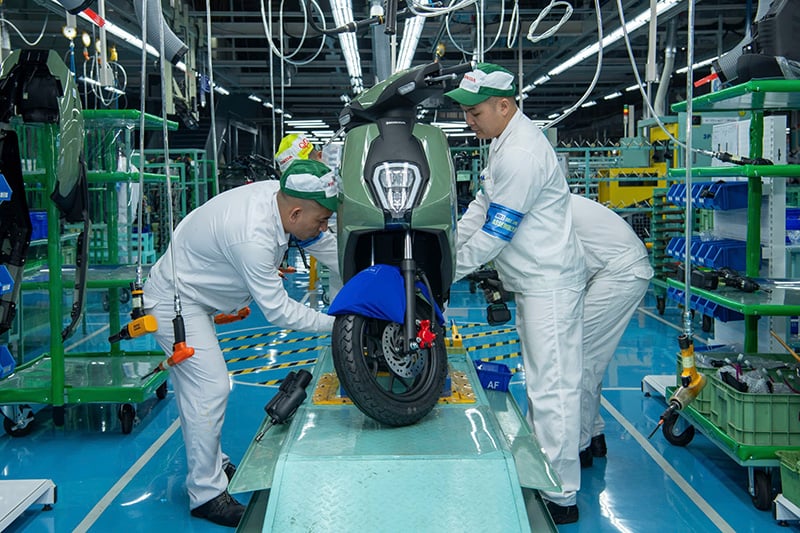
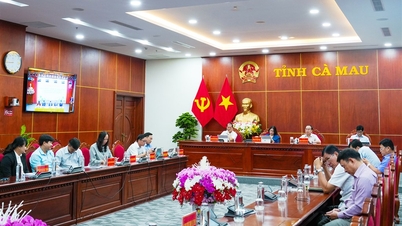
| Strength will be amplified, but to attract investment, localities will have to make greater efforts in improving the investment and business environment. Photo: Le Toan |
Competing in terms of attracting FDI.
Yesterday (June 30th), localities officially announced resolutions and decisions on the merger of administrative units. Accordingly, the country will have 34 provinces and centrally-administered cities. This merger is seen not only as a simple administrative reform, but also as a powerful lever to create administrative units of sufficient scale, development potential, and connectivity. New growth poles on the regional development map may be established. This will also provide a foundation for many localities to accelerate attracting FDI.
Looking back at the current FDI attraction rankings, Ho Chi Minh City is leading with over US$59.723 billion in registered capital, cumulatively up to the end of May 2025. Besides Ho Chi Minh City holding the top spot, the top 10 also includes Hanoi (US$45.372 billion); Binh Duong (US$42.854 billion); Dong Nai (US$38.858 billion); Ba Ria - Vung Tau (US$38.187 billion); Hai Phong (US$32.958 billion); Bac Ninh (US$32.26 billion); Quang Ninh (US$16.435 billion); Thanh Hoa (US$15.768 billion) and Long An (US$14.556 billion).
Meanwhile, if we consider the first five months of the year, Hanoi is the leading locality, followed by Bac Ninh, Ho Chi Minh City, Dong Nai, Ba Ria - Vung Tau , Ha Nam, Hai Phong, Hung Yen, Long An, and Tay Ninh.
However, after the June 30th milestone, when localities are merged, the "ranking" will change significantly, although the top position will certainly still belong to the country's economic powerhouse - Ho Chi Minh City. After merging with Binh Duong and Ba Ria - Vung Tau, Ho Chi Minh City has received an additional investment of US$42.854 billion from Binh Duong and US$38.187 billion from Ba Ria - Vung Tau. Thus, the new Ho Chi Minh City alone now holds a total of US$143.282 billion, accounting for nearly 28% of the total registered FDI capital still in effect in Vietnam.
With this momentous merger, Ho Chi Minh City gains additional potential and outstanding competitive advantages to continue attracting FDI. Along with Ho Chi Minh City, this historic merger will also bring many opportunities to other localities. Bac Ninh and Bac Giang are prime examples.
Currently, cumulatively, Bac Ninh ranks 7th among localities attracting the most FDI. Bac Giang, with over $13.8 billion, only ranks 11th. However, when Bac Ninh and Bac Giang merge, the FDI attracted by the "new" Bac Giang will reach over $46 billion, surpassing Quang Ninh (without the merger, currently attracting $16.435 billion, ranking 8th, after Bac Ninh); Thanh Hoa and Long An.
Meanwhile, Hai Phong received additional capital from Hai Duong (US$11.525 billion), bringing its total attracted capital to US$44.483 billion, closing in on Hanoi and securing a high position in the top 10.
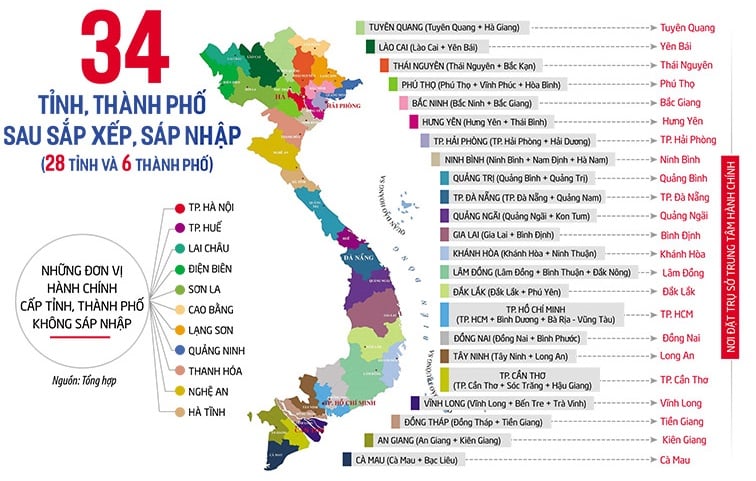 |
| The reorganization of administrative units has opened up new opportunities for many regions and localities in socio-economic development and attracting foreign investment. (Graphic: Dan Nguyen) |
Working together to attract FDI
It's not just about numbers or rankings; what's important is that after the mergers, many localities across the country will be able to leverage their potential and advantages to attract FDI for socio-economic development. Bac Ninh and Bac Giang could be typical examples.
While Bac Ninh has long been a "hub" for major foreign investors such as Samsung, Canon, Foxconn, and Goertek, Bac Giang has only emerged in recent years. Nevertheless, Bac Giang's breakthrough is highly commendable. The efforts of local leaders in directing, managing, improving the investment and business environment, and leading the way in provincial-level planning have made Bac Giang a "magnet" attracting investment from leading global technology corporations, from HanaMicron to Foxconn and Luxshare.
 It's not just about numbers or rankings; what's important is that after the mergers, many localities across the country will be able to leverage their potential and advantages to attract FDI for socio-economic development.
At the recent 26th Conference of the Bac Giang Provincial Party Committee, 19th term, Bac Giang Provincial Party Secretary Nguyen Van Gau directed that preparations must be made well for the ceremony announcing resolutions and decisions on the merger of administrative units. This is one of the prerequisites for the new Bac Ninh province to quickly focus on implementing solutions to boost GRDP growth and attract investment after the merger.
In the first six months of the year, Bac Giang achieved a GRDP growth rate of 14.04%, among the highest in the country. Meanwhile, Bac Ninh's GRDP growth in the first six months was 9.18%. Combining its potential, advantages, and especially the dynamism of its local leadership, the "new" Bac Ninh will score points. This region will soon become the "capital" of the electronics and semiconductor industries in the northern region.
Hung Yen province could emerge as a new attractive investment destination. The province is currently receiving much attention due to the multi-billion dollar project by the Trump Organization, and prior to that, a series of industrial projects, especially those in the Thang Long II Industrial Park by the Sumitomo Group.
Thai Binh, the province that merged with Hung Yen, is also becoming a "new destination" for foreign investors. In 2023, Compal Group - Apple's manufacturing partner - decided to invest $260 million in the province.
Similarly, Phu Tho, which is gradually emerging from its low point in attracting investment through several large projects, such as the BYD Group's project, will have the added advantage of Vinh Phuc, a favored investment location for Honda, Toyota, Piaggio, etc. Combining the strengths of the two localities, Phu Tho promises to be a highly competitive investment destination.
In the South, besides the immense strength of Ho Chi Minh City after its merger with Binh Duong and Ba Ria - Vung Tau, Dong Nai - after its merger with Binh Phuoc, or Tay Ninh after its merger with Long An… will also be a "magnet" attracting new investments.
Strength will be amplified, but to attract investment, according to experts, localities will have to make greater efforts in improving the investment and business environment, as well as preparing infrastructure, land, human resources, etc. Furthermore, after the merger, planning work needs to be accelerated to create a basis for attracting even more FDI resources.
Source: https://baodautu.vn/cong-huong-suc-manh-de-hut-von-fdi-d316398.html














































































Comment (0)