

Digital technology has permeated and brought about advancements in many different aspects of life. Heritage preservation is no exception to this trend. With the rapid development of technologies, heritage preservation has expanded beyond the scope of museums and researchers. It has become an interactive process integrated into community life. From tangible heritage such as architectural structures and ancient artifacts, to intangible heritage such as traditional festivals and folk music , digital technology is providing a new, more effective, and sustainable approach to preservation.
In the past, heritage preservation often required traditional physical preservation methods, sometimes struggling to prevent deterioration due to time and natural elements. Digital technology – the ability to digitize data – has created entirely new means of preservation. Monuments and artifacts can be 3D scanned and recreated with high accuracy, permanently stored in digital space. Not only does this help protect against external impacts, but digitization also creates opportunities to reconstruct heritage that has been lost or damaged over time.
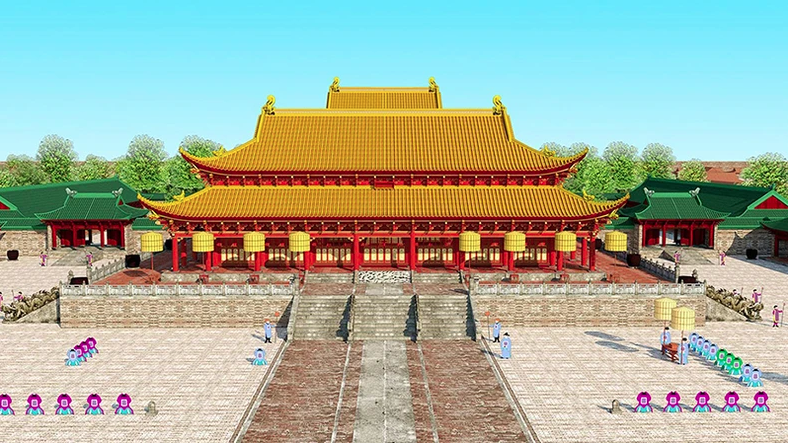
The Thang Long - Hanoi Heritage Conservation Center, in collaboration with other units, recreated the space of the Kinh Thien Palace in 3D rendering. Photo: nhandan.vn
In today's era, the advent of virtual reality (VR) and augmented reality (AR) technologies has expanded people's access to cultural heritage. Now, people can explore historical sites and ancient works of art from the comfort of their homes through technological devices. Instead of having to travel to physical locations, users can simply enter a virtual space with a few easy steps, where they can interact with and experience the heritage as if they were present in real time and space. This not only increases public accessibility but also opens up an effective method of educating about history and culture.
Furthermore, digital technology also promotes heritage preservation through the systematic and scientific storage of information. Instead of relying solely on traditional storage methods such as books and printed documents, digitized data is organized, categorized, and easily accessible. Researchers and conservationists can access thousands, even millions, of heritage-related data points in a short period, optimizing research and protection processes.
Another prominent aspect of digital technology in heritage preservation is its ability to disseminate information and attract public attention. Digitalized preservation projects are no longer limited by geographical space, but can reach millions of people globally through the internet. Documentaries, articles, and images about cultural heritage can now be widely shared, thereby attracting the interest and participation of many people, especially young people – a demographic that is always particularly interested in technology.

Dien Huu Pagoda recreated using virtual reality technology. (Produced by Sen Heritage Group). Photo: nhandan.vn
Perhaps the biggest challenge in applying digital technology to heritage preservation lies in how to make digitized content truly engaging and relatable to viewers. Stories from the past don't always immediately capture attention amidst the plethora of modern information and entertainment available online. Therefore, creating digitized heritage products requires a combination of technology, creativity, and high aesthetic value to both preserve original value and create something new and captivating.
The success of heritage preservation through digital technology always requires the participation of the community and those who love culture. Cultural heritage is not something that can be separated from daily life, but rather the soul inextricably linked to the life of a nation. The community's understanding and appreciation of heritage values, and their active participation in the preservation process, is the key factor in enabling technology to fully realize its potential in this field.
The future of heritage preservation through digital technology is becoming increasingly promising with the continuous development of technical solutions. Technology not only helps us preserve past values but also contributes to spreading and developing those heritages in entirely new and modern ways. Heritage sites are no longer just fragments of the past, but are becoming bridges between the present and the future, contributing to building a solid foundation of national culture on the journey of integration with the world.





























![[Image] Close-up of the newly discovered "sacred road" at My Son Sanctuary](/_next/image?url=https%3A%2F%2Fvphoto.vietnam.vn%2Fthumb%2F1200x675%2Fvietnam%2Fresource%2FIMAGE%2F2025%2F12%2F13%2F1765587881240_ndo_br_ms5-jpg.webp&w=3840&q=75)






























































Comment (0)