

Keywords: cultural industry, artificial intelligence, digital transformation, content creation, heritage preservation.
Abstract: The article analyzes the profound impact of digital technology and artificial intelligence (AI) on the global cultural industry. The explosion of creative technologies such as generative AI, visual AI, digital platforms and virtual spaces is restructuring the creative process, distribution methods and cultural consumption models. In addition to opportunities to promote creativity, expand access and preserve heritage, the article clarifies challenges regarding copyright, ethics, artist identification and technological inequality. From there, the author proposes policy directions and strategies for sustainable cultural development, ensuring diversity, identity and humanity in the digital age.
Keywords: cultural industry, artificial intelligence, digital transformation, content creation, heritage preservation.
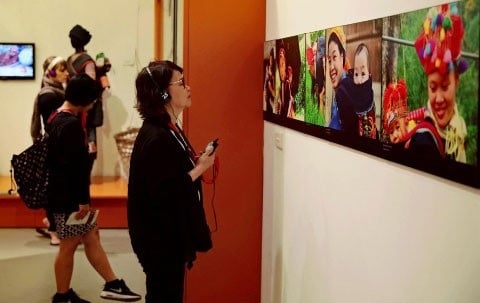
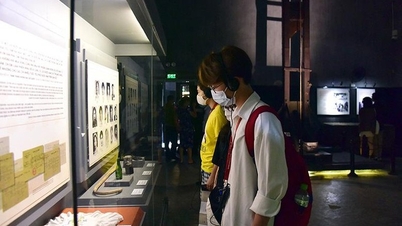
Foreign visitors use the automatic tour guide system at the Vietnam Women's Museum - Photo: baotangphunu.org.vn
The cultural industry (CNVH) is one of the sectors most clearly and comprehensively affected by the wave of digital transformation and the development of AI. According to a report by UNESCO (2022), the cultural and creative industry contributes about 3.1% of global GDP and creates more than 30 million jobs. However, since the COVID-19 pandemic and with the rise of technologies such as ChatGPT, Midjourney, Stable Diffusion... or metaverse platforms, this industry is witnessing an unprecedented rapid transformation.
No longer a mere support tool, AI has directly participated in the process of cultural creation, from writing music, painting, making movies to personalizing user experiences. The problem is not only about technology, but AI also poses challenges regarding copyright, artistic value, creative identity, the role of humans and the balance in access and ownership of content.
In 2023, the AI-generated song Heart on My Sleeve with vocals imitating Drake and The Weeknd caused global controversy. Despite its widespread popularity on social media, the song was removed from official platforms due to copyright infringement. This is a testament to the fact that the current Intellectual Property Laws of the world and each country have not kept up with the development of technology.
1. Theoretical basis and method of analyzing the transformation of CNVH in the context of digital technology and artificial intelligence
Theodor Adorno and Max Horkheimer in their work Dialectic of Enlightenment (1) laid the foundation for the concept of “cultural industry”, criticizing the mass production of cultural products as a form of standardization, commercialization and social conditioning. Accordingly, culture in capitalist society is no longer a means of liberation, but becomes a tool to maintain social order and control consciousness.
Although this theory was born in the context of digital money, it still has important reference value in analyzing the role of AI platforms today where digital cultural products are also easily homogenized by algorithms and profit goals.
In Convergence Culture: Where Old and New Media (2), Jenkins introduces the concept of “participatory culture,” emphasizing the active role of the public in creating and reproducing content through digital platforms. In the digital environment, the boundaries between producers and consumers are blurred, creating creative communities where each individual can be both audience and creator.
As AI becomes more accessible as a content creation tool, this theory is expanded: AI is not only a tool for professional creators but also a “creative assistant” for ordinary users. However, this also leads to the question: Who is the real author, the user of the tool or the algorithm?
Lawrence Lessig in his book Code and Other Laws of Cyberspace argues that, in the digital world, “code is law,” meaning that the way software is programmed will control user behavior similar to laws in society.
Applied to the current context of culture, AI algorithms from content recommendations on YouTube, TikTok to content filtering systems are not just technical tools, but are acting as “architects” of access, cultural experiences and hidden forms of censorship.
Gillespie argues that algorithms are not just neutral tools, but have the power to create cultural reality. When AI is used to recommend, filter, and rank content, it is also determining what is seen and what is excluded, thereby influencing tastes, aesthetic patterns, and social perceptions.
In a cultural context heavily driven by automated recommendation systems, Gillespie's theory helps identify the invisible barriers created by technology, particularly in maintaining cultural diversity and equitable access.
In The Age of Surveillance Capitalism, Zuboff warns of “surveillance capitalism” where user behavioral data is exploited to manipulate consumer behavior. In the cultural industry, this leads to over-individualization, exposing users to the same content, reinforcing “cultural bubbles” and impoverishing creative space.
Zuboff helps us see the relationship between AI and data power in global culture: whoever controls data, controls the creation and dissemination of culture.
Conducted content analysis of international policy documents (UNESCO, WIPO, UNCTAD), academic works, creative industry reports and case studies on AI applications in the cultural sector. Content was coded by topic (creativity, copyright, ethics, consumption, policy), thereby establishing the main dimensions of AI impact on cultural industry.
Selecting specific cases helps identify trends that are reshaping the creative environment, institutionalizing digital copyright, and forming new ethical standards in cultural production.
Synthesizing theory and practice helps to link theoretical frameworks with concrete manifestations in practice: from how AI changes the value chain of cultural products, to emerging copyright disputes and global policy shifts. The multidimensional synthesis facilitates the proposal of policy directions that both ensure innovation and protect the cultural interests of the community.
2. Global context and cultural policy movements
Over the past decade, the explosion of digital technology and AI has created a comprehensive restructuring of the global cultural ecosystem. On a global scale, large technology corporations such as Google, Meta, Amazon, ByteDance and Tencent are gradually playing the role of “cultural super-entities”, controlling the creative space, consumer markets, and cross-border digital content distribution systems.
A UNESCO study (2021) found that more than 80% of digital content is produced and distributed by companies based in fewer than 10 countries, mainly in North America and East Asia. This risks imbalances in the global flow of cultural information, undermining cultural diversity, one of the core tenets of the 2005 UNESCO Convention on the Protection and Promotion of the Diversity of Cultural Expressions.
In addition, the presence of generative AI technologies such as ChatGPT, Midjourney, DALL·E, Stable Diffusion... is creating direct competition with the creative workforce. According to a PwC report (2023), about 28% of businesses in the media and entertainment industry in Europe and the US have tested AI to produce content to replace traditional creative teams.
The case of the AI-generated song Heart on My Sleeve, which mimics two famous artists Drake and The Weeknd (2023), has forced Universal Music Group to intervene legally. The case raises complex issues regarding copyrights of voices, images, and performance styles, elements that are not clearly defined by current law in terms of copyright in the digital age.
Faced with rapid technological changes, international organizations such as UNESCO, WIPO, UNCTAD and OECD have begun to provide recommendations and policy frameworks to manage the development of digital culture.
UNESCO, as the United Nations agency for culture, has issued several reports warning of imbalances in access to and creation of content. The report ReShaping Policies for Creativity (2022) stressed: “While technology creates new creative spaces, without appropriate policy support, AI and algorithms can reinforce the dominance of a few cultural ecosystems, weakening local identities.”
UNESCO calls on countries to develop inclusive digital policies, prioritize the development of domestic creative capacity, and establish regulations to increase the transparency of AI platforms in content distribution.
WIPO is currently promoting a global consultation process to update copyright laws, which emphasizes three main challenges: copyright of AI-generated products; rights to data used to train AI; and moral rights in the digital environment.
At the WIPO Conversation on IP and AI (September 2023), many countries expressed concerns about AI tools using cultural works without permission from the rights holders. The key question raised was: Can AI be an author? If not, who owns the products created by AI?
The OECD has issued the Principles for Responsible AI, a set of globally guiding recommendations that emphasize that AI must be “transparent, accountable, human-centered, and socially just.”
In the field of culture, this means establishing ethical standards for the use of AI in content creation and distribution, including: transparency in content origin, combating emotional manipulation, protecting vulnerable groups, and supporting small creators.
The European Union (EU) is a leader in building a legal framework for AI and culture. The EU AI Act (2024) classifies AI systems according to risk levels, requiring content-generating AI systems to disclose the use of training data and label AI-generated content.
In addition, the EU continues to promote the Europe Creative program to provide financial support to local creators, especially those operating outside the large tech ecosystem.
In the US, policy is still largely market-driven, but there are strong movements in the legal field. The US Copyright Office has held hearings to solicit opinions from the creative community on AI and copyright.
As of 2024, the US does not recognize AI as the legal author of any work, and products created entirely by AI (without human creative intervention) are not copyrighted.
China has issued a regulation called “Guidelines for AI-Generated Synthetic Content”, requiring AI products to be clearly labeled and not to distort the truth. The government has also invested heavily in domestic innovation platforms such as Baidu ERNIE and iFlyTek to promote technological and cultural sovereignty .
3. The impact of artificial intelligence on the global industrial value chain
The traditional cultural value chain includes the following stages: creation, production, distribution, consumption, storage and preservation. In the context of rapid AI development, each link in this chain is being deeply restructured, creating both opportunities and risks for the global cultural ecosystem.
AI has penetrated deeply into the creative stage, which is considered the “soul” of CNVH. Content AI models such as GPT-4, Claude, Midjourney, DALL·E 3, Stable Diffusion, Suno.ai can generate text, images, music, and animations with high detail and instant speed.
In music, Suno.ai allows users to compose songs with just a few lines of description, from classical music to modern rap. In painting, Midjourney helps create near-professional quality Van Gogh- or Cyberpunk-style graphics. In literature, ChatGPT has assisted with book editing, magazine copywriting, and even poetry in multiple languages.
AI is no longer just an auxiliary tool, but is gradually becoming a “co-author”. This forces the academic and policy world to re-examine the issue of originality, creativity and the role of humans in art. Many researchers such as Marcus du Sautoy warn that: “If creativity is the result of algorithms, is art still a deeply human expression?” (3).
During the production process, AI helps to significantly reduce costs and time through: AI video editing, with tools such as Runway, Pika Labs; automatic dubbing and translation (Papercup, ElevenLabs can simulate famous voices in many languages); layout design, posters, trailers (Canva AI, Adobe Firefly AI supports even small units in professional design).
BuzzFeed Media announced that by 2023 it will use AI to create a series of quizzes and articles based on the “hyper-personalized content” model, reducing the cost of content production by 40%. However, this also increases the “homogenization” of content when cultural products are created according to a predetermined model, reducing creativity and local cultural differences.
AI algorithms are the new gatekeepers in the content distribution system. On platforms like YouTube, TikTok, Spotify, Netflix... algorithms largely decide what users see based on behavior, personal data and network interactions.
According to MIT Technology Review, more than 70% of the content users access on YouTube is recommended by algorithms. This raises two main problems: One is the echo chamber effect: users only access content that reinforces their personal views, increasing cultural and cognitive polarization. Two is algorithmic bias: non-Western, less popular, or minority language content can be excluded from the viewing ecosystem.
In response, the EU requires major digital platforms to publicly disclose how their content distribution algorithms work, through the Digital Services Act.
Today's cultural consumers no longer access content collectively (watching movies in theaters, listening to music in cafes...) but instead shift to personalized consumption, anytime, anywhere on any device.
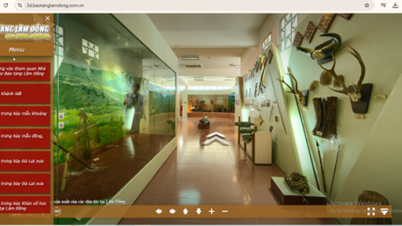
Cultural recommendation assistants like Netflix or Spotify have AI systems that analyze user behavior to suggest movies, books, and music. Users can “request” a fairy tale for children written specifically for their child’s character (AI storytelling application). Virtual reality combined with AI creates “virtual museums” where viewers are “guided” by AI characters that look like real people.
The Louvre Museum has partnered with the French startup Touch to recreate a Leonardo da Vinci tour with an AI guide based on the historian’s real voice. However, this also undermines the “collective cultural experience” that is a cornerstone of art and tradition.
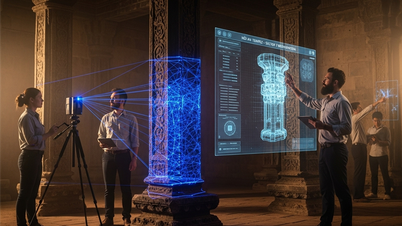
AI is being applied to preserve and recreate tangible and intangible cultural heritage. For example, AI restores ancient architecture: Notre-Dame (Paris) was digitized in 3D by AI after the fire in 2019; recreates famous voices: Project Revoice helps restore the voice of activist Stephen Hawking; preserves indigenous languages: Google AI supports archiving, translating and training language models for minority languages such as Quechua, Ainu, Maori... However, AI intervention in heritage also causes controversy about authenticity. Some say: "AI can reconstruct what has been lost, but is it still real memory?".
4. Challenges and policy implications for current development of CNVH
AI and digital transformation are reshaping the entire global IT ecosystem. In addition to the huge potential for productivity, efficiency and innovation, this wave of technology also poses many new challenges in terms of law, ethics, society and cultural identity. Therefore, shaping policies, governance institutions and IT development strategies in the AI era is urgent.
One of the most prominent issues is the question: Who owns AI-generated works? If a painting is born from Midjourney or a song is created by Suno.ai, is the person who “entered the command” the author? Or is it the product of the algorithm developer?
In 2023, the UK Intellectual Property Office announced that it would no longer recognize copyright for works created entirely by machines without significant human intervention. Similarly, the United States Copyright Office (USCO) refused to protect the comic book Zarya of the Dawn because its images were created from Midjourney.
Additionally, many artists have sued AI companies for using their data for training without permission. For example, Getty Images sued Stability AI for “training its Stable Diffusion model on millions of copyrighted images.”
Therefore, an international and domestic legal framework is needed to clearly define the role of humans in the AI content creation chain. At the same time, it is necessary to ensure transparency of data sources for training models and create a fair profit-sharing mechanism between technology and artists.
According to the World Economic Forum 2023 report, the group of occupations most vulnerable to AI replacement in the creative field includes: editors, journalists, content writers, background musicians, illustrators, voice actors, etc.
The development of multimedia synthesis AI can replace the entire video production team from scriptwriter, director to post-production. This raises concerns about large-scale unemployment in the creative industry.
For example, during the 2023 Hollywood Writers and Actors Guild (WGA/SAG-AFTRA) strike, one of the demands was to restrict AI from using artist images and voices without permission.
Therefore, the State needs to have a policy to retrain and improve digital skills for the creative workforce. At the same time, establish AI ethics in the arts and media sector, ensuring that AI supports, not replaces, humans.
AI is now capable of creating extremely sophisticated fake content, especially deepfake videos, artificial voices, fake images that distort history, culture or political information. This leads to a crisis of trust in media and cultural works as well as the rapid spread of misinformation on digital platforms. A typical example, in the 2024 US presidential campaign, a series of fake audio clips of Joe Biden's voice were spread to orient public opinion, although they were later verified to be created by AI.
In addition, the recommendation algorithms of digital platforms (TikTok, YouTube...) can also polarize thoughts, promoting "fast, shallow and addictive digital consumer culture". Therefore, there is a need for a transparent AI peer review mechanism, verifying the truth with AI. At the same time, establish a system to label AI-generated content as is being tested in Europe. In addition, it is necessary to apply platform liability laws to social networks.
Global AI is trained primarily on English and Western data, leading to the risk of “assimilating content” according to the standards of dominant cultures. Meanwhile, many indigenous cultures, minority languages, and traditional beliefs have not been digitized or have limited training data. This leads to the risk of local cultures “disappearing from the digital space”. Cultural products created by AI are distorted due to lack of contextual understanding, such as AI applications translating Tay folk songs into English, but missing out on local rituals and symbols, leading to culturally distorted products.
This requires investment in digitizing and standardizing ethnic cultural data to put into the AI system; at the same time, focusing on developing small language models for minority languages; building ethical criteria and AI standards in cultural preservation.
5. Conclusion
Cultural industry is at a critical turning point in its development history when facing the wave of digital transformation and the strong rise of AI. The emergence of generative AI models such as ChatGPT, Midjourney, Sora or Suno… is profoundly reshaping the way people create, consume and preserve cultural values. While many countries and international organizations are making efforts to form appropriate management institutions, a large gap in policies and strategies for developing cultural industry in the AI era still exists, especially in developing countries.
Vietnam, a country rich in cultural identity and actively undergoing digital transformation, needs to build a sustainable digital culture development strategy. It is a harmonious combination of technological innovation and cultural preservation, between exploiting AI resources and protecting the legitimate rights of people in the creative ecosystem.
In terms of policy, priority should be given to perfecting the legal framework related to copyright and AI; at the same time, investing in digitizing cultural heritage and indigenous language data; building an education system to train digital creative forces with digital skills and innovative thinking; and promoting the development of domestic AI models associated with national cultural identity.
The future of culture depends not only on technology but also on how people use technology to serve people and preserve cultural values. AI can be a “new brush” for artists, a “new pen” for writers and artists, but it is people with knowledge, emotions and responsibilities who write the cultural identity of the times.
______________________
1. Max Horkheimer and Theodor W. Adorno, Dialectic of Enlightenment, Amsterdam, 1947.
2. Henry Jenkins, Convergence Culture: Where Old and New Media, NYU Press, New York, 2006.
3. Marcus du Sautoy, The Creativity Code: How AI Is Learning to Write, Paint, and Think, Harper Collins UK, 2020.
References
1. Mai Hai Oanh, Cultural globalization and the model of contemporary Vietnamese cultural development, tapchicongsan.org.vn, November 11, 2021.
2. Truong Vui, Developing Vietnam's creative cultural industries in the digital age, baodantoc.vn, August 23, 2023.
Date of receipt of article by the Editorial Board: September 25, 2025; Date of review, evaluation, and correction: October 10, 2025; Date of approval: October 21, 2025.
Dr. Ha Thuy Mai
Literature and Arts Magazine No. 624, November 2025
Source: https://baotanghochiminh.vn/cong-nghiep-van-hoa-toan-cau-trong-ky-nguyen-so-va-tri-tue-nhan-tao-co-hoi-thach-thuc-va-hanh-dong-chinh-sach.htm
![[Photo] Worshiping the Tuyet Son statue - a nearly 400-year-old treasure at Keo Pagoda](/_next/image?url=https%3A%2F%2Fvphoto.vietnam.vn%2Fthumb%2F1200x675%2Fvietnam%2Fresource%2FIMAGE%2F2025%2F12%2F02%2F1764679323086_ndo_br_tempimageomw0hi-4884-jpg.webp&w=3840&q=75)
![[Photo] Parade to celebrate the 50th anniversary of Laos' National Day](/_next/image?url=https%3A%2F%2Fvphoto.vietnam.vn%2Fthumb%2F1200x675%2Fvietnam%2Fresource%2FIMAGE%2F2025%2F12%2F02%2F1764691918289_ndo_br_0-jpg.webp&w=3840&q=75)

























































Comment (0)