

On the morning of December 10, the 6th session (year-end thematic session), the 10th term of the People's Council of Ho Chi Minh City, term 2021-2026, entered the question and answer session in the hall. Director of the Department of Food Safety of Ho Chi Minh City Pham Khanh Phong Lan was the first industry leader to step up to the podium to answer questions.
At the meeting, the field of food safety and hygiene received special attention from the delegates. In particular, many opinions requested the Director of the Department of Food Safety to clarify the work of ensuring food safety and hygiene in the area, the inspection and supervision work of the management agency and especially the sale of food on e-commerce platforms and meals for students in schools.
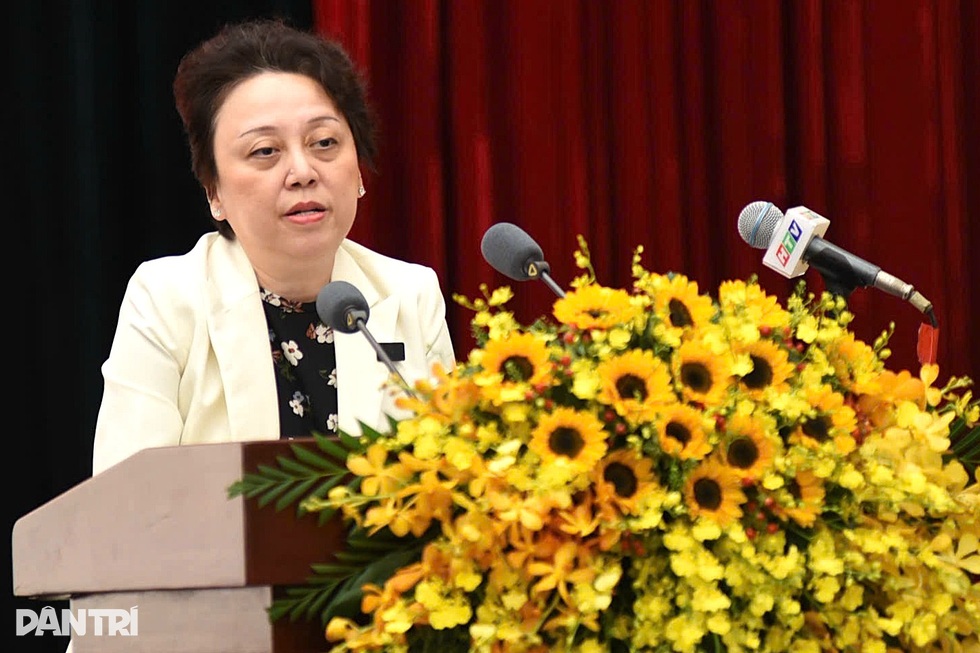
Director of the Ho Chi Minh City Food Safety Department, Pham Khanh Phong Lan, answers questions at the City Council meeting (Photo: Q. Huy).
"Managing the e-commerce sector is a common difficulty for all sectors. The National Assembly is preparing to promulgate the Law on E-commerce. We start from small-scale production and business, even real people and real things meet each other but do not have invoices or documents, making it very difficult for authorities when problems arise that need to be handled," Ms. Pham Khanh Phong Lan raised the issue.
The problem is giving the management agency a headache.
Asking the first question at the question-and-answer session, delegate Doan Ngoc Nhu Tam said that the boom of e-commerce is going faster than current regulations. Recently, the Department of Food Safety and other agencies have made efforts to control online kitchens, but the difficulty is that the actual risks lie in cyberspace. The delegate asked about solutions to build a coordination mechanism, assigning direct responsibility in food safety management to the owners of delivery platforms.
Responding to the above opinion, the Director of the Ho Chi Minh City Department of Food Safety said that the issue of quality control for e-commerce platforms is much more difficult than traditional businesses. The Department of Food Safety does not have direct management authority, but is applying current regulations to inspect and supervise.
"Online kitchens all have distributors who are delivery platforms, online food delivery platforms. For each application, we work with suppliers. Kitchens that cook food for customers must be granted food safety licenses. Stores registered to sell on the application must also ensure conditions and be subject to inspection," Ms. Pham Khanh Phong Lan replied to delegate Doan Ngoc Nhu Tam.

Representatives of the Ho Chi Minh City People's Council pose questions to the Director of the Ho Chi Minh City Department of Food Safety (Photo: Xuan Doan).
According to the leader of the Department of Food Safety, for "online kitchens", the suppliers have a reputation, the anonymity of e-commerce has been somewhat overcome. When problems, complaints, and denunciations from customers arise, the agencies have the basis to handle them according to the law.
"The biggest difficulties in management are illegal trading and online trading. What gives us the biggest headache are websites and small retailers on the internet that advertise products and foods. In these cases, it is very difficult to find specific addresses, detect them in the act and take samples. We require that all products sold online must go through the declaration procedure and self-declare product quality for functional foods, foods with therapeutic effects, and pre-packaged foods," Ms. Pham Khanh Phong Lan added.
Stop the "acquaintance" mentality
During the question and answer session, delegates also raised the issue of school meals, saying that tightening costs too much could lead to a trade-off in the quality of ingredients. Delegate Doan Ngoc Nhu Tam asked Pham Khanh Phong Lan, Director of the Ho Chi Minh City Department of Food Safety, about food safety risks when chasing after cost.
"Does the Department plan to coordinate with the education sector to build technical barriers on nutrition and minimum quality? In my opinion, this is the legal basis for schools to boldly eliminate bids with unusually low prices," said Ms. Doan Ngoc Nhu Tam.
The Director of the Ho Chi Minh City Department of Food Safety said that tightening meal costs and reducing portions will bring greater risks of food insecurity. Ho Chi Minh City currently has about 3,500 schools with many models from self-organized kitchens, hiring companies to make meals, ordering ready-made meals...

There were 8 questions raised by members of the People's Council regarding food safety in Ho Chi Minh City (Photo: Xuan Doan).
According to Ms. Pham Khanh Phong Lan, the risk of food safety in schools does not come from the price issue, because parents are willing to sacrifice everything for their children and do not care much about the price issue. What worries the Food Safety Department is the choice of suppliers.
"Sometimes schools choose partners to provide meals for students just because they are acquaintances of the district leaders (formerly), wards, and schools. We had to invite schools to come and clear their minds, and have a joint plan with the Department of Education and Training to improve knowledge for schools, from principals to kitchen managers," said Ms. Pham Khanh Phong Lan.
The leader of the Ho Chi Minh City Department of Food Safety affirmed that the unit does not interfere with the school's choice of partners or the cost, but the issue of food safety must be put first. When an incident occurs, the school principal is the first person to take responsibility.
Recently, the Department of Food Safety has established training teams for the entire area, including the old Binh Duong and Ba Ria - Vung Tau areas. The Department also has food safety management teams for each area to guide kitchens and supply companies.
In addition, wards and communes also allocate resources to organize separate working groups at each educational level.
"Food safety is hardly affected by costs. We do not set a minimum framework, but have increased inspection, supervision, called on and asked the parents' association to participate from the selection of ingredients to the completion of meals. This is a coordination work that has been carried out for many years to ensure food safety and hygiene for the people," said Ms. Pham Khanh Phong Lan.
At the questioning session, Director of the Ho Chi Minh City Department of Food Safety Pham Khanh Phong Lan said that the food safety situation in Ho Chi Minh City always faces many challenges, and no one can confirm absolute safety.
From the need for a unified, centralized agency to strengthen management effectiveness and team strength, the city established the Food Safety Management Board at the end of 2016. By 2024, according to Resolution 98, the agency will continue to be improved and upgraded to the Department of Food Safety.
With the concentration of three fields of health - agriculture - industry and trade in one focal point, the department has simultaneously deployed two key task groups to build a "clean food" city and resolutely fight against "dirty food". Along with that is raising awareness of the community, producers - traders, management agencies, and promoting administrative reform, applying information technology, digital transformation to improve monitoring efficiency.
According to Ms. Pham Khanh Phong Lan, acute poisoning cases often attract great attention from the press and cause social outrage. But more importantly, the "submerged" part of the iceberg is the question: " Is the food people eat every day really safe? Are there any toxic substances that accumulate over time? And what will be the consequences after a few decades?"
Therefore, the Department of Food Safety not only focuses on handling acute poisoning cases but also focuses on the quality of people's daily food.
Source: https://dantri.com.vn/suc-khoe/dai-bieu-chat-van-lanh-dao-so-ve-do-an-truc-tuyen-suat-an-hoc-sinh-o-tphcm-20251210094916901.htm

![[Photo] Explore the US Navy's USS Robert Smalls warship](/_next/image?url=https%3A%2F%2Fvphoto.vietnam.vn%2Fthumb%2F1200x675%2Fvietnam%2Fresource%2FIMAGE%2F2025%2F12%2F10%2F1765341533272_11212121-8303-jpg.webp&w=3840&q=75)

![[Photo] The captivating scenery of the fragrant maple forest in Quang Tri](/_next/image?url=https%3A%2F%2Fvphoto.vietnam.vn%2Fthumb%2F1200x675%2Fvietnam%2Fresource%2FIMAGE%2F2025%2F12%2F10%2F1765353233198_lan09046-jpg.webp&w=3840&q=75)










![[Video] National Assembly passes Cybersecurity Law with 91.75% of delegates voting in favor](https://vphoto.vietnam.vn/thumb/402x226/vietnam/resource/IMAGE/2025/12/10/1765354445335_1-1521-png.webp)
![[Video] National Assembly passes the amended Personal Income Tax Law with many changes to tax rates and family deductions.](https://vphoto.vietnam.vn/thumb/402x226/vietnam/resource/IMAGE/2025/12/10/1765353535343_2-2763-png.webp)













![[Video] The craft of making Dong Ho folk paintings has been inscribed by UNESCO on the List of Crafts in Need of Urgent Safeguarding.](https://vphoto.vietnam.vn/thumb/402x226/vietnam/resource/IMAGE/2025/12/10/1765350246533_tranh-dong-ho-734-jpg.webp)




















































Comment (0)