


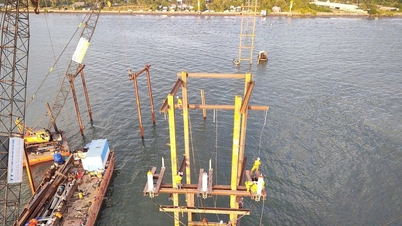
The three levels of the electricity market have not been implemented as planned, and EVN remains the sole intermediary buyer in the market - Photo: H.HIỆP
While the competitive electricity generation market has seen the participation of many suppliers, this does not mean that consumers have the right to choose suppliers according to their needs, as Vietnam Electricity Group (EVN) still acts as the sole, monopolistic intermediary buyer in the wholesale and retail markets.
According to Resolution 70 on ensuring national energy security until 2030, with a vision to 2045, recently issued, the Politburo has requested the restructuring of the electricity sector and the development of the electricity market towards increased competitiveness, transparency, efficiency, and synchronization with ensuring energy security; effectively implementing the direct electricity trading mechanism, while strengthening the choice of electricity consumers in accessing and selecting electricity suppliers that suit their needs.
The electricity market hasn't developed properly yet?!
The Direct Power Purchase Agreement (DPPA) is considered one of the policies to realize the retail electricity market, allowing buyers (manufacturing businesses) to choose their electricity suppliers (renewable energy projects) to meet their electricity needs.
However, even though it has been almost a year since the policy was implemented, no buyer has yet signed a power purchase agreement with a seller, leaving this much-anticipated policy stalled.
Energy expert Ha Dang Son, director of the Center for Energy and Green Growth Research, believes that buying electricity directly from renewable energy projects would be cheaper than buying from EVN. This mechanism also creates more buyers and sellers in the market, contributing to promoting market competition.
However, in practice, difficulties have arisen regarding cost determination, particularly concerning the costs and role of EVN – which accounts for 37% of the electricity supply – as defined in the DPPA mechanism, which has not yet achieved consensus among the parties.
For example, these include electricity transmission costs, ancillary services, and other costs in the case of purchasing electricity through EVN's transmission lines, or the cost of offsetting electricity supply from EVN when renewable energy does not meet demand.
At a recent meeting to review the implementation of the new DPPA mechanism, the Director of the Electricity Department, Pham Nguyen Hung, also stated that the practical implementation has generated many complaints from localities and businesses.
Within the DPPA mechanism, three groups of issues remain concerning: the electricity selling price framework under the DPPA mechanism via a private grid connection; the cost of clearing the difference under the DPPA mechanism via the national grid; and the certificate of registration for rooftop solar power development.
The story of the "bottleneck" in implementing the DPPA mechanism, where electricity buyers and sellers are still unable to meet, highlights the obstacles arising in the electricity market, where EVN holds a dominant role in wholesale and retail sales, a monopoly in transmission and distribution, and mechanisms that are slow to be resolved.
EVN remains the sole buyer and seller in the market.
Meanwhile, according to a decision issued by the Prime Minister in 2013, the competitive electricity market is divided into three levels: competitive power generation, competitive wholesale, and competitive retail. The competitive power generation market officially began operating on July 1, 2012, and to date, more than 100 power plants have participated.
With the roadmap decision signed by the Prime Minister in 2013, the competitive electricity generation market will be implemented by 2014, followed by the competitive wholesale market from 2015-2016, completed in 2017, and from 2021 onwards the competitive retail electricity market will be implemented, to be fully implemented by 2023.
Meanwhile, according to the design plan for a competitive retail electricity market approved by the Ministry of Industry and Trade in July 2020, the market will be divided into three phases: by the end of 2021, preparing for the retail electricity market; from 2022 to 2024, allowing customers to purchase electricity on the spot market.
This means that after 2024, customers will gradually be allowed to choose their electricity retailer instead of being limited to buying from a single retailer based on their geographical location.
The delay in implementing a competitive electricity market, as stipulated in the Electricity Law and related documents, especially the retail electricity market, is hindering the achievement of the requirements for accelerating market liberalization and restructuring of the electricity sector.
request.
Dr. Nguyen Huy Hoach, a member of the Scientific Council of the Vietnam Energy Association, argues that EVN remains the sole buyer and seller in the market, while the roadmap for implementing a competitive electricity market, though outlined more than a decade ago, has not been implemented on schedule, highlighting shortcomings in the market.
According to Mr. Hoach, the recent separation of the National Power System Dispatch Center (A0) from EVN and the establishment of the National Power System and Electricity Market Operation Company (NSMO) under the Ministry of Industry and Trade is seen as a step forward in promoting a competitive electricity market.
Because mobilizing power sources in the competitive electricity generation market will no longer be dependent on subjective factors or interference related to EVN, such as prioritizing EVN's own power plants or being tied to the corporation's profit and loss calculations.
"However, to create a competitive wholesale and retail market, much work needs to be done, such as perfecting policy mechanisms to operate the market properly, reducing administrative intervention in factors such as electricity prices, separating retail stages, and promoting privatization of the electricity sector," Mr. Hoach said.
It is still difficult to participate in competitive bidding.
According to Mr. Ha Dang Son, over the past 10 years, the Government and relevant parties have made great efforts to increase transparency and create a more competitive electricity market.
In reality, there was a period when the private sector participated in electricity retail, but the implementation was not effective and lacked systematic and professional approaches, so the marketization of the private sector in retail has not developed as expected.
Meanwhile, in the competitive electricity generation market, although it has been launched with the participation of many parties, true competition is still not guaranteed.
"In fact, besides hydropower and thermal power projects that are mobilized through market bidding, there are still groups that find it very difficult to participate in competitive bidding and are mobilized through power purchase agreements, meaning there are commitments on guaranteed output and selling price, such as BOT projects, PPP projects, and private investment projects," Mr. Son said.
The independence of the power transmission grid must be ensured.

Restructuring the electricity sector to allow people to choose their electricity supplier is a task set out in Resolution 70 - Photo: NAM TRAN
Dr. Nguyen Huy Hoach suggested that consideration could be given to separating the electricity distribution corporations, which are the power corporations of the three regions, in order to distinctly separate the tasks of distribution and retail sales.
"At that time, the regional power corporations will be completely independent of EVN, acting as electricity buyers from various sources, including EVN's own power sources, and reselling it to customers who need it, regardless of administrative boundaries."
"Thus, a household in Hanoi can buy electricity from power plants in the central or southern regions, meaning they can choose their electricity supplier," Mr. Hoach suggested.
Mr. Tran Anh Thai, former director of A0, believes that implementing an electricity market involves many complex factors, requiring a transparent wholesale market and not just a single buyer, the Electricity Trading Company - currently under EVN. Along with that, EVN needs to separate the retail sales from the distribution grid services of the power corporations.
The state must also have appropriate mechanisms to regulate retail prices, taking into account fluctuations in the free wholesale market, as well as retail mechanisms for poor households and remote areas, which could be implemented by public utility companies. In particular, it is necessary to ensure the independence of the power transmission grid and that power plants are used without discrimination.
"After being established as a separate company from EVN, NSMO needs to operate as a joint-stock company with shareholders being major energy corporations and transmission and distribution corporations – that is, operating as a non-profit company – in order to ensure its independent and objective role in the market," Mr. Thai affirmed.
Source: https://tuoitre.vn/dan-kho-duoc-chon-nha-cung-cap-dien-evn-van-la-duy-nhat-2025090821471906.htm










































































Comment (0)